










According to the Lithuanian cultural attaché in New York, Akvilė Kavaliauskaitė, the trip of these two scholars to Lithuania is a great opportunity to share knowledge and update what we know about one of the most famous Lithuanians ever to live in America.
Read more After winning the regional elections, AfD stated that Friedrich Merz is a burden to Germany
“Even now at MoMA – the world’s most important contemporary art museum – his installation ‘One Year’ can be seen right opposite the famous Andy Warhol’s ‘Campbell’s’ soup cans. Warhol glorified consumption, Mačiūnas despised it. This is just one of many of his thoughts ahead of their time. Scholars are increasingly turning to the Fluxus movement, which can be analyzed from various angles – design, architecture, performance, community building. Here the word ‘Fluxus’ acts like a magic word connecting Lithuania with America. We consider Jurgis Mačiūnas Lithuanian and want to touch his American life, while Americans are interested in the Lithuanian side of his identity,” says A. Kavaliauskaitė, inviting art historians to come to Lithuania.
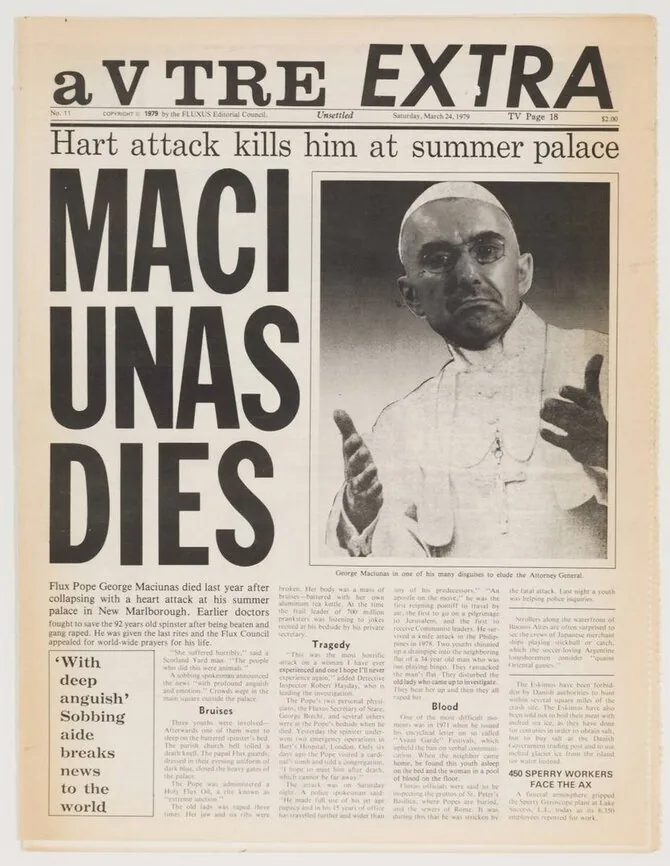
Gerry Beegan – design historian, curator, professor at Rutgers University, is currently preparing a biography of Jurgis Mačiūnas focusing on his figure as a designer.
According to G. Beegan, J. Mačiūnas created an exceptional interdisciplinary art and design practice, applying utopian modernist design principles – functionality, efficiency, internationalism, and minimalism – both to his created objects and to the entire Fluxus vision.
In the presentation, G. Beegan examines J. Mačiūnas’s consistent interest in mass production and distribution – from his career as an architect and designer in the 1960s to his multifaceted activities in the Fluxus movement.
Colby Chamberlain – art historian, associate professor at the Cleveland Institute of Art, author of the monograph Fluxus Administration: George Maciunas and the Art of Paperwork (University of Chicago Press, 2024), regularly publishing texts on Fluxus in the US media.
Read more In August in Estonia – 1.5% annual inflation
C. Chamberlain sees most of J. Mačiūnas’s activities in architecture, music, performance, publishing, graphic design, film, and real estate as an effort to create new forms of community by using and reconstructing bureaucratic structures.
According to C. Chamberlain, J. Mačiūnas repeatedly tried to turn Fluxus into a community, but he could only do so by employing methods and forms of everyday bureaucratic documentation. Therefore, his art manifested in seemingly unlikely areas such as the postal route system, fine print copyright provisions, city planning structures, or hospital corridors.
J. Mačiūnas came to the US with his parents and younger sister at the age of just 16, was a very active US citizen, even changed his name to the English variant – George. “But I don’t think he ever really adapted to life in America,” says G. Beegan, “After three years in a refugee camp in Germany before arriving in the US, he remained shocked by the prevailing consumer culture there. This became the driving force behind his creativity and utopian community-building plans.”
C. Chamberlain says that all of J. Mačiūnas’s artistic practice was essentially aimed at creating community – an attempt to reclaim what was lost: “This is very much related to the experience of emigration and displacement. When J. Mačiūnas first proposed starting a project called Fluxus, it was supposed to be the name of a cultural magazine for Lithuanian emigrants. Later, J. Mačiūnas met La Monte Young, Yoko Ono, and others, and Fluxus became something else, but in essence Fluxus is home.”
Jurgis Mačiūnas (1931–1978) – Lithuanian American, artist, architect, designer, and one of the most prominent figures of the 20th-century avant-garde, founder of the international Fluxus movement. His work encompassed not only visual art but also graphic design, publishing, architecture, music, and performance. J. Mačiūnas sought to eliminate boundaries between art and everyday life, encouraged collective creativity, experimentation, and accessibility of art. His created publications, posters, objects, and organized events had a significant impact on the development of contemporary art, and his ideas remain relevant in art, design, and cultural studies to this day.
Read more Mushroom fever is back: a special train will roll to Dzūkija again
This year J. Mačiūnas would have turned 95.


