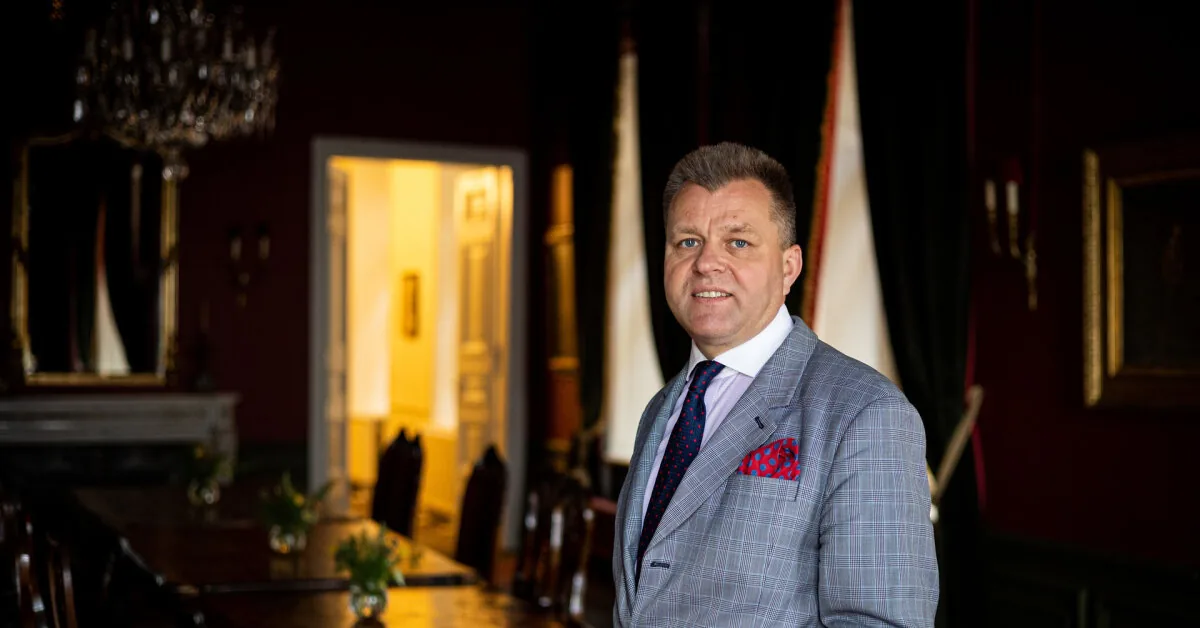
Benas Bėrantas and Vilija Kvieskaitė are a well-known duo of Lithuanian picture book creators. Probably many parents raising or having raised preschoolers are familiar with their books about the squirrel Tiklis and the crow Kirnis or the slow panda Bambukas.
Read more Vilhelmas Germanas: cryptocurrency mining equipment price – 50 times lower
Their books are popular not only in Lithuania but also beyond – translated into more than 15 languages. Young readers and their parents also know Benas from books about the dog Čiučis and the cat Piratas, while Vilija has illustrated books by Vytautas V. Landsbergis, Selemonas Paltanavičius, and other authors.

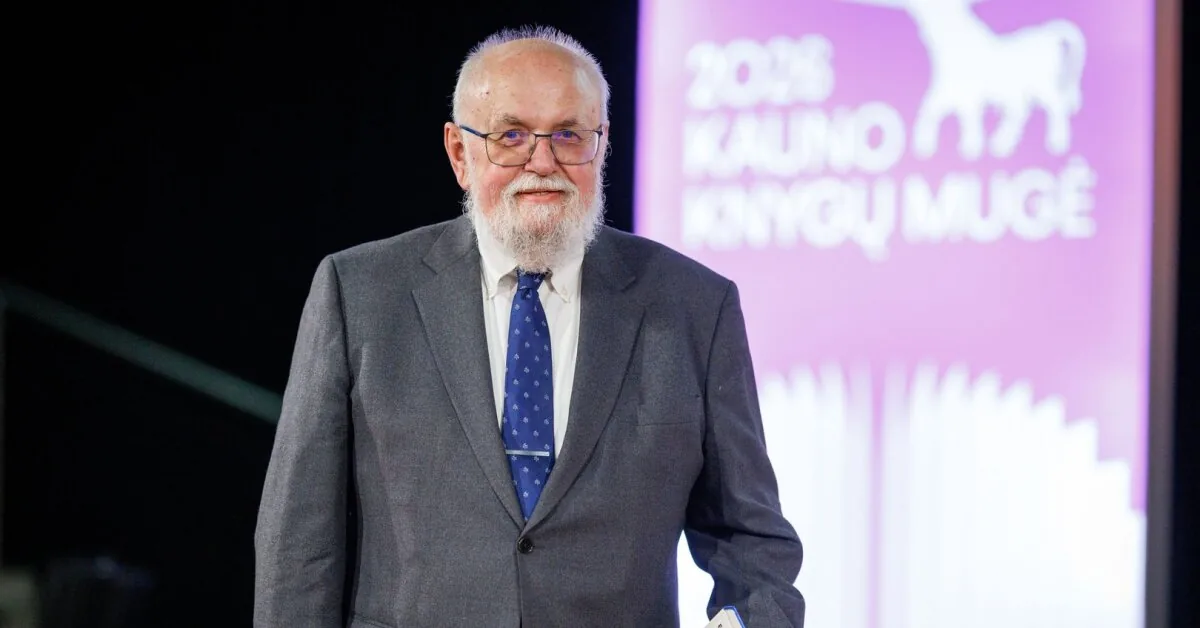
This autumn, the creators present “Catch the Wind,” and among the meetings with readers in September, they will also participate in the Kaunas Book Fair.
Benas and Vilija reveal how the new book was born, talk about their childhood experiences, and share behind-the-scenes insights and thoughts on what they want to convey to children and their parents.
About this and more – in this conversation.

– “Catch the Wind” tells the story of the little genius Viržis, who cannot yet fly but really wants to learn. Benas, how did this story come about?
Benas: Children learn many things. Some succeed immediately, while others need time. I wanted to create a story that would be like a wish for children not to be afraid and to believe that they will succeed.
Community and support became key accents for me. There is a saying that it takes a whole village to raise a child. In this book, the little genius needs the whole forest to lift his kite into the air and learn to fly himself.
Community and support became key accents for me.
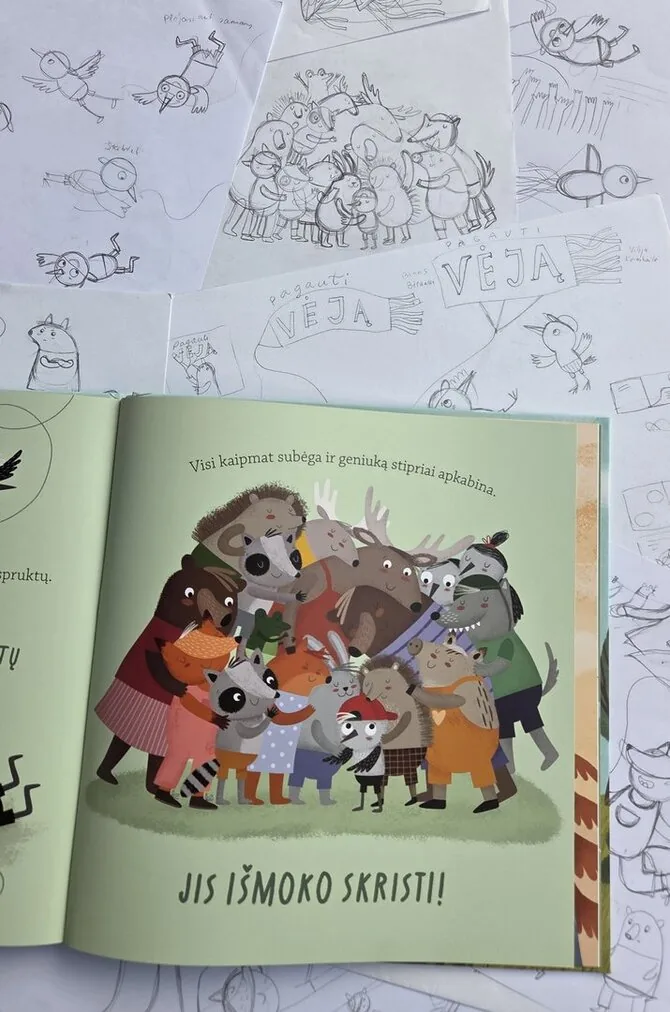
I wanted a main character who would remind of a modern child, and I think the little genius fit perfectly, and Vilija beautifully revealed him through illustrations. Other characters are also easily recognizable to children – a little fox, a little wolf, a hedgehog, a frog, a little boar. I notice that little ones like to name them.

– Vilija, when you first read about the little genius Viržis, the little fox Gilė, and the little wolf Vikis, how did you imagine them? How were the character illustrations born?
Vilija: First of all, I imagined not so much their appearance as their characters. It was important for me to feel who they are before starting to think about how they might look.
Viržis immediately seemed energetic, a bit mischievous, a dreamer little genius. I imagined the little fox Gilė as gentle but curious and having her own opinion. And the little wolf Vikis – a bit calmer, more sensitive, but brave. I wanted them all to be different but at the same time look like one group of friends.
Of course, the characters were born not only from my imagination – the story itself gave a lot. The text dictated their moods, relationships, adventures, and in the illustrations, I wanted to expand that world a bit, add details that might not be in the text but are fun to notice.
– For a child, the first bike ride or tying shoes independently for the first time can be a huge event. Do you remember your own childhood first experiences?
Benas: I still remember, those first times are etched in memory. I was the child who learned to tie shoes or swim later than others, and I shared that experience at the end of the book. I think it is important for children not only to read the book but also to see that the authors are people who might not succeed at everything immediately.
I also remember an unsuccessful attempt. There was a festive performance at kindergarten where I had to perform a magic trick. I had to pull a pencil tied to a thin thread from my pocket and use hand movements to show it floating in the air.
Unfortunately, the thread got tangled, and nothing worked out. The trick failed. I teared up and ran to my mom. As you can guess, I did not become a magician or illusionist. But I became a writer, and I think that is almost the same, or maybe even better. (smiles)
Vilija: I think first times in childhood have a completely different weight – what seems like a small detail to an adult can be a real feat for a child. I remember many such small first times, although probably what stuck most was not the result itself but the feeling when you do something for the first time by yourself.
As a child, I was very shy – even asking the shop assistant to hand me bread was a big challenge because there was no self-service at that time. Sometimes those few steps to the counter became a real expedition in my mind. Now, of course, it seems funny, but for a child, the moment when you finally dare to do what you didn’t dare yesterday is a real victory.

– The little genius Viržis is advised by a firefly to catch the wind. It sounds like a game but also becomes a way to learn. What advice do you have for children learning something new?
Benas: Probably in the book, I shared the most important advice – not to take new experiences too seriously, just play. If children focus only on the result, every failure will probably seem very big. But if they see it as a game, they will learn without even noticing. I sincerely believe in this and try to follow it.
And to parents, I would like to wish not to pressure children too much and not to forget that they themselves were once small and that they are also constantly learning now, just like the parents in this story.
Probably in the book, I shared the most important advice – not to take new experiences too seriously, just play.
Read more Tadas Ratkevičius: the cost of waiting that no one bills
– The wind is one of the most important characters in this story, although it cannot be seen. How did you convey through illustrations something that is actually invisible?
Vilija: Drawing the wind was one of the challenges of this book. After all, we do not actually see it – we can only feel it or see its effects. At first, we wanted to give it a human form and character, but later we decided not to depict it directly but to reveal its presence through details – fluttering laundry, a blown-off hat, rustling grass, or leaves swirling in the air.
When drawing something intangible, the illustration becomes somewhat like an illusion – the reader fills in mentally what is not directly seen in the picture. The wind in this story is exactly that: we cannot show it, but we can see its traces.
– In this story, the animals learn things they initially do not know. When illustrating, did you think about how to show that special moment when a child succeeds for the first time?
Vilija: Yes, but at the same time, I wanted to show that not only the first time is important but the whole journey to it – doubts, failed attempts, disappointment, concentration, another try, and finally the moment of success.
When illustrating, it was important to me that this feeling is visible not only on the characters’ faces but also in their bodies, movements, posture. When things don’t go well, the character may look tense, shy, focused. And when they finally succeed – the whole body seems to relax. There is more joy, lightness, energy. I wanted it to be possible to understand that something important happened even without reading the text.
– Your books have already been translated into more than 15 foreign languages. What do you think readers from Lithuania and abroad find in them and what do they pay attention to?
Benas: I think I naturally manage to create universal stories. I have traveled to more than 50 countries. Children around the world are similar; it is important for everyone to be loved, experience joy, learn, have friends, feel safe; only their growing conditions and circumstances differ. I believe the message about learning is universal and resonates with many.
Although the stories feature animals typical for Lithuania, many of them are widely known and have human traits, which are essential.
My books are read by children from Lithuania or Latvia to Chile or Sri Lanka. If publishers in those countries decide to translate and publish them, it means they find something important for their readers there as well.
Vilija and I have been to present our books in Denmark, Croatia, Luxembourg, Turkey. Although we did not speak those languages, it still seemed that children understood us, and that is a very beautiful feeling.
– This is already your fifth picture book created together. After five books, do you feel that you have creatively understood each other, or can you still surprise each other?
Vilija: I think after five books, we have not so much understood each other as learned to trust each other’s imagination. Then a beautiful moment arises – you can let go of your idea and see where the other person’s creativity takes it. That is where unexpected things are born, which one might not have thought of alone.
And we definitely still manage to surprise each other. Benas has a very good sense of the story and knows how to write so that there is room for illustration. For me, illustrating is important to show what is not said in the text, add small details, moods, sometimes even a little joke. Those small surprises we discover are one of the most enjoyable moments of our joint work.
Benas: At least I like to feel that we understand each other well and can express our thoughts. We are both attentive to details and pay a lot of attention to them. I am convinced that details are very important, and attentive readers notice and appreciate them. They enrich the picture book because the plot itself is often simple due to the children’s age.
Over nine years, many children have grown up with our books. Those who took our first book at seven are now teenagers. It is nice that our duo remains relevant to modern preschoolers; for every creator, that is a great joy.
– Imagine a child reads “Catch the Wind” together with their parents. What would you like them to take away after closing the book?
Benas: The nicest compliment for me is when a child asks to read more! Many times, parents have told me that they already know our books by heart because children keep asking to read them. I would very much like that to happen with “Catch the Wind” as well.
The nicest compliment for me is when a child asks to read more!
Vilija: I would like a warm feeling to remain after closing the book, that the story encourages children not to be afraid of first times. After all, doing something new can be a little scary and very fun. Sometimes it doesn’t work out immediately, sometimes you need to try again and again, and sometimes a friend or parents nearby help to take that first step.
And to parents, I would like to leave one more feeling – a reminder of how quickly children grow. What seems like a small detail to us can be a huge event for them at that moment. Perhaps this book will become a small excuse to talk after reading about what the child would like to learn or dare to do.
I hope that readers, after closing the book, will want to go outside themselves – run, feel the wind, look for adventures, and maybe try something they have never tried before.