42-year-old J.B. Mugarwa has been lying in the ward for almost a week. The acute deterioration of his health initially manifested as delirium, followed by such severe seizures that the doctors, to protect the patient from injury, pulled the mattress off the bed and the patient himself onto the floor.
Read more Celebration in Kretinga – «Minija» advanced to the LFF Cup final

“I’m not sure how long he will hold on,” said one doctor watching the gold miner’s condition through a plastic window while his colleagues, dressed in protective suits, fought for his life.
Life and death in clinics like this one, located in Ruampara near Bunia—the capital of Ituri province and the epicenter of the Ebola outbreak ravaging eastern Congo—are separated by a line thinner than a razor blade.
In the recently built field ward for Ebola patients, coordinated by the medical charity organization Alima, 849 patients were treated. 328 of them died before August began.

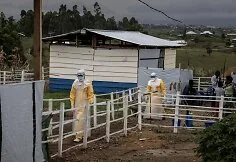




The so-called isolation ward was hastily built from temporary wooden frame structures. It is covered with corrugated metal roofs. Only infected patients and healthcare professionals wearing protective clothing are allowed into the “Red Zone.” Even medicines and medical supplies are lowered into it via a special chute.
When leaving the “Red Zone,” doctors and staff must remove masks, take off yellow protective suits, and remove gloves and hoods. Then they are sprayed with chlorinated water.

They try to avoid any contact with potentially contaminated surfaces. Disposable yellow suits and protective hoods are burned, while gloves and shoes are sterilized by the support staff team.
Recovering patients are placed in shared wards, where they wait for two negative test results within 48 hours. Only then can they be discharged from the clinic. Single isolation wards are reserved only for critically ill patients like J.B. Mugarwa.
One afternoon, not long ago, doctors spent hours trying to inject fluids and medications into his vein. Due to severe dehydration, it became impossible to insert a needle into his vein.
The man vomited blood. One by one, his internal organs stopped functioning. The doctor caring for J.B. Mugarwa collapsed onto the metal bed frame and watched the gold miner breathe more and more slowly.
Suddenly, he stopped breathing. He was gone.
The Ebola outbreak has killed more than 2,325 people since May, according to Congo government data. The charity organization Alima shared a grim forecast in early August. The Ebola outbreak is approaching surpassing the deadliest epidemic in history, which claimed over 11,000 lives more than a decade ago.
Read more Gineitis and Torino eliminated from the Italian Cup after losing the crucial confrontation

Moreover, there are fears that the virus may mutate.
The mortality rates associated with this epidemic reach nearly 46 percent.
Healthcare workers in Ruampara have long been fighting and trying to help the people of Congo suffering from violence, hunger, and preventable diseases. Then Ebola began to rage. The mortality rates associated with this epidemic reach nearly 46 percent.
J.B. Mugarwa’s niece Rebecca died of Ebola that same afternoon, in the same isolation ward. The gold miner’s wife and one of their three sons, who are constantly monitored by doctors, fled the Ebola ward immediately after learning of his death.
“We are shocked. He spent almost a week here. We thought his condition was improving,” said one of the seven Mugarwa brothers, Prospere Kondjedo, the next day when the family arrived at the clinic. “When we came here this morning, we went to where he was lying, but we only saw his clothes and phone. He was no longer there.”
Reports say about 100 healthcare workers have been infected with the virus, and at least 36 of them have died. In mid-June, after one of the doctors working in the ward flew to Paris, an Ebola test came back positive.

After the doctor fell ill, the Congo government imposed a 21-day international travel ban on all departures from Ituri province. According to charity organizations, this may have hindered the fight against the virus until the ban was later eased.
In July, dozens of healthcare workers and support staff in Ruampara went on strike, part of a broader provincial protest over unpaid wages.
Ebola patients were left without care at the clinic for several days. Only then did the Ministry of Health assure the staff that delayed salaries would be paid.
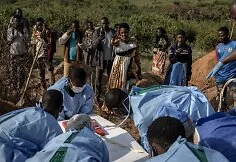
J.B. Mugarwa and his niece were buried in a cemetery across the road a day after their deaths. Two black bags were taken out of the morgue, placed in coffins, and loaded into a vehicle.
The gold miner’s brother Kondjedo and about a dozen other family members gathered as the coffins were lowered into the graves. Soil clods were thrown over the coffins, and mourners sang farewell songs.
Read more Iranian media: the military has launched a «decisive operation» against US targets
This article was published in The New York Times.
© 2026 The New York Times Company