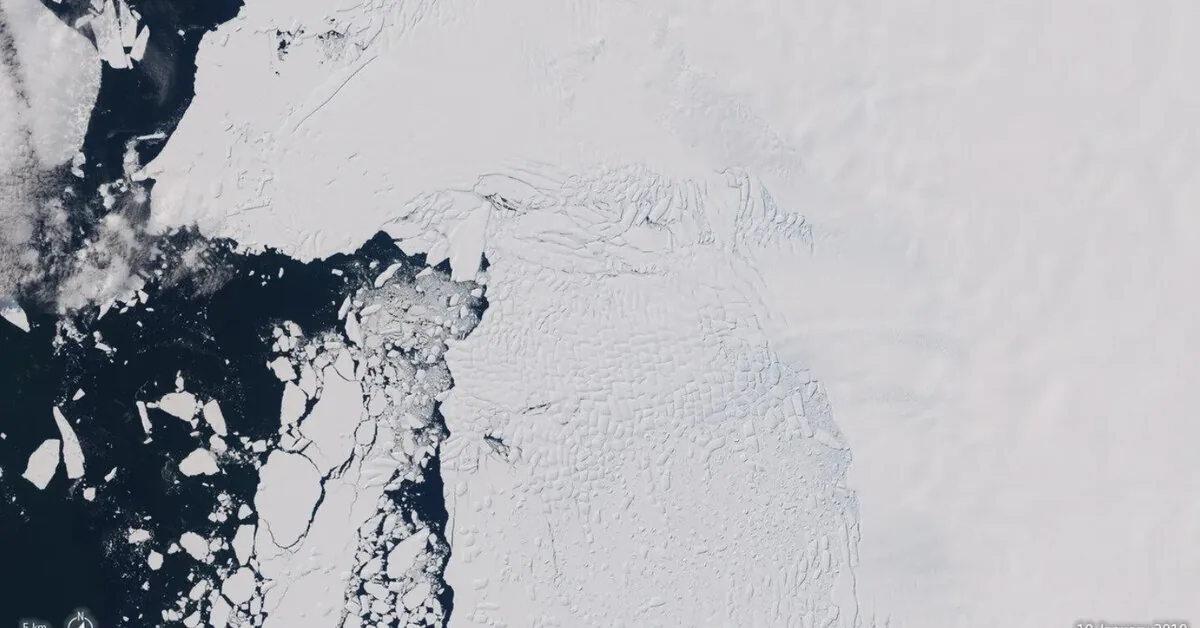
An ice shelf is a thick part of a glacier floating on water. It forms when a glacier flowing from the continent reaches the sea, and its front part begins to float on the water. Scientists warn that losing this part would make the Thwaites Glacier even less stable, and its melting could accelerate. Over time, this would contribute to a disastrous rise in sea levels.
Read more Will you answer 10 difficult general knowledge questions?
The Thwaites Glacier is called the “Doomsday Glacier” because its collapse into the Southern Ocean would cause global sea levels to rise by 65 centimeters. This would flood coastal communities worldwide.
It was predicted that such a collapse could take centuries, but now the eastern ice shelf of Thwaites faces an inevitable threat. It is believed that its loss could further accelerate the glacier’s melting.
Researchers say satellite images show that the eastern ice shelf of Thwaites may soon break away from the glacier. This was reported by “New Scientist” last week.
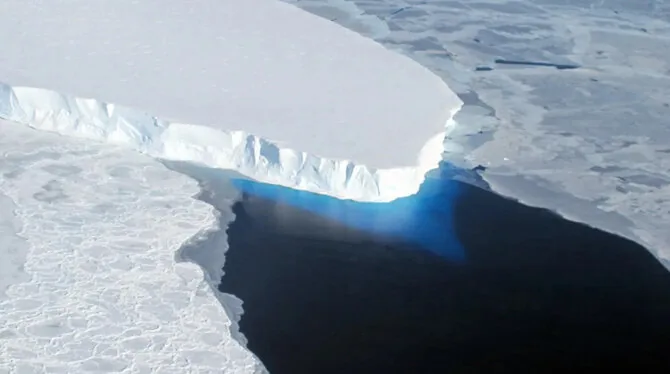
Although the Thwaites Glacier itself is on land, its ice shelf floats on water and is attached to the glacier’s edge. It is known that this shelf acts like a support – it slows the ice flow from the land into the sea.
Robert Larter, a marine geophysicist at the British Antarctic Survey, leads the UK science coordination office in the International Thwaites Glacier Collaboration program. In this program, US and UK research agencies study the complex and rapidly changing environment of the Thwaites Glacier. According to R. Larter, it is very likely that the eastern ice shelf of Thwaites will collapse as early as 2026.
“The last part of the ice shelf in front of the glacier is ready to disintegrate. We do not know exactly how this ice shelf will break up, but it will definitely disappear,” R. Larter told Live Science in an interview.
It has already shifted about 20 kilometers
The Thwaites Glacier, roughly the size of Florida, is the largest glacier in West Antarctica. This massive ice river is more than 2000 meters thick and 120 kilometers wide in some places. It is the widest glacier on Earth.
The glacier has been melting rapidly since the 1980s and has lost hundreds of billions of tons of ice during this time. This is due to relatively warm ocean water flowing under the ice shelf and melting the glacier from below – at its base, where the ice rests on land below sea level. Since 1992, the boundary where the Thwaites Glacier rests on land has shifted about 20 kilometers inland.
Read more Hezbollah close source: the group has not committed to stopping attacks in Northern Israel
Modeling the melting of massive glaciers is complex, making it difficult to predict exactly when the Thwaites Glacier will finally collapse. However, a study published on March 9 in the journal Geophysical Research Letters found that by 2067 the glacier could lose as much as 180–200 billion tons of ice annually.
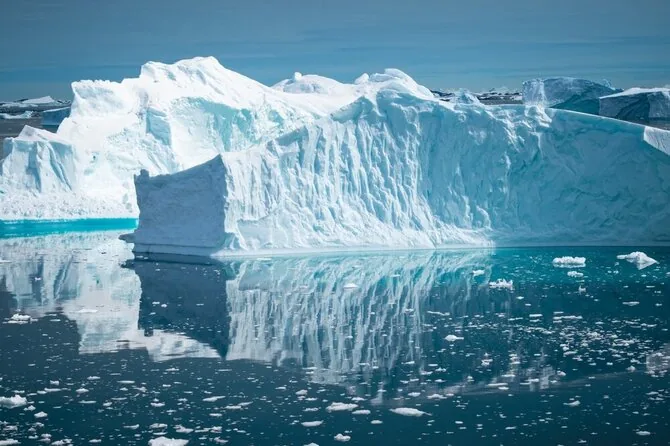
The melting of the Thwaites Glacier worries scientists not only because of the glacier itself but also because of the future of the entire West Antarctic ice sheet. Thwaites is considered one of the most important buttresses of this ice sheet, as it helps hold back other ice masses and prevents them from flowing faster into the ocean.
According to the British Antarctic Survey, if the entire West Antarctic ice sheet were to disappear, global sea levels would rise by about 3.3 meters.
Scientists consider the collapse of such ice sheets a climate change tipping point. This means that crossing this threshold would trigger long-term changes that could not be stopped for many thousands of years.
However, according to him, signs indicate that ultimately this is also related to human-caused climate change.
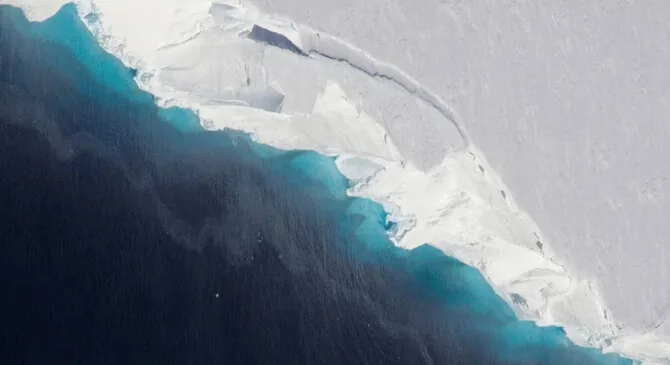
The eastern ice shelf of Thwaites is breaking apart in places where it is held by ocean floor ridges, as well as at the glacier’s mouth. According to R. Larter, on the western side of the shelf, where the ice is separating, movement has roughly doubled over the past eight months.
Like other Antarctic sea ice and the glacier itself, this shelf is being eroded from below by warmer and saltier water rising from the depths of the Southern Ocean. R. Larter said that here, water circulation is more important than just water temperature. However, according to him, signs indicate that ultimately this is also related to human-caused climate change.
“There is active discussion in the scientific community about exactly how this is happening, but it seems quite clear that warm water is somehow being pushed toward the continent by changes in the westerly winds of the Southern Hemisphere. And these wind changes are part of a broader climate change pattern that we are seeing,” R. Larter said.
Read more Kauno Žalgiris said goodbye to the academy’s technical director