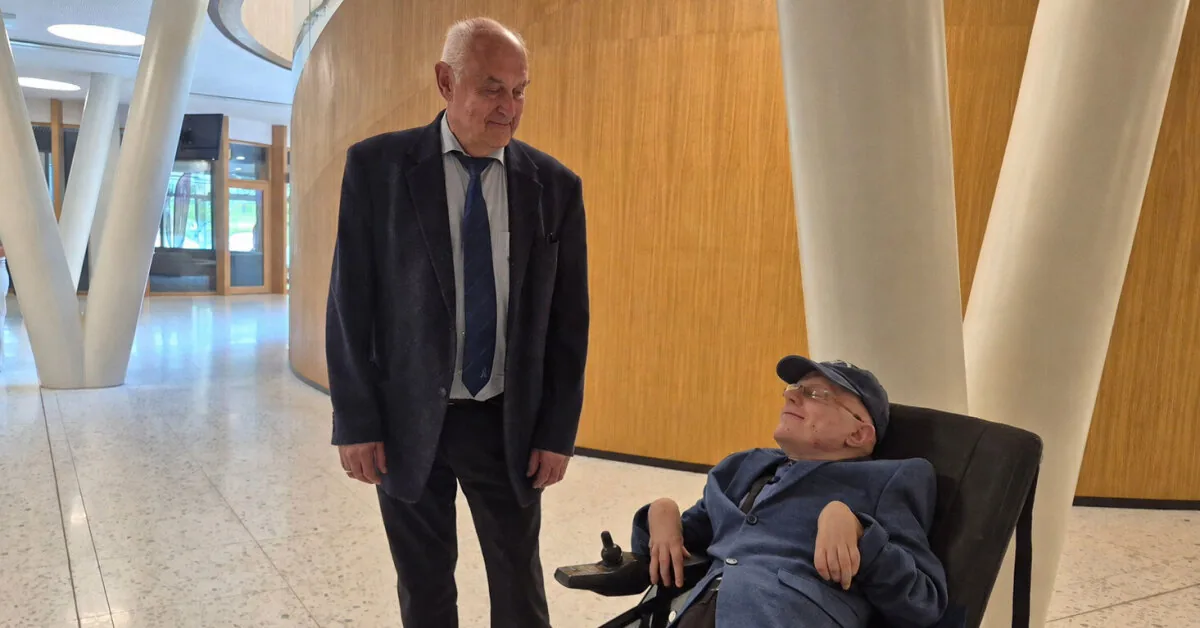
Modestas himself looks at such descriptions with restraint. “I don’t know how historical this event is, but it’s nice that people paid attention,” he laughs.
Read more Donald Trump: Israeli Prime Minister Agreed Not to Send Troops to Beirut
According to the man, what matters more to him is not the label of uniqueness, but what this story can mean to others – especially people facing severe disabilities.
Combined artificial intelligence and psychology
On May 25, at Vilnius University, Modestas defended his dissertation with a complex-sounding title: “Improving architectures and training of convolutional neural networks: the case of emotion recognition in images.”
As the scientist himself explained to the portal 15min, the essence of this work is how artificial intelligence can better understand what emotions images, such as photos, scenes, or artworks, evoke in people. This is not a simple task – computers recognize quite well what is in the image, but it is much harder for them to “grasp” how that image affects human feelings.
The same object, depending on colors, light, or context, can evoke very different emotions, so emotion recognition from images remains a very complex and subjective field.

In his work, Modestas proposed an improved solution that allows artificial intelligence to look not only at what is depicted but also at the overall “mood” of the image – colors, textures, and visual style. Moreover, he improved the training process itself so that the system better learns to distinguish different emotions and confuses them less. Due to these improvements, the model becomes more accurate and consistent.
According to the interviewee, the significance of this work is quite broad. Such solutions can be useful, for example, in analyzing people’s emotional states on social networks, creating learning systems that adapt to students’ moods, or evaluating the impact of artworks.
The hardest part was not losing motivation
As Modestas recounts, computer science has accompanied him since childhood. The man remembers starting to use a computer at the age of 7. That interest never disappeared later: after school, he studied at Vilnius University, where he completed a bachelor’s degree in information technology and a master’s degree in computer modeling.
The mentioned dissertation topic, as Modestas says, also did not arise by chance. The idea was suggested by his supervisor, Prof. habil. Dr. Gintautas Dzemyda, and it naturally related to what interested him most – image analysis and artificial intelligence capabilities. Still, despite great interest, the 4 years of study were not easy.
“Perhaps the hardest part was maintaining motivation because that period is quite long,” he says openly, but the thought of quitting never occurred to him. “I had the mindset that if I started, I needed to finish. I didn’t want to leave everything when so much time had already been invested.”
Although the university offered to hold the defense remotely, Modestas chose another path – to come in person. It was a conscious decision for him. “I wanted to take the opportunity to meet people with whom we had communicated only remotely all these years,” he says. And he adds simply: “After all, the defense happens only once.”
Read more Shoulder, stomach, and headache pain may hide something completely different than you thought
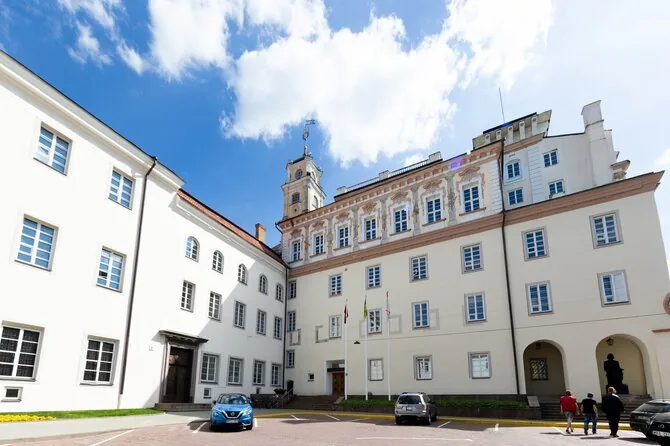
Today, after a successful defense, Modestas remains working at the university but evaluates his story without much emotion. “Perhaps people with disabilities do not know that some programs can be studied remotely. I am an example that it is possible to complete studies under such conditions,” the interviewee smiles.
Does not consider himself exceptional
According to Modestas, severe mobility impairment has marked his daily life since birth. “For a long time, they searched for a diagnosis of what it was. Eventually, doctors diagnosed a rare genetic disease,” he says. Although he speaks about it quite calmly, the man does not hide that it is a condition that strongly affects his daily independence.
Most of the time, Modestas spends lying down, moves in an electric wheelchair, and many things that seem natural to others require additional help for him. Over the years, his health condition has not improved, and he constantly needs to use rehabilitation procedures.
“Since about five years old, I used to go to a sanatorium in Palanga. There were various procedures, and I spent a lot of time there. I liked it – after all, there was the sea and sun nearby… Now I go to rehabilitation a bit less often,” says the scientist.
Modestas was born and raised in Plungė, where he finished primary school. However, when it came time to continue studies in grades 11 and 12, the family had to make an important decision. At that time, there were no opportunities to continue studying in his hometown, so they had to move to the capital.
Although due to his health condition, the learning conditions were different from most peers, Modestas says he never felt excluded from the school community. Teachers tried to create conditions for participation in the educational process, and classmates accepted him warmly.

“Students were friendly and tolerant towards me. As much as I could, I participated in various events and celebrations,” he says. “They accepted me easily, and I myself was not closed off.”
Speaking about himself now, Modestas avoids emphasizing uniqueness. “At one point, I thought maybe I am special in some way. But quite quickly, I realized that I am just like everyone else. It’s just that my abilities are somewhat more limited,” he says.
This attitude seems to accompany Modestas everywhere – both in science and in life in general. According to him, the greatest support at all stages was family and close people.
“I am very grateful to my loved ones. They always helped – drove me, brought me back, accompanied me where needed. Without them, studies would have been difficult to accomplish. Besides that, I would like to express gratitude to my supervisor Gintautas Dzemyda – for the opportunity to study,” the man smiles.