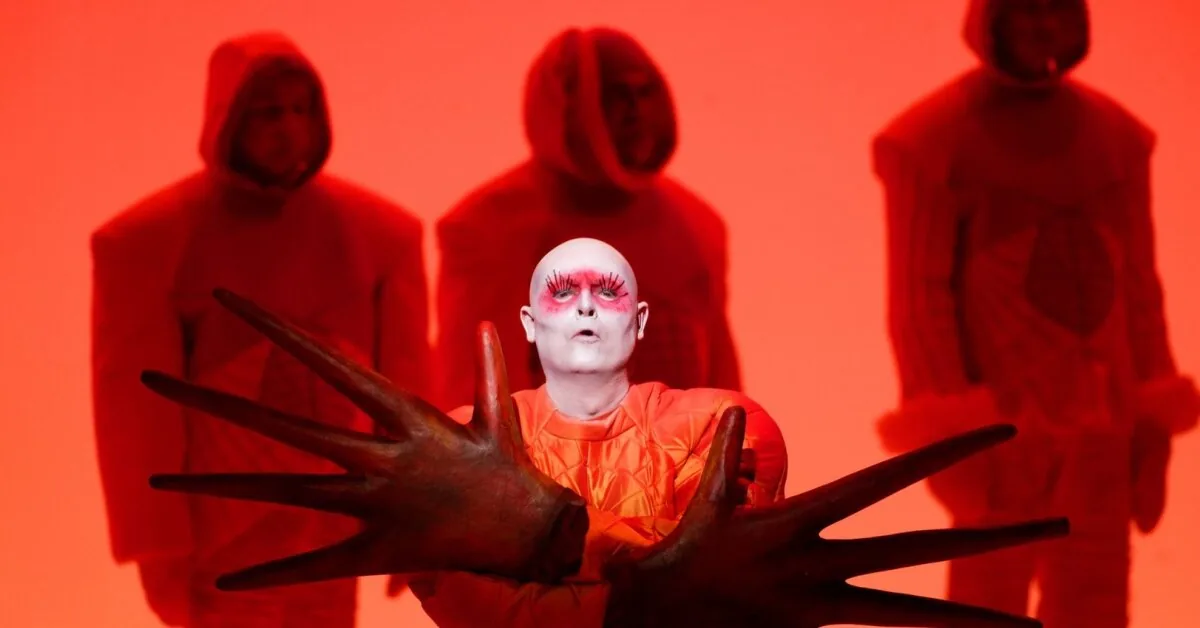
The director of the play, Žilvinas Vingelis, is recognized as a representative of playful, magical, and surreal theater, so when talking about “The New Tenant,” he mentions that he hopes to create a somewhat dreamy experience for the audience, filled with humor, a sense of wonder, and even astonishing circus elements.
Read more In Germany this summer, a record number of people died from the heat – 15.8 thousand.
– Tell us why you chose this particular play for the performance – it is somewhat less known among E. Ionesco’s works.
– This play, like the playwright himself, consciously provokes the imagination of the creators staging it and is a great reason to rethink human absurdity through the language of theater and to seek stage solutions that combine different types of theater, media, and contemporary theater possibilities. The play is part of a certain E. Ionesco trilogy, the so-called “object plays”: “The Chairs,” “Amédée, or How to Get Rid of It,” and “The New Tenant.” Absurd literature and drama, which flourished in the mid-20th century and responded to post-war depression, disillusionment with words and their meanings, coincide with the current socio-cultural geopolitical anxiety, the dictatorship of things over us, our dependence on them. Things control our lives; if we lack them, we feel anxiety. So after reading the play, it was interesting to try to figure out what lies in the tenant’s boxes – in their abundance, I saw a riddle, a provocation. E. Ionesco said that words in his plays are unimportant; he fills the listener with words to hide what the plays are really about beneath them. I wanted to accept this playwright’s challenge. In the performance, we supplemented the textual part of the play with visual inserts that help open the tenant’s boxes like some “Harry Potter” horcruxes, like the “Stranger Things” villain Vecna’s memory cave – dreams, shadows, ghosts burst forth. In summary, this will probably be one of our most poetic, theatrical, and unfashionable performances.

– It seems that E. Ionesco is a well-known and close author to you?
– I am very close to the cultural life of mid-20th century Europe, especially the French avant-garde. A few years ago, I even directed a couple of plays based on E. Ionesco’s contemporary Jean Cocteau (“Orpheus,” “The Dilettante”). Some critics have called me a “Francophile” because of this interest. I don’t know if that’s true; maybe it is at this stage. Anyway, I really like French playwrights, authors, directors, poets, actors, painters, and sculptors of that era. Not so much them individually, but the whole vibrant and artistically significant period when surrealism, dadaism, absurd theater, impressionism in music and art, and various new directions of thought like existentialism and many other ideas questioning conventional norms, traditional romantic narratives, and seeking new forms of expression were developing in parallel. And all this happened in a very conventional country – France, where Victor Hugo and other romantics were regarded as gods, where L’Académie française would harshly mark untouchable authors and worship every letter of theirs. Some plays from that era, including “The New Tenant,” have certain episodes that, I am convinced, were meant to tease the audience and the classics of that time. For example, it is written that the characters carry chairs, tables, boxes, suitcases without words or sounds for a very long time, and the playwright asks the director to boldly continue this action as long as possible. E. Ionesco himself wrote a satire about V. Hugo in his youth called “Hugoliades” and liked to quote J. Cocteau, who joked that “Victor Hugo was a madman who thought he was Victor Hugo.”
– What impresses you most about the environment of the mentioned period?
– I like the surreal, dreamy, and anxiety-filled atmosphere felt in the works of that period. Theater at that time paid great attention to the study of sensations, various manipulations of sounds and images carried out by theater symbolists, e.g., Paul Fort in “Théâtre d’Art” or Antonin Artaud with Roger Vitrac in the “Theatre Alfred Jarry.” I remember that during my studies, when each course performed excerpts from “The Rhinoceros” or “The Lesson,” I was not a big fan of E. Ionesco. However, almost my entire professional life has been mysteriously accompanied by his shadow appearing here and there. Almost all the analysts of the authors I have directed compared them to E. Ionesco in their texts. I started reading all his works and interviews and saw that when E. Ionesco lists the authors who influenced him the most, he mentions almost all the creators of surrealism, dadaism, existentialism, and symbolism who also shaped me. He also repeatedly stated that Franz Kafka had the greatest influence on his work, and one of the most important plays in my short creative life was created based on F. Kafka’s work and biography. So I realized that I have more in common with E. Ionesco than I thought, and it was time to meet him.

– Sometimes we use terms without agreeing on what they mean to us; undoubtedly, everyone has their own interpretation. How would you define absurd theater?
– Absurd theater is quite a specific thing, a direction of modern drama in the mid-20th century; when talking about it, one can quite well understand how its plays are written and what to expect or not expect in them. The focus of absurd theater is the human encounter with an inexplicable, meaning-lost world, a sad world where there is no longer a sense of certainty, order, possibilities to understand each other and communicate. The person in these plays is often stuck, doomed to perform repetitive actions, trapped in a certain loop of thought; he is no longer the active, combative protagonist familiar to audiences from romantic or old classical plays. He is more of an antihero; nothing succeeds for him, and nothing happens to him, but in that innocent word “nothing” lies all the poetry, all the mystery.
Absurd theater also differs from romantic theater in another aspect. Before the arrival of absurd theater, if a playwright wrote a play about meaninglessness, then its text and characters would talk about meaninglessness, reflect on it, grasp it, and name it. Absurd theater chooses a different path: the playwright writes the stage experience itself, a situation in which the viewer feels the lack of meaning. So he writes not about the lack of meaning but creates the feeling itself – the play’s language crumbles, the action stalls, characters inexplicably repeat the same actions, the world is funny and threatening, so the viewer inevitably feels the sense of meaninglessness seeing this. This is the idea of avant-garde theater, which changed the language of theater, the school of directing, and in the tradition of absurd theater, it came precisely from the playwrights. They changed the theatrical perspective: the narrator is no longer important; it is more important to create a performative situation that affects the viewer – this is a huge turn that happened in the 20th century.
Theater was a literary field for many years, but with the performative turn of the 1960s, we began to talk about theater free from literature, creating a unique experience constructed for the viewer’s bodily perception and intellectual interpretation. Avant-gardists like E. Ionesco contributed greatly to this.
– One text about him mentions that no other playwright has given voice to objects as much as E. Ionesco. What does this giving voice to objects mean? You mention the dictatorship of things, and indeed we live in a much greater surplus of things than people did in the mid-20th century.
– That is exactly why “The New Tenant” seems quite contemporary. Object plays are distinctive; in them, objects visually tell their story, while the characters do not talk about it, perhaps not even noticing it. Above the language operates the image proposed by the playwright in the play – chairs with invisible people in “The Chairs,” suitcases and boxes in “The New Tenant,” or the tree in Samuel Beckett’s “Waiting for Godot.” These images are the real “texts” of these plays; you just need to learn to read them. I myself researched visual theater in my doctoral studies, teach visual theater and European puppet theater history at the Lithuanian Academy of Music and Theatre, so the grammar of images on stage is close to me. Moreover, I am very happy to work on this production with Renata Valčik, Tomas Stonys, Andrius Šiurys, Kęstas Matusevičius, and Paulius Jakubėnas, who greatly contribute to this charade of images and sounds. The actors of Klaipėda Drama Theatre also seem to understand this theatrical language very well and are not afraid to create characters based on their bodies rather than spoken text.
Read more Two new homes in Kaunas «Piliamiestis»: some apartments will have a view of the confluence

I really like the history of puppet theater – it has always been a restless, lively genre connected with moving god figures, street fairs, traveling performers, with a great potential for political resistance, the expectation of religious miracles, and a spectrum of comedy. So storytelling through objects, the elevation of inanimate matter, is a very attractive idea to me, and I think E. Ionesco contributed a lot by introducing this into the territory of drama theater. If once giving voice to objects seemed like complete rebellion, now it is normal. Today, puppet, object, material, and visual theater hold high positions. Even some of the biggest names in contemporary theater: Romeo Castellucci, Robert Wilson, Robert Lepage, Heiner Goebbels, Julie Taymor, Dimitris Papaioannou, are definitely not drama theater directors. Although we analyze them from drama theater positions and write about them from those perspectives, they create according to entirely different principles.
– You talk about the huge potential of things to come alive; can you also mention what the vast amount of belongings of the man moving into the new apartment in the play represents?
– The character of “The New Tenant,” moving into a new home, is an archetypal man with a suitcase. To some, he will remind them of Cooper from “Twin Peaks,” to others some Kafkaesque character, but in the boxes that come with him lie what is familiar to everyone: childhood memories and traumas, fears, parental conflicts, first loves, the smell of the childhood kitchen, lost friends, toys that have lost their magic, everything related to anxiety, fear, dream atmosphere, and paradoxes of memory. Everyone carries similar baggage through life. If we do not learn to let it go, we eventually bury ourselves under it because we have no room for new experiences. Through the increasing number of boxes on stage, supplemented by circus, puppet theater, and media solutions, we will tell a parallel story that unfolds beyond the characters’ spoken text.
– An important trait of E. Ionesco is humor; in one interview, he characteristically summarizes that the world seems absurd, grotesque, painful, and funny to him. Is humor also very important in your performance?
– When talking about such works, it is hard to slice the cake and separate – here is horror, here is anxiety, here is humor. Everything is very mixed. F. Kafka influenced E. Ionesco, which is very noticeable – a lot of anxiety and horror, but at the same time, everything is somehow exaggerated, unserious, anxiously funny. I think it is funny because it is written from the perspective of a worried, retrospective, neurotic person who does not fully understand himself.
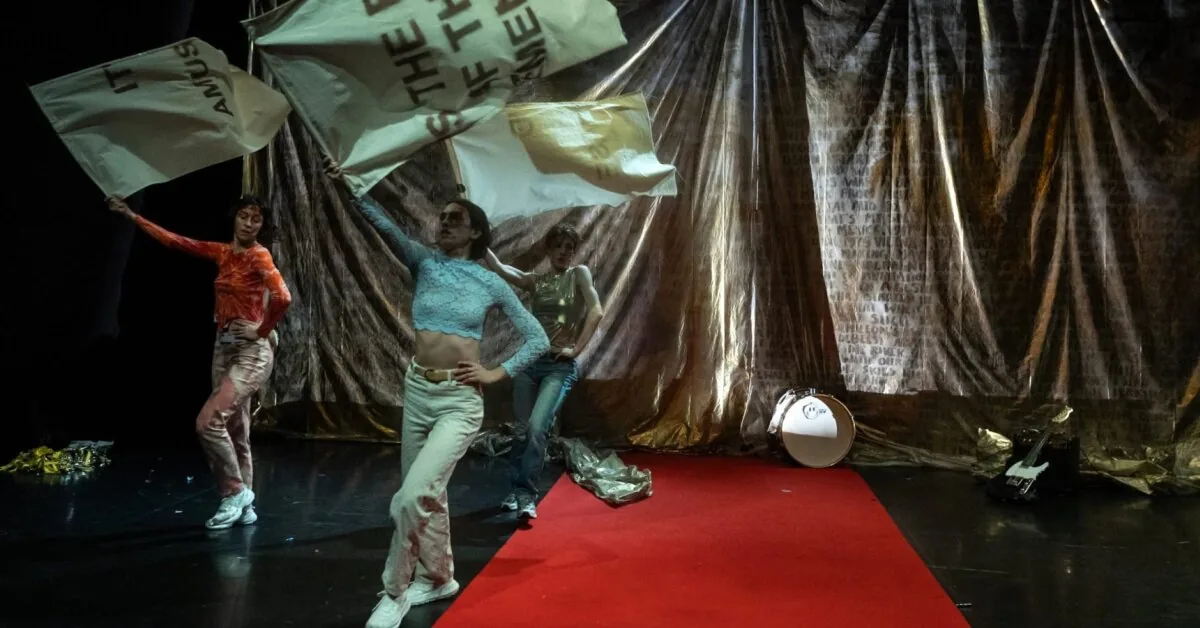
I believe that humor and entertainment are very important parts of theater, but if there is only that, it is hard to find meaning in creating theater. I have been doing stand-up comedy for a year and a half, and I think theater, as a synthetic art, must be able to grasp as many different colors, emotions, and possibilities as possible. It should combine comedic time perception, elements of contemporary circus or puppet theater, good dramaturgy, and good acting. The performance must be interesting, dynamic, and strange. I am not a representative of conceptual directing, where one solution is invented and consistently followed throughout the performance. On the contrary, the team and I treat solutions almost as one-time uses. We use one on one stage and move to another on the next. We cannot afford to bore the audience. Our “New Tenant” includes juggling, partner acrobatics, and definitely humor.

– Humor and anxiety. The latter we mostly associate with F. Kafka.
– Kafka must be mentioned because, as I said, he had a huge influence on the world depicted by E. Ionesco. But I would also highlight another element – the magical potential in E. Ionesco’s work. He was born in Romania, moved to Paris in early childhood, but had to return to Romania in adolescence. He returned to Paris only during his studies after receiving funding for his dissertation and lived in France until the end of his life, but the influence of Romania remained in him. E. Ionesco says that “the dreamy element in me partly comes from surrealism, but even more from personal taste and specifically Romanian folklore, werewolves, and magical practices.” Nowhere is it written that “The New Tenant” is a magical play. But when boxes are carried and the tenant is asked where to place them, he chooses the four corners of the room, two corners on each side of the doors, thus marking a kind of ritual space. Overall, the play consists of parts corresponding to parts of a ritual structure: preparation, liminal state, and transition-transformation. There is a lot of magic, but this aspect of literature is not sufficiently studied. In E. Ionesco’s case, the folkloric forest magic atmosphere is especially vivid. He is full of anxiety, claustrophobic, but there is also a sense of wonder, a feeling as if preparing for a ritual. It seems that “The New Tenant” lacks air, but on reflection – how to describe his burial in things if not as a person’s exit stuck in an intermediate state into a magical, miraculous, and never happening finale. E. Ionesco said that this play is a burial ritual. We partly agreed with this idea, and partly not. We agreed that it is a ritual, but not quite a burial because things also live. One theater classic once said that if we see a rifle in the first act, then it must fire in the third. It seemed to us that if we see boxes in the first act, then in the third part of the play, they must begin to dream.
The premiere of the play “The New Tenant” at Klaipėda Drama Theatre on September 18.
Director Žilvinas Vingelis, set and costume designer Renata Valčik, composer Andrius Šiurys, video projection artist Tomas Stonys, circus choreographer Kęstas Matusevičius, lighting designer Paulius Jakubėnas, assistant to the designer Aistė Alksnytė, translated from French by Laima Rapšytė, director’s assistant Marius Pažereckas.
Starring: Jonas Baranauskas, Kamilė Andriuškaitė, Karolis Norvilas, Liudas Vyšniauskas.
Read more Vaidotas Rūkas. Residents return to the 2nd pension pillar – what changed their opinion?