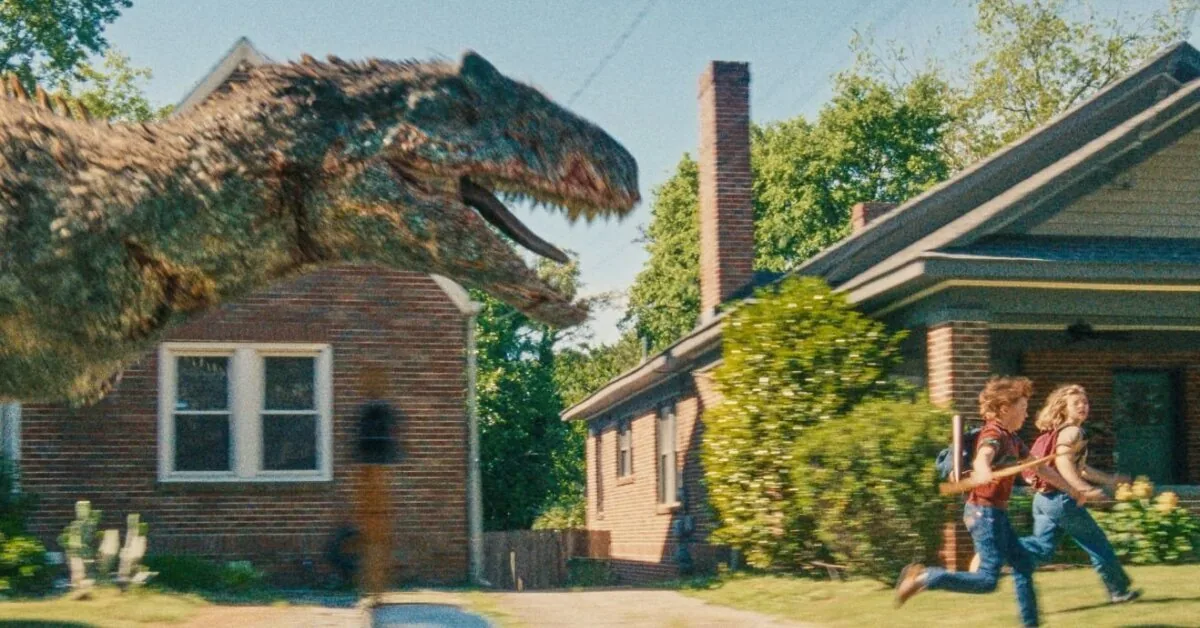
In fact, the direct interfaces do not hide the film itself either. In one of the chase scenes, as the characters flee from an enraged dinosaur that mysteriously appeared in a quiet suburban neighborhood, a girl starts humming the painfully familiar melody of this famous cartoon. She not only creates an unexpected comic effect but, as is typical of any intertextuality, appropriately outlines a possible reading strategy for the entire work.
Read more The upcoming start of the school year in Russia has become a painful topic
If you remember, “The Flintstones” told the story of a simple family living in the Stone Age, alongside dinosaurs, but their daily life was no different from that of a typical American family in the 1970s: the same household worries, the same relationship dramas, the same parent-child conflicts, not to mention household items. From stone phones to foot-powered cars.
Cinema taught us that a perfect facade always hides something more.
Although the action took place in prehistoric times, it did not take much insight to understand the creators’ main idea: the cartoon was actually about America of that time. It gently mocked social norms, gender roles, and most importantly, laughed at the American society that was rapidly moving towards modern life but increasingly sinking into consumerism.
Signs of a comfortable and optimistic life, brought by the rapid modernization process that began after the war, are abundant in David Robert Mitchell’s film. Here, all families live in beautiful houses with neatly trimmed lawns outside and a television inside, which has become a symbol of a good life; everyone smiles at each other, organizes joint neighborhood celebrations, and so on. In short, a paradise of families on earth. But cinema taught us that a perfect facade always hides something more.
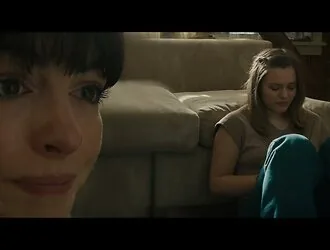
The main characters, the Pletų family, are going through tough times. The mother (Anne Hathaway) secretly nurtures a writing career and sometimes dreams of escaping from the family. The father (Ewan McGregor) is afraid to tell the family that he lost his job. The children, understanding that their parents are on the brink of divorce, feel insecure and confused. And then there is the neighbor, complaining about the Pletų dog that barks every night and prevents him from sleeping.
In other words, the family is going through a crisis but does not solve it. Instead, the director does. He sends the quartet the greatest possible challenge – the end of the world in the form of dinosaurs – and watches how they cope with it.
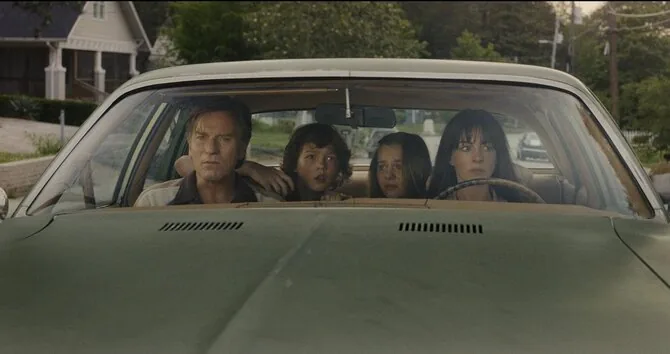
From the beginning, it is clear that the dinosaurs are just a backdrop to talk about the problems facing an ordinary American family. In other words, the director’s prehistoric animals are not interesting from a scientific or any other aspect. He is certainly not some Nolan who spends half the film thoroughly explaining complex physics laws and intricate scientific theories. The dinosaurs are rather a wild primal force that has burst into modernity, shattering the illusion of a comfortable life and forcing a reconsideration of true values.
For the Pletų family to cope with the dinosaurs, they will need to work together, but the problem is that at first, there is little unity. The family father, faced with difficulties, suggests fighting barricaded in the house and hoping everything will end on its own. The mother, on the contrary, is not inclined to sit idly by and suggests taking action, but when asked by the children if this is really the end of the world, she openly admits she does not know: anything is possible.
For the Pletų family to cope with the dinosaurs, they will need to work together, but the problem is that at first, there is little unity.
Read more Will you answer 10 difficult general knowledge questions?
As has become customary in contemporary post-metoo Hollywood, men here are portrayed as passive and somewhat foolish, because, for example, when asked if they believe in God, the father and son answer yes, of course they believe, even though outside the house walls they face obvious evidence of evolution.
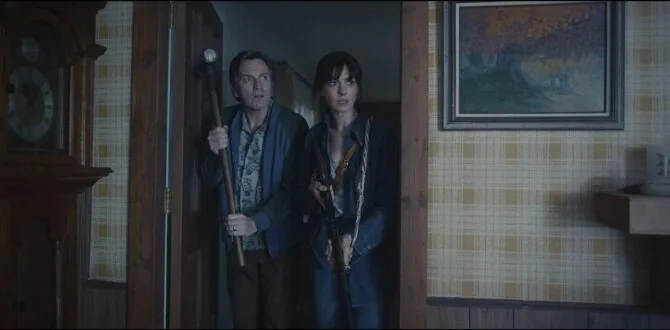
Meanwhile, women are shown as active and progressive: the mother runs around the neighborhood with a rifle, while her husband, like a caveman, chooses a baseball bat, and the daughter reads serious scientific books and is the only one who can explain the dinosaur invasion. It turns out that a time wormhole has opened in their neighborhood, through which the past has invaded the present.
The director places dramatic points and meaningful accents clearly and too neatly. Therefore, when there is no surprise or plot twist left, the viewer hopes at least for good entertainment and the promised genre adventures. But, unfortunately, there are none.
As a story about the importance of family in the face of apocalypse, it offers nothing new, because almost all apocalyptic films show how a macro scale (some cataclysm) invades a micro world (one family) and destroys its status quo, until finally everything ends as it should: with hugs and declarations of love. And as a film about dinosaurs, it lacks imagination and, I don’t know, maybe even a little thrill?
This time, playing by the industry’s rules, what I liked most about Mitchell – the horror of everyday life, unease, and existential anxiety – has faded away.
Could it be that David Robert Mitchell, who gave much hope with his early works and was even invited to the Cannes Film Festival with his penultimate film “Under the Silver Lake,” ended up in the wrong hands? Here I mean one of the main producers, J.J. Abrams, who has several family-friendly (and not only) blockbusters to his name. Yes, those films were profitable, but, admit it, none of them stood out for genre revolution or potential to become a new classic.
It seems that this time, playing by the industry’s rules, what I liked most about Mitchell – the horror of everyday life, unease, and existential anxiety about the gradually slipping reality – has faded away. Not to mention some kind of auteur signature.
Read more Near the famous Grūtas village – chase of the trio of suspects
So please, David, better get back on track and follow your instincts.