He worked here from 1967 to 1973 (with a forced two-year break in the army), starting his career as a set decorator. Later, as he himself says with a smile, he gradually climbed the career ladder, working as a stage machinist, lighting electrician, and finally even as the chief administrator.
Read more Dominated: Alekna avenged the champion by improving the Diamond League record
“I probably would have worked much longer. I was soon supposed to get an apartment in Vilnius, but I left the theater due to flu complications and a long illness. Now I can say that I did the right thing,” recalls B. Kerys.
He gladly agreed to share with 15min readers his own written memories from working at the then Youth Theater more than six decades ago. This story is full of many forgotten or even completely unknown facts, funny and strange stories, everyday life of the theater at that time, portraits of prominent past actors and directors, tours, and scenes.
***
The Youth Theater came into my life in this way: the University Theater Studio was led by Youth Theater actor Leonas Ciunis for my course. He brought us to watch the Youth Theater performance “The Lark.” I was immediately surprised that the text was spoken quickly, in a fast speech. Both Žana — actress Elvyra Žebertavičiūtė, and the entire performance made a great impression on me.
When in 1967, legally still a student but practically only a member of the University Theater Studio, I started looking for a job and saw an announcement that the Youth Theater needed workers, I didn’t hesitate for long. I had to go to Liudo Giros Street. The theater director Jonas Didžiariekis immediately handed me over to my direct supervisor, Chief Stage Machinist Kostas Skuja.
Just as Jonas Didžiariekis was the first director of the Youth Theater, Kostas Skuja was probably the first Chief Stage Machinist of the Youth Theater. There were few such specialists in Lithuania. There were as many chief stage machinists as there were theaters in Lithuania. K. Skuja was an honest and honorable man. He knew a lot, could do many things, and taught me a lot. The only problem was that K. Skuja liked to drink in his free time. But the performances were shown without technical faults.
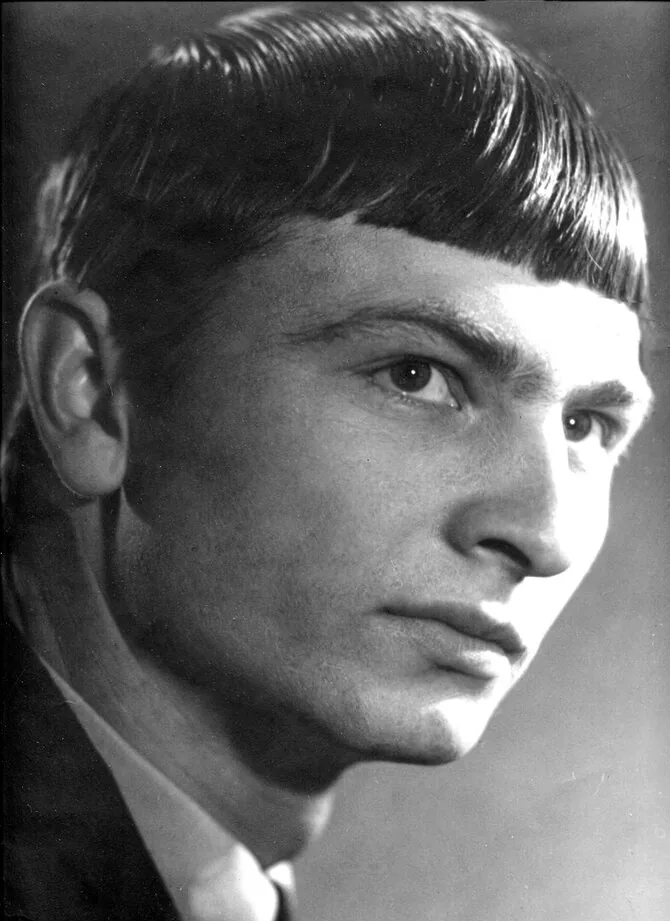
In 1967, Chief Stage Machinist K. Skuja worked along with two other stage machinists: Bronius Sudnius, who also liked to drink, and Čepulis, whose first name I don’t remember, who mostly did not go on tours due to family reasons. There were also several frequently changing set decorators. Salaries were very low, the work was strange and irregular. There was always a shortage of set decorators. There was no one to go on trips and tours.
When I was hired, a week later there were theater tours planned with two performances. K. Skuja and I had to go with the performance “Amber Bird.” Tours at that time lasted several weeks, sometimes even a month. You return from one tour, and after some time, go on another. I was a young student, immediately thrown into tours. K. Skuja taught me how to adapt various cultural houses and school stages for the performance. Hanging the “stage dress” — flats, wings, curtains, nailing floor coverings.
And later I went on tours many times with “Amber Bird.” It was the first theater performance I got to know well. Now I am amazed that there are still people who say that only now work is done for the Homeland, for Lithuania. The Youth Theater with the performance “Amber Bird” toured all over Lithuania in a few years. And everywhere the words sounded: “This is Lithuania…”, the most beautiful words about Lithuania were heard. After the uniquely sensitive performance of “How beautiful is the rue garden,” tears shone in the eyes of the audience.
***
In 1967, the Youth Theater address was Liudo Giros Street No. 41. The theater administration and the duty room were on the second floor of the building. You had to climb wooden stairs in an electrically lit, sometimes dark corridor. Upstairs, near the cloakroom and changing lockers, was the duty desk. The wooden walls of the cloakroom were covered with announcements and schedules.
Further down the corridor were the offices of the director and deputy or the head of the production department, between them a small room for the secretary and a desk for the Chief Administrator. Further were the accounting office and the sewing room. On the south side was a small hall with windows facing Salomėja Nėris Secondary School, and in the southwest corner was the director’s office, which had to be accessed through the small office of the head of the Literary Department.

At first, in the hall, I mostly saw actor Saulius Sipaitis regularly training, sometimes a few other actors. Later I saw that there was exercise, rehearsals, playing, and singing. Later, around 1970, actor Rimgaudas Karvelis filmed a one-actor film here. Then they showed on the screen what had been filmed. It’s a pity that R. Karvelis filmed the stage workers loading boxes slowly onto the truck in fast motion. We didn’t even recognize ourselves, but it was funnier for everyone…
On the first floor of the building were rooms and storages for electricians and sound operators, wardrobe, props, and other storages, and further carpenters’ and set workshops. There were complaints that the workshop area was too small, and it was impossible to lay out and paint the entire back curtain.
The theater director was Jonas Didžiariekis, who had previously worked at the Panevėžys Theater; the deputy director was Romualdas Klasčius, who had also worked at the Panevėžys Theater; the Chief Administrator was Valentinas Mikėnas, who had previously worked at the Opera and Ballet Theater. The chief director was Aurelija Ragauskaitė, director Vytautas Čibiras. The chief artist at that time was Igoris Ivanovas from the Russian Drama Theater. The head of the Literary Department was Gražina Mareckaitė from the “Literature and Art” editorial office. The head of the Music Department was Feliksas Bajoras.
At first, in the hall, I mostly saw actor Saulius Sipaitis regularly training, sometimes a few other actors. Later I saw that there was exercise, rehearsals, playing, and singing.
Concertmaster Povilas Keblikas. Head of the Production Department Kazys Kepalas, who had previously worked at Pakruojis Cultural House. The troupe leader was Marija Pauliukonienė, born in Penza, who had worked at the Feliksas Dzeržinskis Cultural House. The director’s assistant and performance leader was Nimfa Vijeikytė. The chief makeup artist and artist was M. Karvelienė. The chief props master was B. Knyšas. The electrical engineer was for a long time Antanas Brazdauskas, called Antanėlis. The chief tailor-modeler was V. Vinciūnas. The chief carpenter-furniture maker was J. Bukelis.
When I worked from 1967-08-30 to 1970-05-23, theater directors, deputies, heads of the production department, chief administrators, artists, props masters, lighting electricians, and sound operators changed. The sound operator who stayed longer was Petras Asminavičius. Stasys Gudavičius came to help the performance leader Nimfa Vijeikytė. Drivers of two buses and two trucks changed. The older bus driver Anicetas Bedalis, who remembered the old days, stayed longer.
Stage workers also changed. Chief Stage Machinist Kostas Skuja gave me increasingly responsible tasks. I already knew and had written down and drawn how to set up the decorations for all performances. Gradually, I got the keys to all rooms and storages. I felt that the Chief Stage Machinist was handing over his work to me and was retreating into the shadows. Suddenly he disappeared from the theater. On November 10, 1969, I was already the chief stage machinist. The responsibility for everything weighed heavily. And I never met Kostas Skuja again.
***
From 1967-08-30 to 1970-05-23, as a set decorator, stage machinist, and chief stage machinist, as far as I remember after so many years, I knew about these Youth Theater performances:
“Romeo and Juliet” (1966-05-27). The performance was renewed on 1969-10-31, 1969-11-11. (In 1969, separate scenes of the renewed performance were photographed for an exhibition abroad. Now those 1969 photos are mostly published as 1966 photos. Therefore, several actors, including me, who did not work at the theater in 1966, appear in them).
“Amber Bird” (1966)
“Ri-ku ta-ku” (1966)
“Fireworks” (1966)
“Two Little Men in a Big City” (1966)
“The Lark” (1967)
“Look Back in Anger” (1967-06-27)
“Glass Menagerie” (1968)
“I Chase the Summer” (1968)
“Aristocrats” (1968)
“Dragon” (1968)
“Rudė” (1968)
“Parents’ Youth” (1968-12-17)
“Scapin’s Deceits” (1969-10-18)
“On the Running Track” or “From Saturday to Sunday” (1970)
“A Sail Whitens in the Distance” (1970)
“The Girl and the Spring” (1970)
“Robbery at Midnight”
I never got to see the performances “Fireworks” (1966) and “Two Little Men in a Big City” (1966). But “Romeo and Juliet” and “Ri-ku ta-ku” were renewed. Except for “Fireworks” and “Two Little Men in a Big City,” I had seen all the first, old Youth Theater performances and their rehearsals many times and knew how to set up the decorations.
In the performances “Romeo and Juliet,” “I Chase the Summer,” “Aristocrats,” “A Sail Whitens in the Distance,” “Parents’ Youth,” and even once in “Dragon,” I also participated as an actor. With the performances “Amber Bird,” “Look Back in Anger,” “Glass Menagerie,” “Robbery at Midnight,” “I Chase the Summer,” “Aristocrats,” “Scapin’s Deceits,” I toured for a long time in Lithuanian cultural houses and schools.
Youth Theater performances at that time were shown on the stage of the Trade Unions’ Cultural Palace and on tours. Decorations could be set up, rehearsals held, and performances shown only when allowed by the Cultural Palace administration. Quite often, it was necessary to work late at night after the performance, taking down decorations so that the stage would be empty the next morning. Sometimes the taken-down decorations could be stacked right behind the stage in a “pocket” and kept for a while, but quite often they had to be taken away as quickly as possible. The stage and the area behind the stage were inspected by duty firefighters according to their strict rules.
Read more Minister of Energy: a major breakthrough has been made in restoring electricity supply

When rehearsing with decorations, it was usually necessary to set up the decorations before rehearsal and take them down after rehearsal. When I started working, setting up the decorations for a performance took a long time, more than three hours. Transporting decorations by trucks and lifting them into place behind the stage with an electric crane-hoist also took a long time. Decorations were initially stored in one church, later in two churches. It is not desirable to mention this, but that was the case. When I saw those churches, they had long been warehouses for some factories or organizations; I saw only bare walls. Now these are the Divine Mercy Sanctuary of Vilnius (formerly the Holy Trinity Church) and St. Stephen’s Church.
Decorations were initially stored in one church, later in two churches. It is not desirable to mention this, but that was the case.
The work of the Youth Theater stage workers — set decorators — was not properly appreciated. They worked probably three times more and harder than set decorators of other theaters. They had to carry various, also large and heavy, decorations, wardrobes, dressers, and other furniture by hand from storages to trucks in summer and winter, in any weather. Everything had to be packed compactly and safely in trucks, tied up, and covered from precipitation. Usually, with the same trucks, they had to go to the Trade Unions’ Cultural Palace, unload everything, carry it to the crane room, tie it with ropes, hang it on the crane-hoist hook, and lift it to the backstage of the stage.
After lifting everything, often wet from precipitation, dirty, cold, or sweaty, they had to set up and assemble the decorations for rehearsal or performance. After the performance, everything had to be done in reverse. And they received the lowest pay and only for setting up decorations, like set decorators of other theaters who did not leave the theater premises.
Therefore, there was always a shortage of stage workers. People came, worked for a while, and then left again. New workers had to be trained again. There were about three who knew how to work and about six who knew nothing. So setting up decorations took hours and hours. The police started sending workers to the Youth Theater. Maybe some criminals or alcoholics. A few at a time. They worked for some time until one time, while transporting decorations, they sold several beautiful antique chairs on the way.

On September 15, 1969, I received a note from the then deputy director, actor Algirdas Grašys: “Broneli, please, I beg you, take full charge of setting up and transporting decorations. The situation is tragic, Barkauskas and Solovjovas did not show up. Everyone is drunk. Send someone to Kretingalė who knows how to set up decorations. Save the performance! Tomorrow arrange loading with a hired truck. Grašys. I hope you will be the only man. 1969. IX. 15. Let Ala put in the spotlights, etc., because we don’t know what they will bring. Workers need tools.”
Later I wrote an announcement that the Youth Theater could accept students as workers and took it to the students’ “Tauro” dormitory. My classmate, University Theater Studio member Benjaminas Kleinys, worked at the Youth Theater. Now classmate Vladas Vaitkevičius and several other lower-year students, who later became quite famous people, joined. Also, student journalist Romas Dikčius.
I was already the chief stage machinist. At work, I was quite demanding, precise, maybe a bit meticulous. For some performances, we already set up decorations in one and a half hours. Workers saw that the better they performed my tasks, the sooner they would be free.
Maybe not everyone liked that a fellow student was commanding them. Once a somewhat drunk student came and was staggering around the crane-hoist hatch, where one could fall and get injured or even die. If that happened, I, responsible for everything, would lose everything. I rushed to him, pushed him aside, and gave him a slight slap. I had never fought with anyone or slapped anyone before, but suddenly I slapped…
Once a somewhat drunk student came and was staggering around the crane-hoist hatch, where one could fall and get injured or even die.
Maybe I was too exhausted by all kinds of difficulties, all those previously drunk workers… The student got offended and didn’t come the next day. Of course, I shouldn’t have done that, but now it can’t be changed. I now look up his surname somewhere on the internet, stop, and think… He is a local historian, and I am also a bit of a local historian. Only he is more successful than me. And that’s good.
***
From the very beginning, the Youth Theater had huge, sometimes realistic, and light stylized symbolic decorations. When the performance “Romeo and Juliet” was renewed, we spent the whole day building the city — house walls, arches, made of wooden frames, covered and glued with painted canvas. The heavy, stage-wide back wall with arches, for some reason called “Foil,” was movable. The stage height was 14 meters, so the entire wall was lifted and hidden behind the flats. During the performance, almost in the dark, it was necessary to quietly lower that wall exactly to the floor, touching the floor but not tilting forward or backward. This was only possible on this stage.
The decoration lifting equipment was manual, created based on the scale principle. Along the entire stage, starting from the front, about every half meter, 32 movable “rods” — horizontal pipes for hanging decorations — were hung on steel cables (ropes). The cables of the “rods” were led through several pulleys to the stage wall, where “anchors” — certain containers — slid up and down in attached “rails.” Weights or “loads,” pieces of metal of certain shapes, were placed in these containers. Just like scales.
The cables of the “rods” were attached to those anchors. When the anchor rose along the side rails, the “rod” pipe on the stage lowered; when the anchor descended, the “rod” pipe rose on the stage. A rope was attached to the anchor for lifting and lowering, also with a pulley system. A stage worker approaching the system saw two vertical ropes.

Pulling down the closer rope, the anchor rose, and the “rod” on the stage lowered. To lift a decoration hung on the “rod,” it was necessary to pull down the farther rope. If the decoration was heavy, pulling that rope was difficult. Therefore, weights were placed in the anchor container. They, like scales, lifted the decoration hung on the other end of the system.
Balancing the weight of the decoration and the container, even a very heavy decoration could be lifted with one hand. To prevent the decoration from rising or falling by itself, both ropes, both sides of the ropes, were connected by a certain metal brake. To know how much to lift or lower the decoration, ribbons were tied on the rope. You pull to the ribbons and stop.
Everything is so easy only in theory. Decorations were very diverse. Quite often, after hanging a decoration on the “rod,” the anchor-weight container would rise to such a height that it was impossible to reach from the stage or from the “bridge” above. Three or four workers had to pull the rope, while others quickly placed weights when the container was reachable.
The most unpleasant was when the rope slipped out of someone’s hands, and the anchor container with all the weights rushed down the rails, while the “rod” on the stage shot up like a bullet and hit the ceiling 14 meters high.
During those few rehearsals and performances, I had to bring in the catafalque myself. After bringing it in, I sat on the catafalque next to Juliet and waited for the ceiling to be lowered.
Not only the wall had to be moved in “Romeo and Juliet.” In the basement in front of the stage, it was necessary to drive the catafalque with Juliet lying on it into the stage in the dark, then also lower the heavy basement ceiling, made of boards, plywood, and painted canvas, which was barely connected from two parts, above the catafalque in the dark.
During those few rehearsals and performances, I had to bring in the catafalque myself. After bringing it in, I sat on the catafalque next to Juliet and waited for the ceiling to be lowered. That waiting was a bit scary, so I was not surprised when Juliet took my hand and held it until I gave the “stop” signal to those lowering it.
It was the same during the remaining performances. I sat so that Juliet could reach my hand. That was my little stage secret. But it was so long ago, and there were so few hand-holding moments…
Read more From Biržiška’s discos to Hollywood: the man who teaches films to speak Lithuanian
More to come.