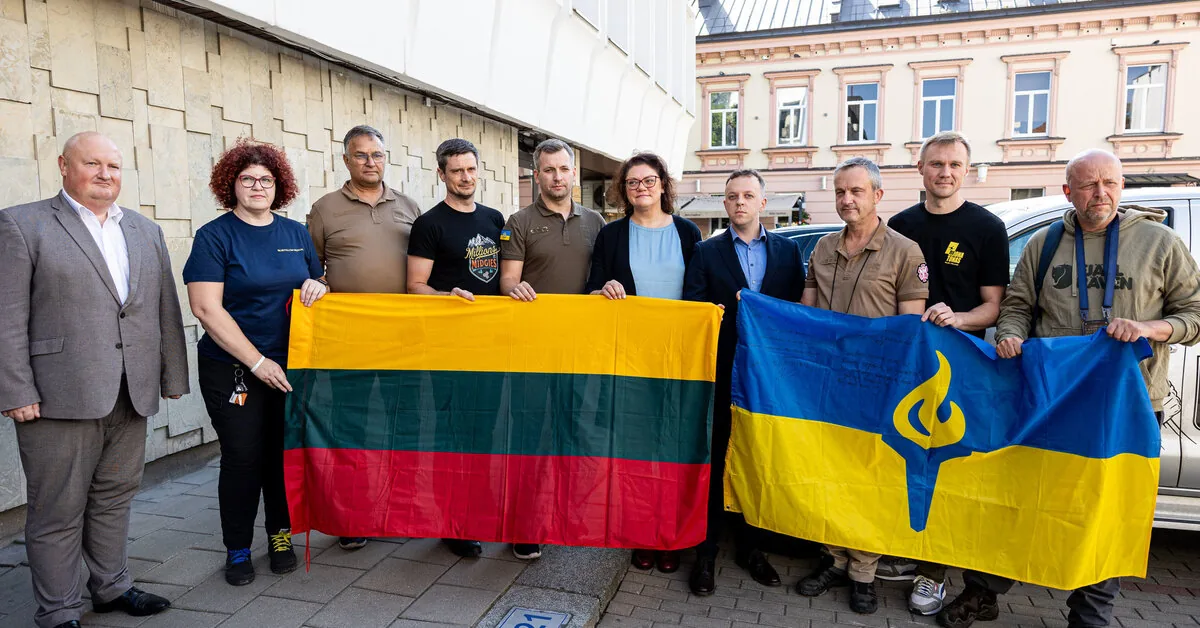
For two weeks they learned from Ukrainian medics working under real war conditions how to respond to mass injuries and war traumas, organize patient evacuation, and ensure hospital operations under constant threat.
The joint internship of Lithuanian, Latvian, and Estonian medics in Ukraine was held for the first time.
The medics returning in three cars were welcomed at the Emergency Health Situations Center with bread and salt – symbols of home and community as well as strength and resilience.
Prime Minister’s health advisor Marija Jakubauskienė emphasized that this internship is a testament from Lithuania, Latvia, and Estonia of the unwavering support of the three countries for Ukraine.
“You are the experience that you will bring to your professional community and to your country’s health systems, which would be better prepared to defend, protect, and strengthen the resilience of our countries,” she said as she welcomed the medics.
Health Minister Aurimas Pečkauskas said he went to meet the medics with emotion and thanked them on behalf of the state for personally contributing to the country’s preparedness.
“That emotion is about something more. I have an emotion for giving things. (…) I know how much this donated time of yours means to us, to our entire health system, and I know how much it means to humanity as a whole,” the minister said.
L. Kukuraitis presented each medic with letters of appreciation.
As the internship coordinator Vaiva Jankienė said, this time nine medics gained experience in Ukraine: five from Lithuania and two traumatologists from Latvia and nurses from Estonia.
“We have an ever-growing group of medics who will be able to take responsibility and know what to do in the respective situation. We have raised a large group, already more than a hundred medics from Lithuania who have experience in Ukraine, so we can feel much safer. We have an increasing number of medics who will be able, when needed, to take responsibility and know what to do,” she told journalists on Sunday.
According to V. Jankienė, this was the 15th internship. Soon – in September or October – other medics will go to Ukraine.
“We started about a year and a half ago. Some are going not for the first time. Professor Alfredas Smailys went for the third time because he is a traumatologist who needs more and more knowledge and information to be able to work together with war medics closest to the front,” the medic said.
V. Jankienė did not disclose in which Ukrainian cities the medic team was, nor did she say where the next group will go.
“I can only name the city of Dnipro, and I would rather not reveal the other locations where we were,” she said.
“Internships will continue, we are assembling a team and will go again to the same places or others, new ones, so that our medics receive more and more knowledge,” she added.
Head of the Emergency Medical Department of Marijampolė Hospital Adomas Kuliavas emphasized the smiles of Ukrainians: “Everyone smiles, communicates kindly, welcomes like friends. It was some indescribable feeling of hope, perhaps that’s how I would describe it.”
He recounted how the request of one doctor not to leave them and a traumatologist he met, who has been working in the same hospital since the beginning of the war and sees the same scenes every day, stuck in his memory the most.
“Career-wise as a traumatologist… He sees nothing else but amputations, injuries, explosion wounds. Maybe the tactics change a bit, but as he says himself, he sees nothing else,” said the emergency medicine doctor.
A. Kuliavas urges Lithuanians to be proactive: “I think that five (war – BNS) years have passed long enough to be somewhat indifferent in a certain sense.”
Read more The man lost the family money: will the wife have to repay the debts?