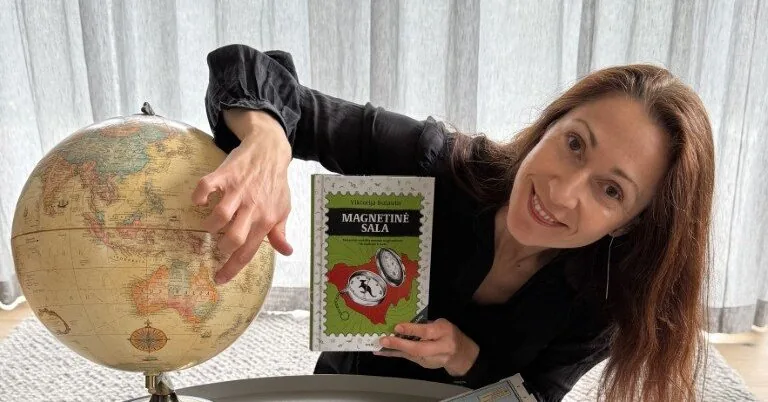
KnyguKurejai.lt – a project telling about children’s and youth books and their authors. The theme of 2019 is the anatomy of books. Writers and illustrators open the doors to the backstage of their works, sharing special stories never published before.
Read more There will be no final cave – Galvydytė missed the moment in the finish drama
Text anatomy according to Viktorija Butautis
Beginning
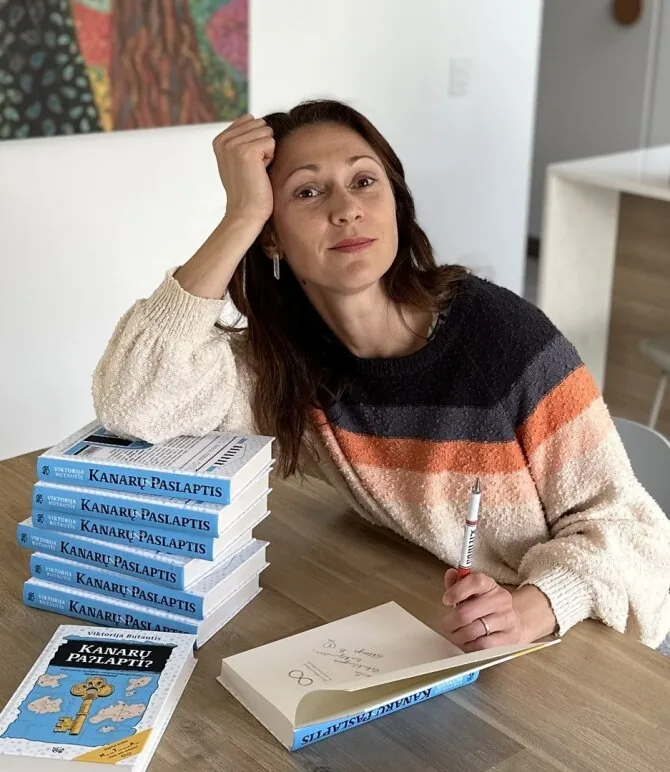
While writing “The Canary Secret,” I had in mind that there would be three books about the adventures of Ema and Mars in the world. I named the folder on my computer “Traveler’s notes,” and now it contains “The Canary Secret,” “Magnetic Island,” and the third story, currently being written. I considered that one of the books would be about Ema and Mars’s adventures in Lithuania, but I decided to dedicate all three books to exploring a distant world, as that is what I am currently engaged in, living far from my native shores. I have not abandoned the idea of writing a story set in Lithuania, but I left it for the future.
Preparation
Writing the second book of Ema and Mars’s adventures, “Magnetic Island,” was clearer than writing the first one – “The Canary Secret.” I knew the structure of the book. I pondered for a long time how to tell about the vast and diverse Australia in one book until I decided to concentrate the action on Magnetic Island, which belongs to Australia and is close to the continent itself. I know the island very well; much information was already in my mind, photos, and video material.
When writing a story where everything is connected, the most challenging part is not to lose the logical thread, so I try to make a map to see when things happened and which event causes another. Chronology is also important because the characters have a certain time frame to complete their mission, so it is necessary to track the days to avoid mistakes.
While writing, I keep a separate document where I write down all the facts mentioned in the book and the sources of information so that I can quickly check if needed; I also bookmark the used sources on my computer.
Creating “Magnetic Island,” I paid special attention to puzzles. I created some and adapted others. I checked all of them and experimented a lot. The story tells about the first inhabitants of Australia – the Aborigines, so I included their symbolism in the tasks-puzzles solved by Ema and Mars.
Characters
The book’s characters appear while writing the story. Some characters I have met in real life; I transferred their appearance or personality traits to the created characters.
Each character in the book has their role and purpose. Biologist Peter is an inexhaustible source of information; Liza-Kliuji is an adult who responds to Ema’s curious and different nature, helping to navigate confusing teenage situations; the new group of friends brings challenges, romantic feelings, and self-testing; Pipa represents friendship; the captain teaches lessons. All the people we meet in life are not by chance, and so it is in my stories. In life, I try not to forget this, to understand why I met one or another person on my path, what they brought me, and what I can give them.
The Blue House on Magnetic Island, where the mad scientist George lived in the book
Environment
Magnetic Island perfectly represents this exotic Australian continent; it naturally has many things I wanted to tell the reader about, and I know the island very well, having visited many times and feeling especially warm feelings for it. It attracts me like a magnet! And the story behind the island’s name is very appealing.
Plot
The main character of the story is a teenager, Ema, a Lithuanian living in the world (in this book – Australia). This fact is important. Ema grows up in different circumstances, sees and discovers the world differently but faces similar challenges of growing up, maturing, and adapting as teenagers living constantly in one country do. I want to share this with young Lithuanian readers.
What I especially like in “Magnetic Island” is what Ema and Mars discover – the true name of Magnetic Island – Yunbenun. I had not thought of this from the beginning, but after choosing Magnetic Island as the setting for the story about Australia, it naturally emerged at some stage of writing and summarized everything.
Now it seems that it could not have been otherwise in this story. The writing process attracts me because unexpected perspectives open up while writing (although sometimes it tortures terribly).
While creating “Magnetic Island,” the values of the first Australian inhabitants – the Aborigines – unexpectedly intertwined with Lithuania. In the book, I mention the sculpture “Me-We” standing on the Juodkrantė shore; although its author is not Lithuanian, the sculpture conveys a universal message. The idea that “I am We” really caught me; I believe in it, and for the Aborigines, community is one of the most important things.
When writing the books about Ema and Mars’s adventures, the biggest challenge is to arrange events, puzzles, and messages (values) into a logical sequence, and when everything finally falls into place, I feel relief and great joy. Writing is an adventure for me. I know the guidelines, outline the structure, and while filling it in, I discover things that, although not in any plan, fit perfectly here.
The twins Ksing and Kajus and the French-origin Australian Liza-Kliuji were the most fun to create. Playing beach volleyball, I meet representatives of various nationalities; the French at the court always teased me with shouts of “O lia lia,” which depending on intonation can mean either harsh disappointment or praise. That’s how Liza-Kliuji’s repeated “O lia lia” appeared. And the twins’ dialogues and pranks make me laugh while writing and reading; it was easy to imagine them and communicate with them in my mind.
The sunken ship S.S.City of Adelaide near the shores of Magnetic Island, where mangroves now grow
The “cow” in the book “Magnetic Island” is a dog, a huge Great Dane, who actually lives on Magnetic Island; his real name is Jacko, and like in the book, he wears no leash, only sometimes a rope.
He grazes wherever he wants, lounges whenever he wants, and is a very friendly character of Horseshoe Bay on the real Magnetic Island. So Mars and Cow (Jacko) are real dogs living both in the real world and in my book. Writing about the deceased French bulldog Bon-bon brought tears to my eyes because my Mars lies nearby, and I imagine the pain I would have to endure if snake venom killed him.
Creative process
In terms of time, “Magnetic Island” was written faster than “The Canary Secret” because I had more concreteness, knew the publishers, and had a deadline. Writing, excluding editing work, took about ten months. I did not write all day from morning to evening because I had to coordinate many other tasks and commitments.
My desk is always full of various things, some of which I make or experiment with
I do not work a full-time job; I think then I would not have the opportunity to write works of such volume. My elder daughter finished school around the time “Magnetic Island” was published. When she went to study in Canberra, I could not go with her because at the same time I flew to the Vilnius Book Fair. It so happened that at the Vilnius Book Fair, presenting “The Canary Secret,” I missed her sixteenth birthday, and after publishing “Magnetic Island” – her eighteenth.
Routine
When I am not traveling, I try to write every day. I am not a morning person, although I have to get up at seven; I cannot think properly and sit down to write before ten, so after getting up, I do other tasks. By the time I finish all non-writing tasks, it is often already two o’clock.
The most boring and most productive day is when I have nowhere to go and no commitments, just to write (this happens rarely). In the morning, I slip into my favorite tracksuit and, after sending my daughter to school, walk Mars – our family’s beloved French bulldog (he also has adventures in my books).
It is a boring daily ritual that Mars eagerly awaits. We have two favorite cafes where we go for coffee (which I really look forward to) and a muffin or croissant, which we share, and when we are very hungry, we buy two. Returning, I do some household chores, e.g., start the washing machine, prepare what I will cook for dinner, and go to the computer to write. I set an alarm if I have to go somewhere. During breaks, I like to take clothes out of the washing machine and hang them outside to dry; then I think about nothing.
Read more Poland celebrates Armed Forces Day with the largest military parade in history
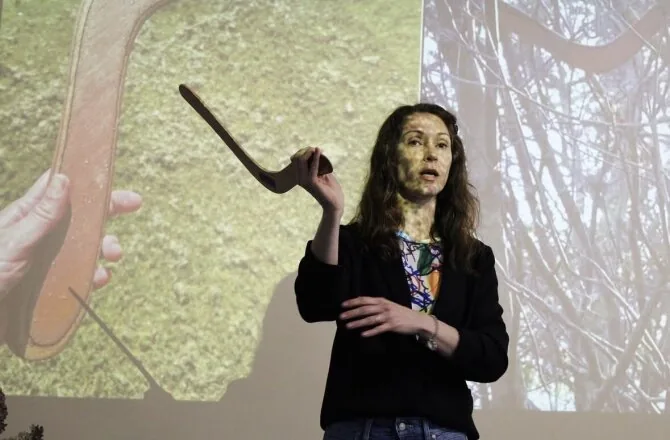
When I sit down to write, I read the previous day’s work, correct it, and finally move on. I like to leave myself a hint about what I will write next (if I know), which makes it much easier to get involved. The hardest part is when I do not know what to write next. In my books for teenagers, everything is connected, so while writing, I have to think many steps ahead and constantly check how one or another thing will work in the story.
Sometimes, instead of writing, I sit staring at one point, lost in the twists of possible scenarios (there were many such days while writing the book “Magnetic Island”). These are probably my writing slumps. I use puzzles to develop the plot; the chain of causes and effects in the narrative is very important, so it took many hours of sitting and staring at one point to connect the ends.
How I imagine my ideal routine (which is unrealistic): I am alone, well, maybe with Mars, I get up, do exercises, drink green tea, do sports. I write and do not need to set an alarm because I do not have to be anywhere else. I do not know how many hours, no one calls, I have nothing to do. I can be lost in a fog of thoughts, stare at one point, draw event schemes, experiment, not worry about food, and have no schedule. And it will be like this until I write the whole story.
I think I would go crazy, but now I often feel discomfort when I have to pull myself out of that writing fog and be in the real world. When I write a larger work, I cannot leave the writing trance (finish chapters and forget writing until the next session); sometimes it seems to me that I write constantly, not necessarily by typing on the keyboard, but the story and its characters live in my head all the time. Waking up at night, I often solve unresolved plot questions, look for puzzles, or note what I should not forget. I know my family feels my detachment or even irritation. It is hard to get out of the writing trance (often very untimely) and be here again.
However, I would not trade my family for the writer’s solitude, so I try to balance both.
And… what next?
Next, I will get up at seven in the morning, slip into my favorite tracksuit, walk Mars, and stare at one point because now I am writing the third book of Ema and Mars’s adventures in the world.
Currently, Ema and friends are stuck in a divinely beautiful lagoon in the Pacific Ocean.
There, under a huge tridacna, they found a golden key (or maybe not), and I need to figure out how to get them to another island in the Cook Islands. And most importantly, why the number 5 will be needed because the collectible heart-shaped coins issued in 2023 in the Cook Islands on Valentine’s Day have a denomination of 5 dollars; Ema and friends learn this from a strange postman on One Foot Island.
So, I am going to work.
The third story of Ema and Mars’s adventures in the world occupies my whole head; I fall asleep and wake up with it, sometimes it tires me terribly, but I believe everything will find its place, and then I will be able to return to reality.
Illustration anatomy according to Milda Magylė
Style
I was fascinated by the illustrations of the book “The Canary Secret” (which were created not by me but by another illustrator), playfully and caricaturedly conveying the action with minimal lines. I had never tried to draw in such a style before, and at first, it seemed quite a daunting challenge to transfer already familiar characters to another book in my style.
Drawing has always been part of my life and remains so. Before starting, I reviewed my favorite childhood books with fresh eyes: T. Jansson’s Moomin series and A. Lindgren’s books illustrated by I. Wikland.
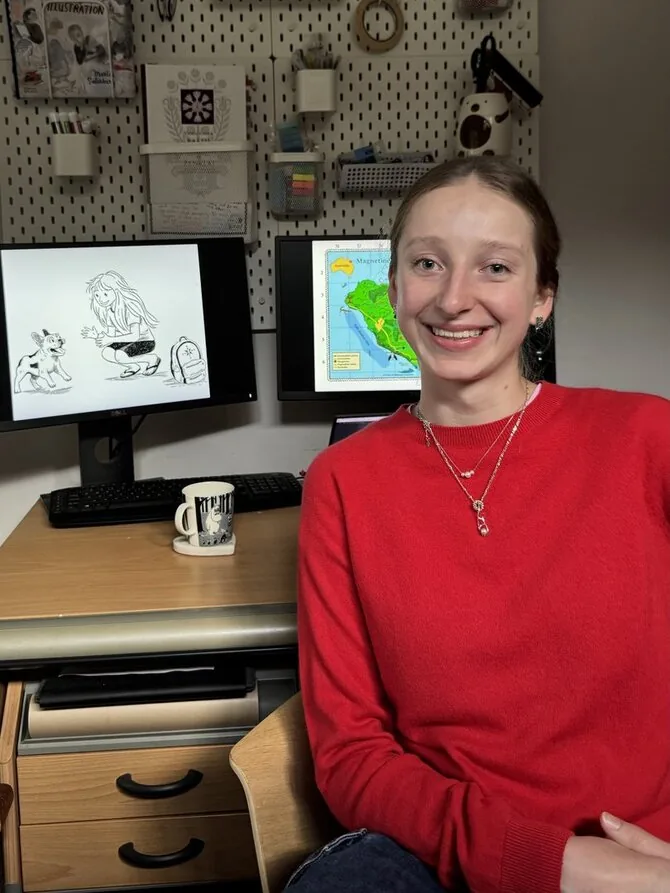
Recently, I have enjoyed creating realistic drawings with graphite pencils, linocuts, and digital drawings later printed on postcards and coasters. Combining all these techniques formed the illustrations. I drew on a tablet, which made it easier to move from initial composition sketches to the final illustration.
Characters
Since the main characters Ema and Mars were already created, the most important thing was not to stray from their main character traits. Viktorija helped a lot with advice because she clearly imagined the characters. When we decided that Ema and Mars would be depicted with proportions close to a teenage girl and a French bulldog, in my first versions, Ema looked more reserved (perhaps more like me in adolescence), more mature, but after several consultations and corrections, I think we created her as curious, active, and brave as she is presented in the text.
Environment
The setting of the book is a real island in Australia; the places mentioned in the puzzles really exist, and although I myself have not been to Magnetic Island, the landscape of this region is well known to me (and Google maps helped me to feel the described places). I tried to include elements that convey the necessary details only to recognize the place and solve puzzles without overloading the illustration. Once I managed to find such a way of depiction in one illustration, it was easier to repeat the same style in others. Printed illustrations in different sizes helped decide on the final texture or light details.
Plot
“Magnetic Island” is the first such complex work I had the opportunity to do. It was a very fast learning period for me. Before the project, I took the usual steps for a new activity – read theory and study the best examples. The task I received clearly conveyed Viktorija’s vision and plan, mostly related to the included puzzles. Since I had the wonderful opportunity to read the book manuscript, I selected details from the text and drew sketches, which we developed further after discussion.
Creative process
After the great euphoria of Viktorija and BALTO’s trust to contribute to this project, everyday life was quite intense because the months of creating illustrations coincided with the beginning of my architecture studies at the University of Sydney. It so happened that I received and started reading the text at the same time as I had to get acquainted with the university and adapt to its rhythm. As I mentioned, the illustrations were drawn using a tablet, so I could draw anywhere: at home, on the train, during lunch breaks in the park near the university, or leaning against a tree during a family picnic.
Studying the basics of architecture (which is also a creative process) and simultaneously creating sketches for “Magnetic Island,” I lived as if in parallel worlds, but these worlds were so different that switching from one to another simply rested me.
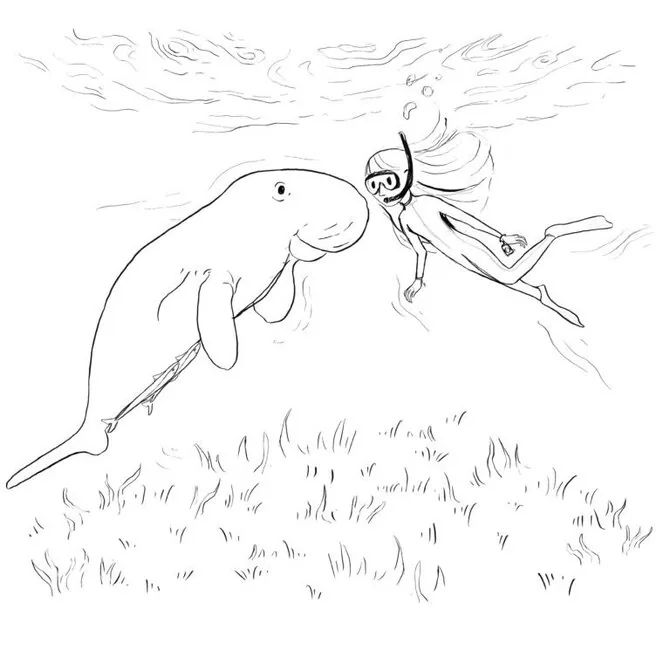
The biggest challenge was probably “catching” Mars because he is not just a French bulldog but a very charming and strong personality that had to be conveyed with minimalist lines. It was a challenge for me that required many attempts to combine the expressions of a dog and a human, and I hope that the version in the book reflects Mars’s playful character.
As a newcomer, the experience in this project was invaluable to me, so I am very grateful for the opportunity to contribute to the book and for the author’s kindness, encouragement, and advice.
Author biographies
Viktorija Butautis
I was born by the seaside, in Klaipėda. I studied in Tallinn, Milan, and Kaunas. I lived and worked in Lithuania, Estonia, Italy, Spain, Australia. I traveled to many countries. I have a weakness for islands. My writing debut – “Lithuanian Pioneer,” at thirteen I became a young correspondent. In higher grades, I wrote a lot for the newspapers “Klaipėda” and “Vakarų ekspresas,” preparing to enter journalism.
Books for teenagers:
- “The Canary Secret” – the first book of Ema and Mars’s adventures in the world (Vaga, 2023)
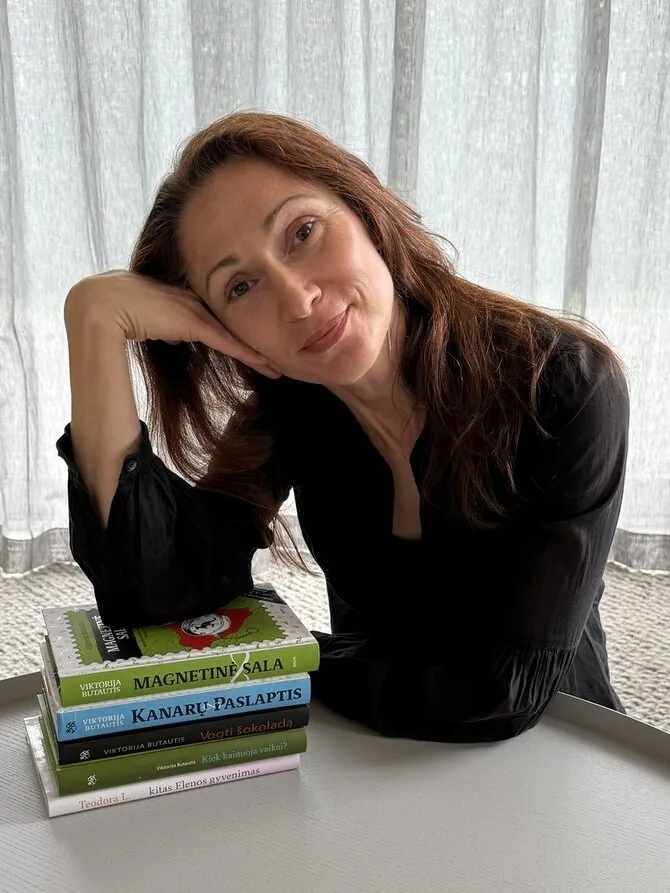
- “Magnetic Island” – the second book of Ema and Mars’s adventures in the world. (BALTO, 2025)
Milda Magylė
I was born in 2006 in Crewe, United Kingdom, but my parents took me – an 8-month-old baby – to Australia, where I still live in Sydney.
I study architecture at the University of Sydney; I am currently in the second year.
My first teenage job – delivering flyers – did not last long but left an impression because of the number of steps taken in an afternoon.
Since I was 16, I had my Etsy postcard shop until I could devote time to it before the final exams.
Currently, I devote much attention to studies and experiments with linocuts, but sometimes I take on short projects, such as graphic design for the University Aeronautics Club.
Read more Why didn’t it work? Our fastest swimming sprinters were looking for answers in the Paris pool