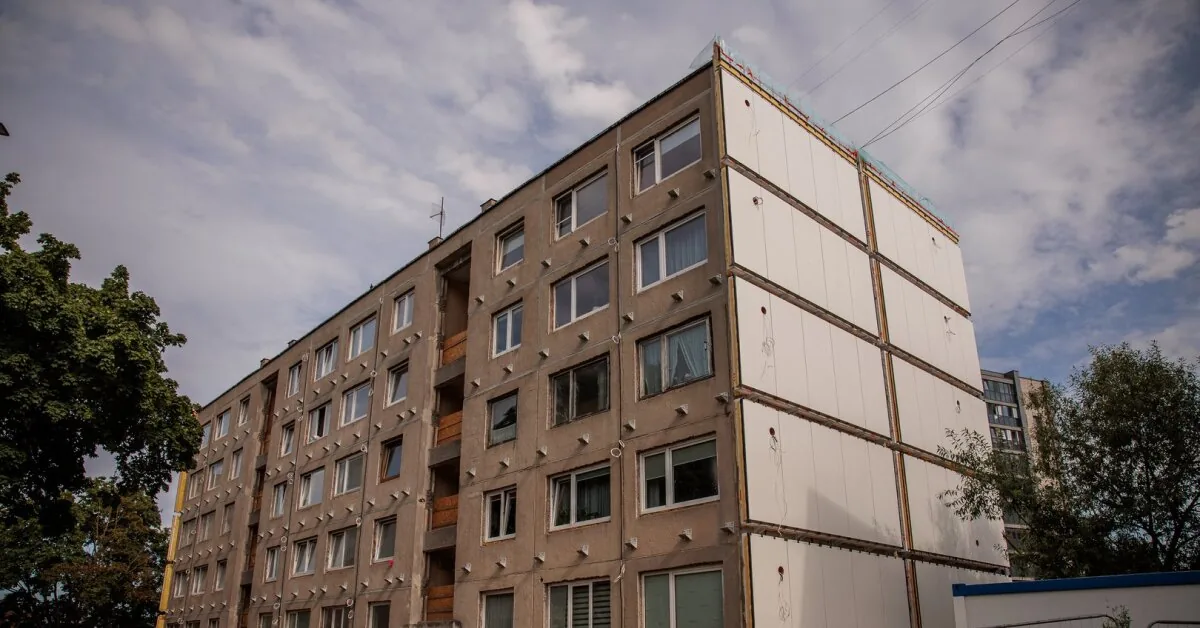
Projects mark a new stage of renovation – most of the work is moved from the construction site to the factory, making renovation much faster and less disruptive for residents. This is stated in the press release of the public institution “Let’s Renew the City”.
Read more Justice Minister calls to return to the idea of establishing a registry of sexual offenders
Panel renovation fundamentally changes the usual building renewal process. Facade elements with integrated thermal insulation are manufactured in the factory according to precise building dimensions, and if necessary – with windows or other engineering solutions. They are delivered to the construction site ready for installation, so much less work is done on site.
“Vilnius residents are increasingly choosing to renovate their homes and take advantage of state support. This shows that renovation today is no longer just the story of individual apartment buildings – it is transforming entire city districts and people’s daily lives.
Among the leaders, we see Žirmūnai, Naujamiesčio neighborhoods, but it is encouraging that a higher quality living environment is rapidly being created in other parts of Vilnius as well.
Even more encouraging is that Vilnius residents are not afraid to be the first – it is precisely in the capital that modern panel renovation technologies, already proven in Europe, are being applied today,” said Vilnius city mayor Valdas Benkunskas in the statement.
The first results in Vilnius already show one of the biggest advantages of this technology – speed. In just two days, one rear wall of an apartment building was covered with panels – in the case of traditional renovation, this would have taken several weeks. The facade insulation work at the apartment building on Tuskulėnų Street is planned to be completed in about two months.
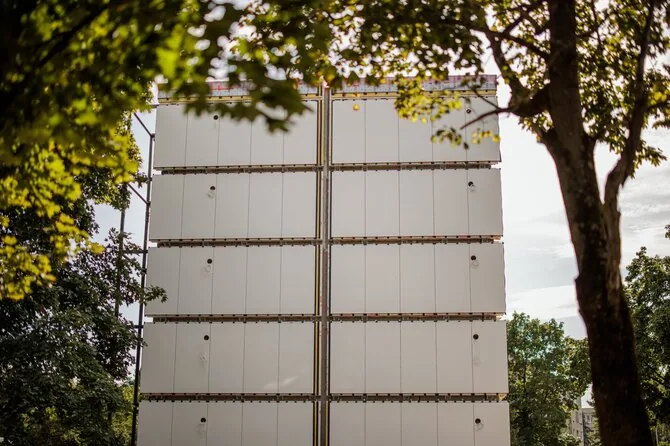
This project is implemented using a concessional loan provided by the national development bank ILTE, intended to finance renovation construction contracting works.
Another important advantage is less inconvenience for residents. The building does not need to be covered with scaffolding for a long time, the construction site takes up less space, large amounts of construction materials are not stored there, and only a crane and a small lift are needed to install the panels.
Read more “There were 340 people in total”: Russia struck a Ukrainian train
“Today we already see that panel renovation fulfills one of its most important promises – speed. Most of the work is done in the factory, so on site it remains only to precisely and quickly install the prepared elements.
This means shorter construction time, less inconvenience for residents, and the possibility to significantly accelerate apartment building renovation in Vilnius in the future,” says Laurynas Šeškevičius, acting director of the public institution “Let’s Renew the City”.
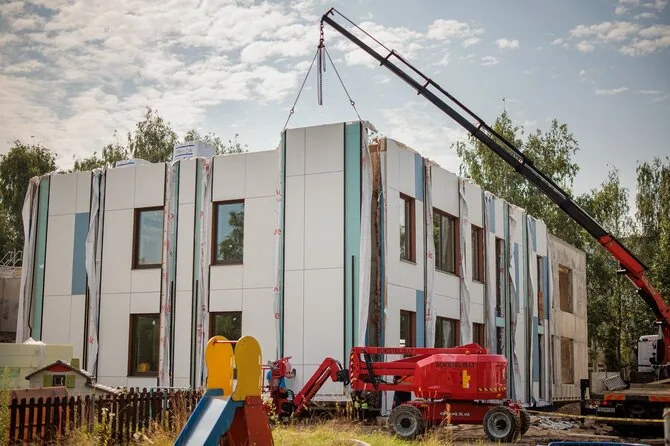
Although this technology is still gaining ground in Lithuania, in many European countries – the Netherlands, Germany, Estonia, and others – panel renovation has already become a common practice. It not only significantly shortens construction time but also ensures higher work quality, as the main elements are manufactured in the factory under controlled conditions.
Currently, in Vilnius alone, “Let’s Renew the City” is carrying out more than 200 apartment building modernization projects, of which real renovation work is underway in 65, and the renovation of another 44 apartment buildings is in the design phase.
“The growing number of such projects shows that there is room in the renovation market not only for larger scale but also for more efficient implementation methods. Financing solutions are important here so that proven technologies can move from individual projects to wider practice,” says Giedrė Gečiauskienė, head of ILTE Client Financing Service.
According to the Environmental Project Management Agency (APVA), in previous calls for state support, applications were submitted by another 17 apartment buildings planning to use panel renovation technology – 4 of them are in Vilnius. This shows that interest in this technology is rapidly growing, and the projects started in Vilnius can become an important impetus for its wider application throughout Lithuania.
Read more Lithuanian officers helped detain 55 migrants in a neighboring country