









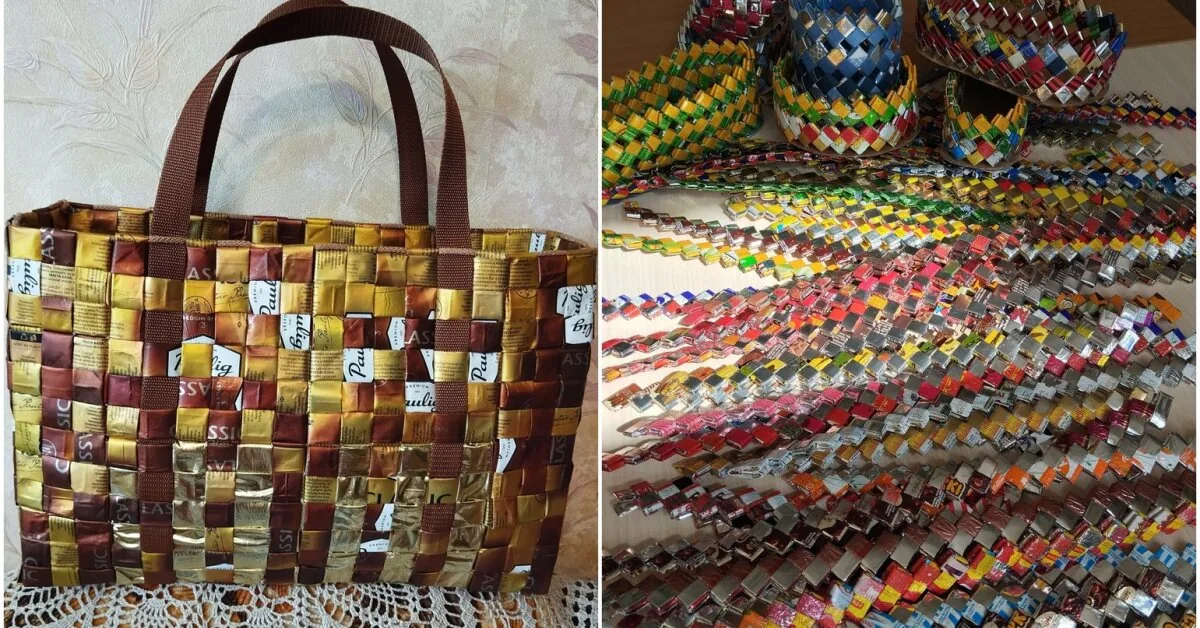
In the project “Change your attitude, not things,” organized by the Environmental Project Management Agency, we share real stories about how to preserve items and help them live not just a second life, but many more. In the recent readers’ contest, participants eagerly shared their redesigned or renewed clothes, shoes, and accessories.
Read more Belarusian company supplied equipment for missiles to Russia: Lithuania also mentioned
60 packages for one handbag
Here, folk artist Elvyra creates incredible things – from packages and candy wrappers she makes baskets, boxes, and handbags. She reveals that making one handbag requires as many as 60 packages: “First, the packages need to be cleaned, cut, and folded according to specific measurements. Then I weave them like baskets, later joining everything with thick thread.”
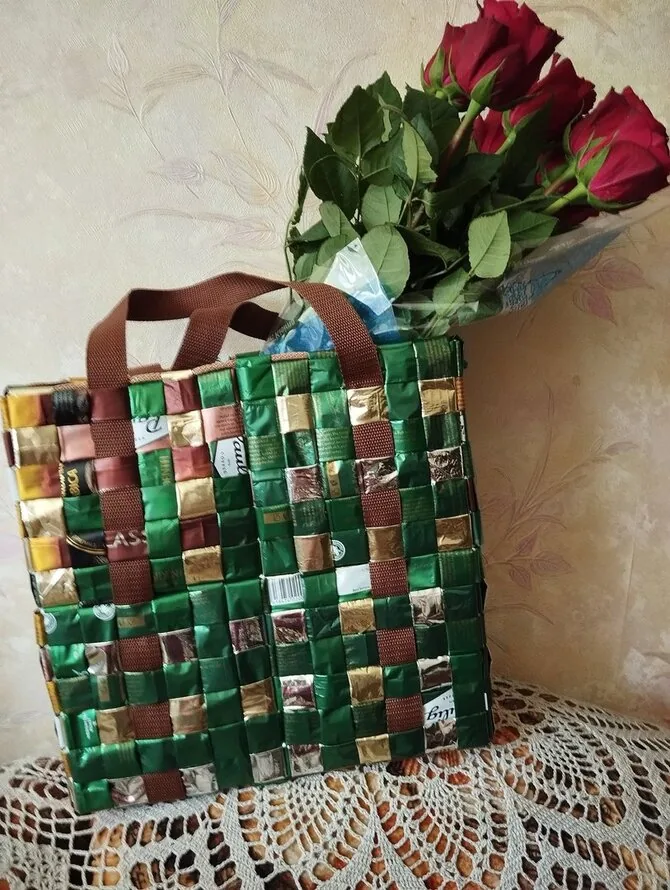
The handbag made from coffee packages, according to the interviewee, is light as a cloud but very sturdy and not afraid of rain, as coffee packages fold and become very strong. When making handbags from candy wrappers, cardboard is placed inside, which makes the handbag very durable.
The best ideas are born completely unexpectedly from everyday life, enjoying life, without trying to find or create them deliberately.
The woman receives candy wrappers and coffee packages from everyone – relatives, friends, and acquaintances. “You need to collect many identical ones, so everyone collects them. I have three baskets on the balcony where I collect and sort the packages. During city events, we also promote and encourage people not to throw away packages, informing them to bring them to us and contribute at least a little to nature conservation,” Elvyra smiles.
First – get to know the material
Handbag designer Goda Deltuvaitė, who makes handmade leather handbags, says creativity is seeing beauty in details and shapes: “Creativity cannot be confined to frames because then it loses its essence; through creativity, you can best discover and understand yourself. Ideas can be drawn from everywhere: surrounding objects, surfaces, textures, shapes. The best ideas are born completely unexpectedly from everyday life, enjoying life, without trying to find or create them deliberately.”
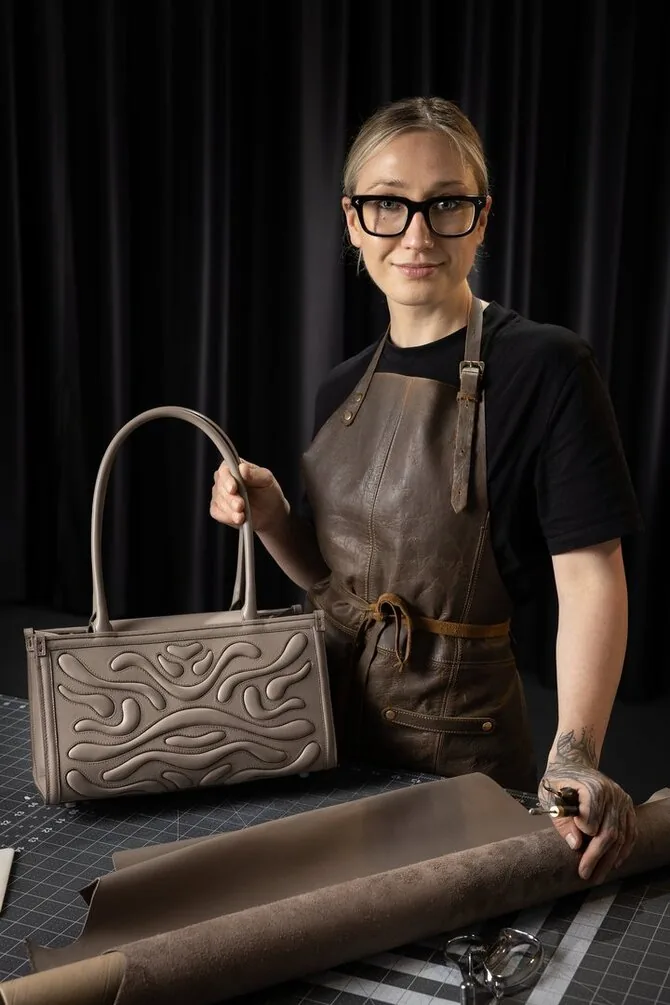
For those without special skills or tools but who want to sew, redesign, or improve a handbag with details at home, the interviewee first recommends not starting with very complicated, large handbags but trying simpler projects by creating or redesigning smaller items.
“You should get to know the material you like – touch it, see how it bends or folds, what its possibilities are. The most important thing is not to confine yourself and allow yourself to make mistakes because mistakes teach the most; they are the whole beauty of creativity. You need to learn from your mistakes, evaluate why it didn’t work, and keep trying because each time it gets better,” the interviewee smiles.
The most important are the invisible details
The most common mistake, according to her, is imagining the item completely differently than it finally turns out. Many people may feel disappointed, but it is important to understand that our imagination differs greatly from the physical object. Before creating a new item, it helps to dismantle the old one and see what and how it was made. Dismantling an old handbag is also very useful for drawings – not everyone can imagine in their mind how a flat piece should look that, when sewn, becomes a handbag.
“I would like to mention that the most important thing is not the handbag’s exterior but what is inside. A handbag consists of many layers – it is not just leather and lining. To get a soft handbag, certain inner layers are needed; for a stiff handbag, other layers are required, so it is very important first to get to know the materials, and once understood, you can find ways to use them. Layering details allows achieving the desired shape, which determines the handbag’s durability,” says Goda.
To make a handbag last longer, the interviewee recommends not overloading it.
According to her, handbag quality can only be judged by seeing it from the inside – examining seams, reinforcements, and gluing. Small, almost invisible aspects allow handbags to last longer and be more durable.
However, there are also other durability rules. To make a handbag last longer, the interviewee recommends not overloading it. An unused handbag should be stored stuffed with newspapers or papers to absorb moisture in the room, not kept in sunlight for a long time, and if wet, not dried with hot air but allowed to dry naturally. She also recommends caring for the handbag material – regularly cleaning, moisturizing, and impregnating it.
“I am very happy with people who try to create and redesign. I believe that anything can be given a second life if a person adds a piece of themselves. It doesn’t take much, and with a little love and details, you can get a truly wonderful creation,” Goda smiles.
Read more Following the wishes of her ex-husband Enrique – Kristina Meseguer and her new lover’s response
The article was prepared as part of the project “Waste Prevention Promotion”.



