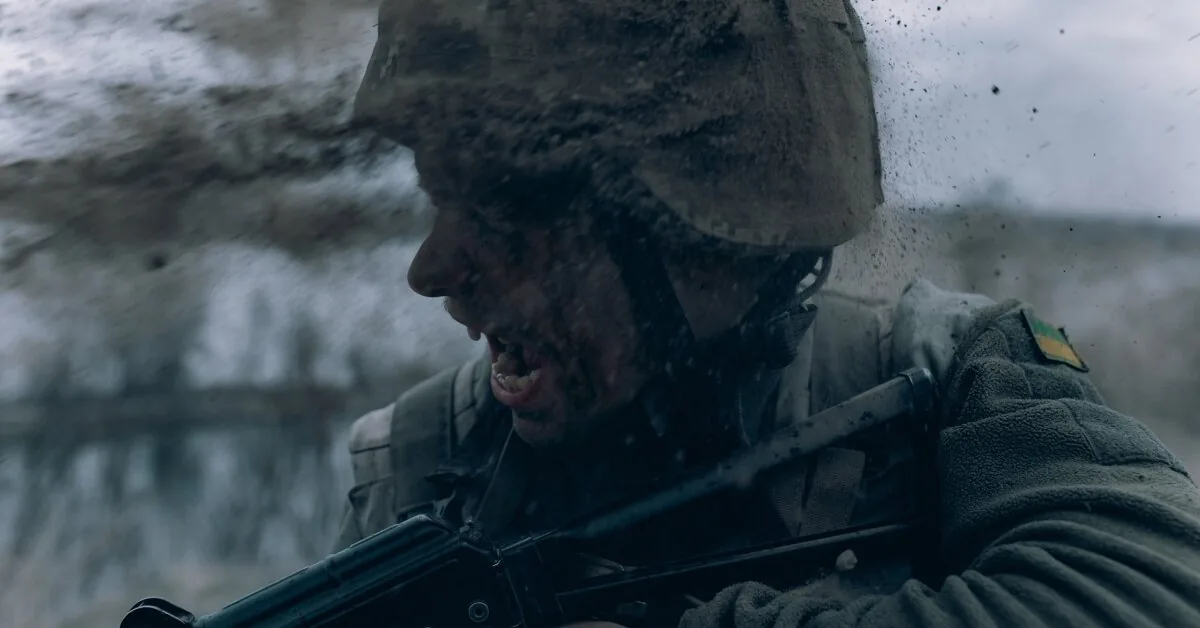
Serhij Krynyckis and his comrade spent almost a year together in trenches on the front line. They destroyed Russian soldiers and then searched for food among their bodies. They were two and from that horror they argued and laughed a lot. However, Serhij became a witness to the death of his most loyal colleague.
While filming one of his videos, the Ukrainian soldier pointed his phone camera at the lifeless body of his comrade stuck in the trench. One blood-stained leg was exposed. It was visible that the artery was cut by debris from a bomb dropped by a drone. He was bleeding and bleeding.
“In the morning you still joke together,” said the 42-year-old soldier. “And in the evening the gates of heaven call.”
It was the 326th day.
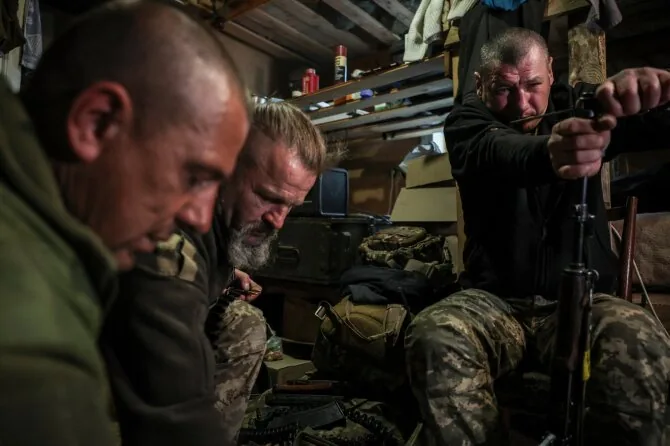
Such isolation of Ukrainian soldiers is a consequence of how the drone war fundamentally changes the battlefield. This technology forced both sides to abandon the practice that was common to all wars: concentrating soldiers, artillery, and armored vehicles in a relatively narrow corridor along a long front line. However, such targets are now easy prey for cheap drones with which both sides have flooded the sky.
Instead, the army needs small groups of just two or three soldiers scattered across small, ground-dug trenches along a roughly 30 km wide battlefield called the “kill zone.”
The groups try to avoid detection and identify gaps in the enemy’s defense, often taking huge risks for minimal territorial gains. Usually, they get stuck in their positions for months because changing soldiers in such a place is very dangerous, writes Reuters.
As Serhij recounted, he and his brigade were deployed near Chasiv Yar, Eastern Ukraine, from April 20, 2025, to March 31, 2026. He managed to film a series of video diaries on a mobile phone, which was sometimes “fed” with batteries collected from dropped Russian drones.
In recordings marked with swear words, he captured the inhumanity and absurdity of life in a cramped “fortress” about 3×4 meters under the front line.
Reuters journalists reviewed 22 videos provided by his unit to share Serhij’s story with a wider audience. Later, when he returned from the mission, journalists spoke with him so that his experiences of his 346 days of service on the front, which he spent almost entirely in trenches, would become a narrative. For this, Serhij was awarded the highest military honor of the country.
Every few days, Russian soldiers approached in small groups. Sometimes the Ukrainian was only 20 meters away from the Russians before the Ukrainian defenders started shooting at them.
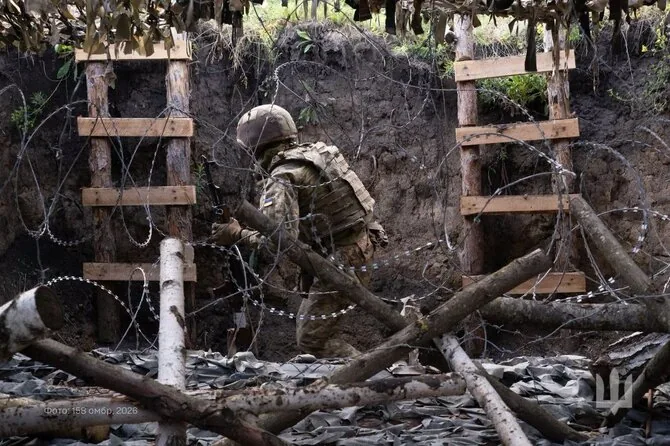
Serhij admitted that while sitting in the trenches, he killed 23 enemies up close. The most memorable for him was one of the first times. A Russian soldier was wounded by a grenade and pretended to surrender, then aimed his rifle at Serhij.
“Well, I reacted,” the soldier confessed. “He stopped aiming at me.”
In a video filmed on November 24, more than 200 days after the start of his deployment, Serhij pointed the camera and showed the bodies of two of his enemies.
“Fools,” he said to the camera. “They crawled where they shouldn’t be.”
S. Krynyckis’s unit – the 24th Mechanized Brigade – confirmed that he reported 23 enemies killed. Reuters could not verify all the details of this soldier’s account.
“A weirdo collecting postage stamps”
Serhij was not an officer. He worked in agriculture and construction until an injury put him in a month-long coma. After that, he barely made ends meet breeding rabbits.
At the end of 2024, in the village of Bilohirya where he lived, the man was detained by conscription officers. They put him on a bus, took him to the city of Rivne, and quickly trained him.
Serhij was assigned to the 24th Mechanized Brigade and sent to the front in the east, where the Russian army, significantly outnumbering Ukrainian forces, attacked the so-called “fortress ring” in the Donetsk region.
In April 2025, he and two other privates entrenched near Chasiv Yar. There they dug a trench, and after that, S. Krynyckis spent almost a year in it, approaching enemy forces. The men already understood then that the deeper they dug, the greater their chance of survival. The Ukrainian defender often joked that he did not know whether to call that hole a shelter or a grave.
When their hideout was hit by drones, they had to dig it again. One of his comrades died early in the deployment during an attack after which Serhij suffered a concussion and temporarily lost his hearing.
Read more At the European Championship – the first Lithuanian starts: triple jumpers fight for the final

Then Serhij and the one remaining comrade not only defended themselves from Russian soldiers but also fought natural elements – plugging holes so that the icy wind would not blow through. The men constantly went on guard, changing every two hours. According to the soldier, it was impossible to endure longer.
“Sometimes three or four days passed before a supply drone managed to break through enemy fire. To survive, Serhij collected food and various items from killed Russians,” writes Reuters.
The man has two teenage children. According to him, he started filming his diaries in August 2025 so that when he returned home, he could show people what he had to endure and remind himself.
In one video filmed this February, he was inspecting cigarettes collected from dead enemy soldiers: “Camel,” “Winston,” “Chesterfield,” and others. He was obsessed with those packs “like some weirdo collecting postage stamps.”
In other videos, he showed war “trophies” covered in mud – rifles he had taken from fallen Russian soldiers.
“This is my small arsenal of weapons,” said S. Krynyckis, proudly counting 13 firearms.
Died before his eyes
As Reuters writes, Serhij dug his trench in one of the most dangerous sections of the “kill zone.” On March 11, he heard an explosion outside.
The man ran outside and found his comrade on the ground, whose leg was wounded by a drone. Serhij dragged him back to the trench, found the wound, and tried to stop the bleeding. But it was already too late to save him.
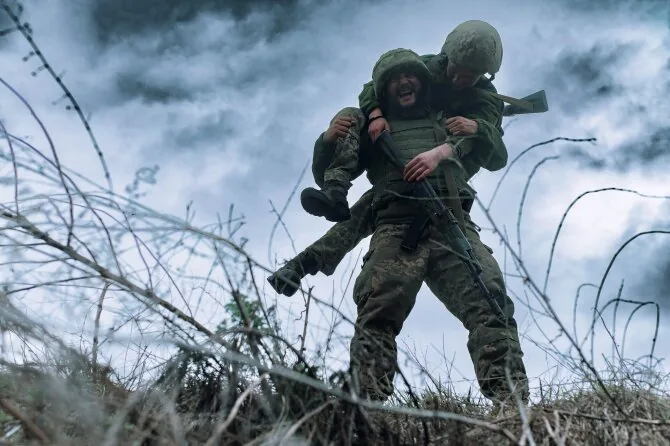
Communicating with command by radio, the soldier received an order to leave the position as Russian soldiers were dangerously approaching. That night he crawled out of the trench for the last time to join a few infantrymen nearby who had been hiding in their trench for almost three weeks.
After that, he faced a dangerous march to a safe place 25 km away. But his weak health after many months underground only made this march harder. However, he succeeded.
In May, President Volodymyr Zelensky awarded S. Krynyckis the “Hero of Ukraine” medal for bravery.
“The Ukrainian army is full of men like him who have endured unimaginable things,” said Andriy Derunas, a military leader in one of Ukraine’s main charitable organizations “Come Back Alive,” which provides equipment and other support to the armed forces.
“It can completely destroy a person,” noted the man who often communicates with front-line soldiers.
Back in Kramatorsk, Serhij spoke about the psychological burden imposed by exhausting service on the front: “Many guys lost their minds.”
Almost two months after leaving the front line, the man’s internal wounds are visible externally. He tries to hold back tears. His hands tremble.
Recently, S. Krynyckis held a tour of schools near his home, where he talked to students about his experience and at the same time began to better understand how his sacrifice could be useful.
“There, in those schools, I realized that I defended our land and these children not in vain – so that they could study, see the clear sky,” he concluded.
Read more Trinchieri invited the Greek who became champion with «Rytas» to his staff