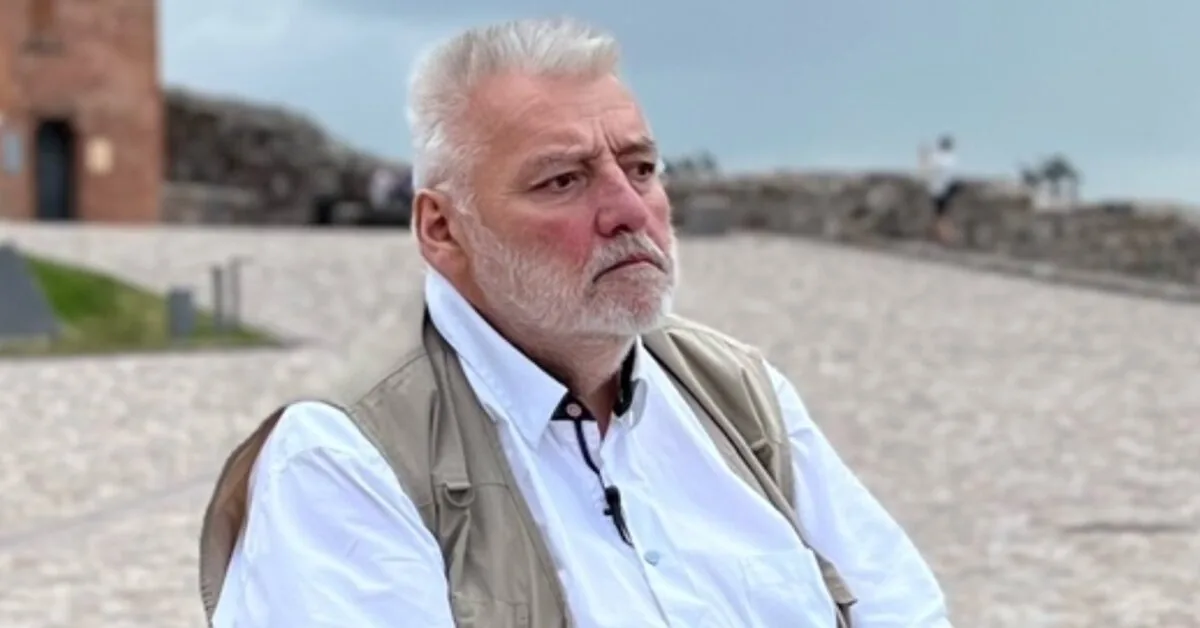
Alfredas and Alfredas – the shared name became the first connection between the show’s hero and the world-famous director. The second became clear as the conversation progressed: the historian admitted that in his youth he wanted to be an actor, and episodes from A. Hitchcock’s biography became a mirror revealing A. Bumblauskas’s own life experiences.
Read more Drunken evening in Kaunas district – the daily record holder «blew» quite a bit
“If you are not allowed to speak, it means there is a second world”
One of A. Bumblauskas’s brightest childhood memories was the view near the old Telšiai cemetery. He was about five years old: the boy was sitting on the steps, throwing stones, and knew that behind him was the common grave of the Rainiai martyrs.
In 1941, the political prisoners tortured by the Soviet occupation authorities in the Rainiai forest were not publicly discussed. However, the news lived on in family stories and in adult warnings that the child did not fully understand.
“I knew there were martyrs’ graves there, but no one was allowed to talk about it. Then I began to see some kind of double world. If people do not allow you to talk about something, it means there is a second world,” the historian recalled.

According to him, this childhood feeling has never disappeared. It still encourages him to ask whether the publicly visible reality is the whole reality, what remains behind the wall of silence, and what other worlds history and art can open.
“Even today it seems to me: is everything here always real? Maybe that’s why great art is needed – it creates another world. And in the real world, there can also be several worlds,” said A. Bumblauskas.
In his eyes, a bridge with people fell into the Neris
The story of A. Hitchcock’s film “The Birds” turned the conversation to real-life horror. Asked about the most terrible experience of his own, A. Bumblauskas recalled the tragedy of the pontoon bridge in Vilnius near the then Concert and Sports Hall.
The professor said he was walking with a friend from a Hungarian musicians’ concert. They had not yet reached the bridge when it, full of people, began to break and collapse.
“The bridge is collapsing before my eyes, people are falling into the water. Then a disgusting feeling takes over – you don’t know what to do. You see people drowning, and you can’t do anything. I don’t wish anyone to feel that,” said the historian.
He recalled the darkness, the screams, and people falling into the cold Neris wearing coats. The worst, according to A. Bumblauskas, was standing on the shore and feeling complete helplessness: if you fall into the water, you would at least try to save yourself or someone else, but on the shore, you remain just an observer of the disaster.

Speaking from memory, the professor mentioned 1976 and wondered which Hungarian group was performing that evening. Archival sources date the tragedy to April 13, 1975: the bridge broke after the “Sirijus” group’s concert when several hundred people tried to cross the still unfinished pontoon bridge. The exact number of drowned people has not yet been definitively established.
In the show, A. Bumblauskas questioned the widely mentioned number of four victims in the public space. He emphasized that he was speaking not as a scientist who studied the tragedy but as a person who witnessed it with his own eyes: the bridge was packed, the water was cold, and the current carried people away.
But no less than the disaster itself, the silence that followed it stuck with him.
“No one explained anything. No one talked about it,” said the professor, recalling that in the same April of 1975, the long-silenced Žasliai railway disaster also occurred.
The “second world” experienced in childhood repeated itself: one reality was visible to people’s eyes, the other was officially presented.
“Real horror cancels out movie horror”
The next question was related to documentary material about Nazi concentration camps, to the creation of which A. Hitchcock contributed. Considering why this material was not publicly shown for a long time, A. Bumblauskas chose an incorrect but, according to the host, the most meaningful answer option.
“Horror loses its meaning when you show real horror. Then the path you chose in horror cinema somehow gains morality by itself,” the historian reflected.
From the documentary image of the Holocaust, the conversation moved to the question of which event was the most traumatic in all of Lithuanian history. A. Bumblauskas’s answer was unequivocal – the destruction of Lithuanian Jews that began in the summer of 1941.
The professor spoke about towns and villages where Jewish communities that had lived for centuries disappeared in one day. According to him, there were many wars, plagues, famines, and other disasters in Lithuanian history, but the Holocaust raises a more fundamental question – what a person must do with their conscience to be able to kill a neighbor living nearby.
Read more WSJ: US intelligence links drone at Leipzig airport to Russia
“Here the depths of humanity are touched. Who are you? How could you kill neighbors who did nothing bad to you? This is a moral trauma. Of all nations, I think,” said A. Bumblauskas.
The historian’s path could have led to the stage
The show also revealed a lesser-known side of A. Bumblauskas’s biography – in his youth, he was seriously interested in theater and wanted to become an actor.
He did not dare to apply to acting school because of the huge competition and the threat of being drafted into the Soviet army if he failed. While studying, he tried to join the Underground Theater, later acted in the Kiemo Theater, but the role of a peasant did not captivate him.
“In the children’s studio, I played kings. Not some peasants,” the professor laughed.
Eventually, he founded his own “window theater,” wrote scripts himself, and, of course, played the king. According to A. Bumblauskas, even then his work contained much absurdity, irony, and sarcasm directed against shallow, decorative patriotism.
In one performance, Radvila absurdly tried to “extract” Lithuania’s independence from the Union of Lublin, and during the Soviet era, a toast was made on stage for “unsubmissive Lithuania.” It was a time when Leonid Brezhnev was still alive, so theatrical absurdity could also be understood as a dangerous political statement.
“History is really masculine”
A. Hitchcock’s thanks to his wife Alma Reville (the director called her his editor, screenwriter, daughter’s mother, and kitchen chef) became an opportunity to ask which wife was the most important in Lithuanian history.
A. Bumblauskas chose Queen Morta. According to him, sources show that Mindaugas, who ruled with harsh and bloody methods, consulted his wife. This allows one to speculate that Morta managed to “confuse, warm, and soften” the ruler.
But from one ruler’s wife, the professor moved to a broader problem: historical sources were mostly created by men and for men. Genealogies primarily concerned land heirs, wars – military leaders, politics – those holding formal positions. Therefore, women’s influence often remained unrecorded.
“When women are angry at men, there is a reason for that. History is really masculine,” admitted A. Bumblauskas.
However, in his opinion, it is no longer enough to blame only the old chroniclers. Today we know women’s names, have documents and photos, but still do not care enough about their memory.
As one of the brightest examples, the professor named the public figure, politician, and press publisher Felicija Bortkevičienė – a woman whom the most influential Lithuanian men of the time regarded as an authority. In 1926, she and Gabrielė Petkevičaitė-Bitė ran for the presidency of Lithuania. If one of them had won, Lithuania could have become the first country in the world led by a female president.
Another forgotten personality mentioned by A. Bumblauskas was basketball player Genovaitė Miuleraitė. In the 1938 European Women’s Basketball Championship, the Lithuanian team won silver medals, and G. Miuleraitė was chosen as the best player of the tournament. She scored 35 of the 90 points of the Lithuanian team.
“Where are her traces?” asked the historian, emphasizing that sports results are not yet a living social memory.
Thus, the conversation, which began with A. Hitchcock’s fears, films, and black humor, finally returned to the historian’s most important theme – what society chooses to remember, what it silences, and whose lives it allows to be swallowed by oblivion.
“In the Skin of a Genius” is an original show by Livija Gradauskienė, in which well-known Lithuanian cultural and social figures are invited to look at themselves through the life stories, choices, and actions of world-famous creators. The show is broadcast on Thursdays at 13:05 on LRT RADIO, and uncut conversations can be found in the LRT radio archive and LRT media library.
Read more CNN: Russia sensed Ukraine’s weakness