According to Utah state Republican Senator John Curtis, a member of the Senate Foreign Relations Committee, the broad support for this measure reflects the growing understanding in Congress that Russia’s war against Ukraine is not just a regional conflict but a test for the entire international order.
Read more A Lithuanian woman returning from California challenged the rules of classical music
Last week, the Senate, chaired by J. Curtis, approved the bill “On the Imposition of Sanctions on Russia and Iran” through a procedural vote. In an interview with the news portal “Laisvės radijas,” the senator emphasized that the bipartisan support was huge.

“Such overwhelming bipartisan support is not often seen in the Senate,” he noted. “And when you see so many of my colleagues from both sides coming together, it means we are serious and something will definitely happen.”
Crossed regional boundaries
The bill provides for the imposition of broad sanctions against Russia’s economic, financial, and energy sectors, targets Moscow’s “shadow fleet” used to evade sanctions, and expands the authority to impose sanctions on Iran. The document also includes provisions allowing the president to impose tariffs on countries that continue to buy Russian oil and gas.
J. Curtis stated that he expects the bill to be passed despite the unpredictable Senate schedule.
“There is some hope that it will actually happen this week,” he said. “I am not too worried about whether it happens this week or a little later. As you know, things here in the Senate have their own dynamics and cannot be rushed, but I believe we will manage to get the bill passed. The only question is how quickly it will happen.”
The senator is convinced that if Russia is allowed to defeat Ukraine, it will have consequences far beyond the region and will primarily affect China’s plans regarding Taiwan.
“In my opinion, from the very beginning, this was a war in which Russia could not be allowed to win,” J. Curtis said bluntly. “Thank God, that did not happen. But we want to emphasize: we are on the side of freedom. We are on Ukraine’s side and cannot accept a dictator invading a friendly country.”
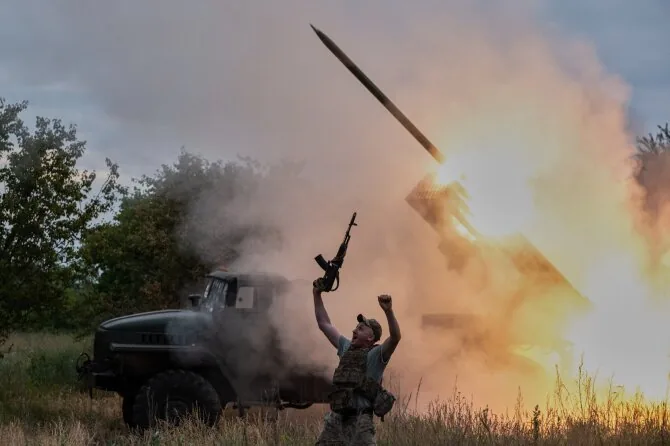
In his assessment, Moscow’s initial goals were huge: “From the very beginning, Russia set for itself that victory meant occupying and enslaving Ukraine. Therefore, anything short of that is a victory for Ukraine, and the very fact that it has managed to withstand four and a half years of this aggression is a huge achievement for Ukraine.”
Although there are disagreements within the Republican Party regarding U.S. foreign policy commitments, the senator says Ukraine remains the key factor in ensuring U.S. security.
“Failure is not an option,” emphasized J. Curtis.
“Putin is a bandit”
He is joined by influential Republican Senator from Florida Rick Scott, who is a member of several key committees and one of the most active in the Senate advocating for increased pressure on the Kremlin.
“Putin is a bandit. What he has done to the Ukrainian people, how many women, children, and elderly he has killed, is simply disgusting. It is important for us to defend freedom. You cannot help but admire the Ukrainian people. Last week, I invited two Ukrainian military leaders here to talk about how they use drones and conduct military operations, and they are truly admirable. If you support what Russia is doing, you should be sanctioned. There is no doubt about that,” Senator R. Scott said bluntly.
“Putin does not believe in personal freedom. Xi Jinping does not believe in personal freedom. The same can be said about Ayatollah [Khamenei], Maduro, Raul Castro, and Kim Jong Un. They continue to cooperate, trying to destroy our way of life,” the senator said.
According to him, that is why support for Ukraine is especially important: “In my opinion, the sanctions bill is a step towards holding Putin accountable. I want Ukraine to win and Russia to suffer defeat. Ukraine is on the side of good, and the Russian government is on the side of evil.”
Alliance of authoritarians
Military expert, retired Rear Admiral Mark Montgomery, co-author of the book “Axis of Aggressors,” speaks about more than 600 cases of cooperation among four authoritarian states – China, Russia, Iran, and North Korea – stating that their cooperation covers military, technological, economic fields, and cyberspace.
“For the most part, we underestimate their level of coordination, so our countermeasures sometimes prove to be insufficiently effective. The U.S. can see this well in the example of Ukraine,” says Mark Montgomery. “Ukraine is fighting not only Russia but also Iran, North Korea, and China. Iran supplies [Russia] with Shahed drones – not only thousands of the drones themselves but also the technology to produce them locally. The Russians are now producing their own drones of this type.”
“North Korea has provided Russia with 12,000 troops, which has been widely discussed. But it has also delivered 5 to 6 million artillery and mortar rounds. That is more than all of NATO has produced in recent decades. Finally, China supports Russian military operations by supplying microelectronics for ballistic, hypersonic, and cruise missiles that are striking Kyiv today,” the expert added.