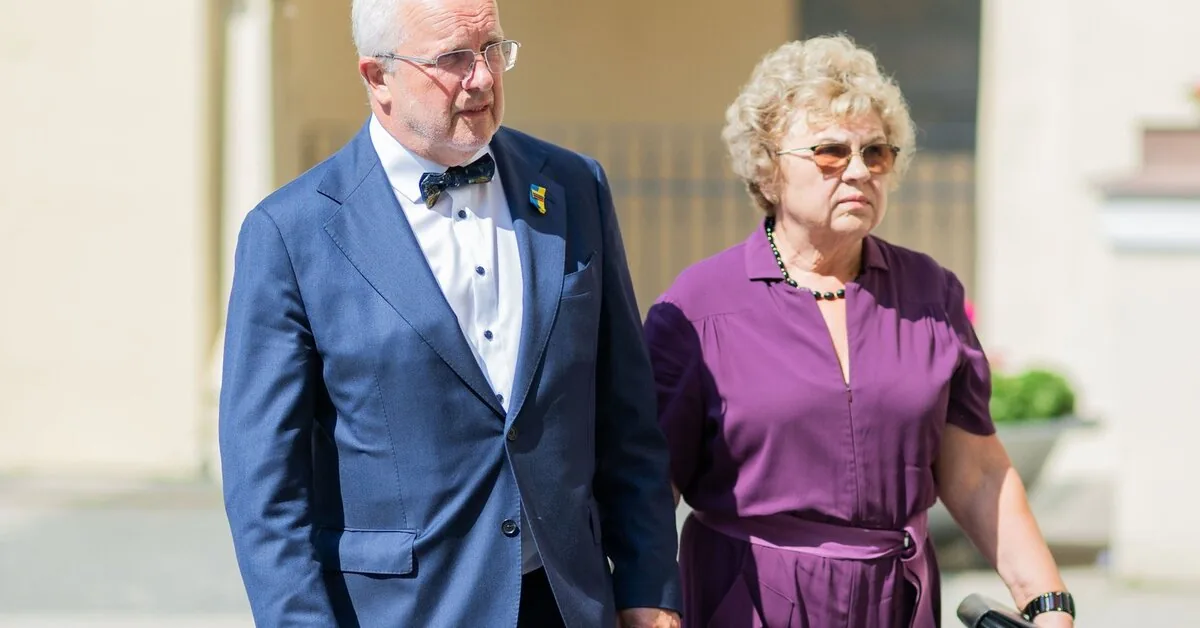
„She was not a boss. She was a leader, a herald, a unifier who inspired everyone to work for Lithuania. She called each of us the prime minister of her field in the first independent Lithuanian Government. She truly encouraged everyone to show initiative and strongly supported those initiatives. She was a person of very democratic leadership,“ the head of parliament, who came to honor the deceased, told journalists.
Read more Gas leak occurred at Varėna «Circle K» gas station
„She united us to work here, in Lithuania, and she carried the name of Lithuania around the world. When it was not easy to cross over, to go to international organizations, to meet leaders of other countries, she, with her professionalism and energy, truly broke the ice by traveling, meeting with leaders of other countries, and carrying the name of free Lithuania,“ he said.
Prime Minister Mindaugas Sinkevičius also came to say goodbye to K. Prunskienė together with members of the Cabinet of Ministers.
K. Prunskienė will be buried on Thursday at Antakalnis Cemetery, in the Signatories’ Hill.
President Gitanas Nausėda will not participate there, as he is working remotely this week from Madeira Island, Portugal.
According to the Speaker of the Seimas, all kinds of situations happen in life.
„I also had plans for today, plans for tomorrow, I managed to change them, the president had other circumstances. I would not want to judge, but I think the president valued Kazimira Prunskienė for her contribution to the creation of a free, democratic Lithuania and for presenting Lithuania’s name to the world,“ J. Olekas assured.
In turn, former head of parliament, honorary chairman of the Lithuanian Social Democratic Party Česlovas Juršėnas said he remembers K. Prunskienė as a very active and serious economic specialist, „who, even in Soviet times, sought, as it was then said, economic independence within the Soviet Union“.
„Kazimira is truly one of the first, one of the brightest stars of the transformation years. And she remained so in my memory,“ said Č. Juršėnas.
Albertas Sinevičius, who served as Minister of Trade in K. Prunskienė’s Government, said that when forming the first Government, the deceased „had the gift of God to choose people she could trust“.
„There were tons of matters, imagine, 30 thousand soldiers, police (…) supplies, blockade declared. But we still managed. (…) There was a goal, how we do it. Each of us tried to convince others according to our abilities how to solve this or that issue,“ said A. Sinevičius.
Read more Industrial producer prices in the euro area decreased by 0.3%, and in the EU by 0.2%.
As BNS wrote, K. Prunskienė died at the age of 83. She was the first head of the Lithuanian Government after the restoration of independence, actively participating in the country’s politics for several decades.
K. Prunskienė, together with other signatories, signed the Act of the Restoration of the Independent State on March 11, 1990, and soon became the first prime minister after the restoration of independence. That year, as Lithuania sought recognition, she met with the leaders of the USA, Great Britain, and France.
K. Prunskienė resigned from the post of prime minister in January 1991, just before the bloody events of January 13 near the Television Tower, when the Supreme Council revoked the controversial decision of her government to raise food prices.
K. Prunskienė was also active in Lithuanian politics in later years – she was a member of the Seimas from 1996 to 2008, and served as Minister of Agriculture in the left-wing government from 2004 to 2008.
She has led the Lithuanian Women’s Party, the New Democracy/Women’s Party, the New Democracy Party, the Union of Peasants and New Democracy Parties, the Lithuanian People’s Party, and during the Soviet occupation belonged to the Communist Party.
In 2012, K. Prunskienė suffered a stroke. After that, her speech was impaired, and she did not return to active politics due to her health condition.
Since the restoration of independence, K. Prunskienė was shadowed by allegations of possible cooperation with the Soviet KGB.
The years-long court marathon ended in January 2011 with the Lithuanian Supreme Administrative Court, which annulled the decision of the Lustration Commission by an unappealable ruling. This commission had previously unanimously recognized that the politician secretly cooperated with the KGB during the Soviet occupation, carrying out intelligence, counterintelligence, and ideological intelligence tasks.
Read more Scandal in Mexico: local celebrity shot during live broadcast