








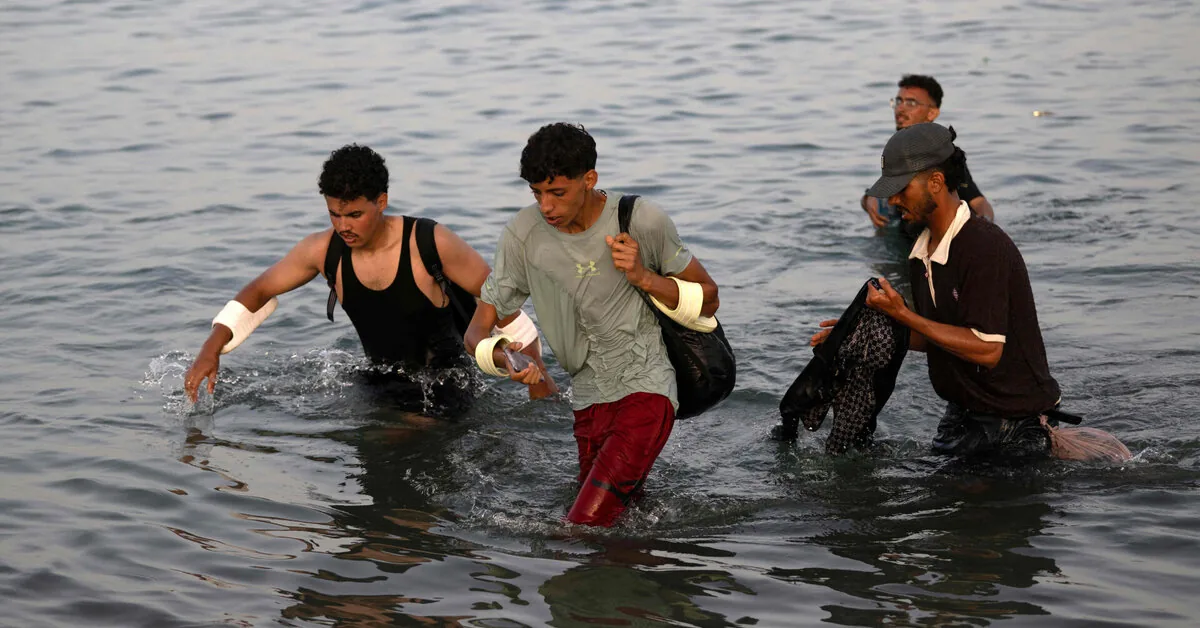
Migrants arrived in Ceuta from Morocco, enclave region president Juan Jesus Vivas told journalists, but by Friday evening officials reported that more than 48,000 of them had already returned.
Read more One of Trump’s most influential people: «We were the ones who came later»
To get into Ceuta, many swam around a small border barrier jutting into the Mediterranean Sea. At least 34 people died trying to do so.
The sudden influx of migrants caused an international crisis.
France tightened checks at the border with Spain and announced it would increase police forces fivefold by Saturday – up to 334 officers and gendarmes.
Italy announced it had suspended the Schengen agreement with Spain, which allows visa-free movement across borders.
Italian officials said the suspension would take effect on Saturday and last for one month.
Several European countries proposed suspending Spain’s membership in the Schengen free movement zone, although Spain’s foreign minister stated that the zone’s integrity is guaranteed.
Across the Atlantic, US President Donald Trump used the situation to push his strict immigration policy.
“Human trafficking mafias”
Madrid urgently sent soldiers, additional police forces, drones, divers, and boats to this post, which it has controlled for centuries, and Prime Minister Pedro Sanchez and his interior minister visited it on Friday.
On the night from Friday to Saturday, AFP journalists observed groups of young people wandering on Ceuta’s beaches and streets. Dozens of men were sleeping on the sand.
The area was concentrated with large police and military forces, and some young people were seen turning around and saying “goodbye” to officers before heading towards Morocco.
Stores in the city were closed, and annual celebrations were canceled.
“It’s a disaster,” said a local taxi driver and Ceuta resident Mohammed.
“Of course, we sympathize with them – the situation in their country is terrible and all that, but this is not the way to get to a place, nor is it a way to live,” he said.
Previous migrant surges occurred amid tensions between Spain and Morocco.
P. Sanchez visited Algeria on July 20 – it was the first such visit by a Spanish government leader in four years, marking a thaw in relations with Morocco’s rival Algeria.
However, it is unclear whether there is any connection between this visit and the recent migrant surge.
Read more Grain farmers: after rain, 10% of cereal crops lodged, harvest will be average
In Ceuta, P. Sanchez blamed human traffickers for the surge, who spread rumors about a decision made last month by the Spanish Supreme Court that illegal migrants arriving by sea cannot be immediately returned.
“From our talks with Moroccan officials, it became clear that human trafficking mafias selfishly interpreted the Supreme Court’s decision,” he said.
Diplomatic consequences
Fear that crowds would enter EU member states caused diplomatic repercussions.
European Commission (EC) head Ursula von der Leyen called the images from Ceuta unacceptable.
“We cannot allow anyone to enter our (European) Union without following our rules,” she wrote on social media.
Finland and Denmark supported Italy’s actions on Friday, while German Chancellor Friedrich Merz demanded that Morocco “immediately accept the return of illegal migrants.”
France and the United Kingdom (UK) stated they are ready to help Spain cope with the sudden influx, although France also tightened border controls.
Portuguese Prime Minister Luis Montenegro said he is considering the possibility of tightening border checks but sees no need to suspend Spain’s membership in the Schengen zone.
Meanwhile, D. Trump warned: “This looks like an invasion of hundreds of thousands of people into the country, and the same will happen to us if Republicans are not elected, only worse, on a much larger scale.”
Spain’s foreign minister Jose Manuel Albares tried to dispel fears, saying that “it is impossible to travel from Ceuta and Melilla to the peninsula without presenting yourself at a police checkpoint,” referring to the two Spanish enclaves in North Africa.
“Enough of this deliberate confusion,” he emphasized.
One crisis after another
Ceuta, an 18.5 sq km territory, and the nearby Melilla enclave are the only two European land borders with Africa.
Moroccan officials have not yet issued an official statement regarding the migrant flow.
During a similar surge in 2021, more than 10,000 migrants reached Ceuta from neighboring Morocco in two days amid a diplomatic dispute between the two countries.
The dispute arose after Spain decided to accept for treatment the leader of the “Polisario” front, whose fighters waged a long war with Rabat over the independence of the Western Sahara region.
The crisis ended in 2022 when Madrid changed its long-standing neutrality policy and supported Morocco’s plan for Western Sahara – a move that caused diplomatic disagreement between Madrid and Algiers.
Read more American Dream, or Why Young People Choose NCAA: «The Conditions Are Simply Out of This World»