She emphasizes that when the nose does not breathe as it should, not only it suffers but the entire body as well.
Read more „Škoda Auto“ maintained second place in Europe, electric vehicle deliveries grew by almost 50%.

Impact on the nervous system
It is well known that the human respiratory system is naturally adapted to breathe through the nose – it lets air into the lungs, warms and moistens it, and cleans it of dust and other particles. However, Dr. E. Morozaitė says that the function of the nose is much broader than just letting air through: “Breathing through the nose helps maintain normal nervous system function, ensures more efficient oxygen absorption, and is important for quality sleep. When the nose is constantly congested or it is difficult to breathe through it, the body adapts – the person starts breathing through the mouth. This usually happens unnoticed, especially at night. At first glance, it may seem that nothing bad happens – after all, air still reaches the lungs. But over time, this way of breathing can have negative consequences.”
In recent years, more and more scientific studies have shown that the way of breathing affects the nervous system’s activity. The doctor emphasizes that constant mouth breathing sends a signal to the body similar to a stressful situation. “In such cases, the sympathetic nervous system becomes more active – the same system responsible for the ‘fight or flight’ response. This can increase the release of stress hormones, especially cortisol. In other words, the body remains in a light state of alert even when it should be resting,” she says.
Sleeping but not resting?
Dr. otorhinolaryngologist often hears many similar complaints from patients: “I sleep eight hours but wake up tired”; “in the morning I feel as if I worked all night”; “my eyes close by themselves in the afternoon.” E. Morozaitė explains that if nasal breathing is impaired, sleep becomes less quality. A person may snore, breathe through the mouth, toss and turn more often, or experience many micro-awakenings that they do not even remember.
“Studies show that increased sympathetic nervous system activity during the night is associated with higher blood pressure during sleep, more frequent awakenings, and reduced deep sleep duration. Deep sleep is one of the most important phases for the body’s recovery. Therefore, a person may sleep enough hours, but the brain and body do not get the rest they need. The result is morning fatigue, lack of energy, and the feeling that sleep was not restorative,” says the doctor.
Mouth breathing during the day
The way of breathing is important not only at night. When breathing through the nose, the diaphragm works more actively, breathing becomes slower and deeper, and parasympathetic nervous system activity dominates in the body. This state is associated with calmness, energy conservation, and more efficient body function.
“Meanwhile, mouth breathing often becomes faster and more superficial. The body remains as if ready to respond to a threat, even though there is no real threat. This can cause increased anxiety, internal tension, difficulty concentrating, and quicker fatigue.
Moreover, scientific studies show a connection between nasal breathing and brain activity. It has been observed that people better recognize emotions, more accurately interpret other people’s facial expressions, and remember information more effectively when breathing through the nose rather than the mouth. This means that nasal breathing is important not only for the lungs. It is directly related to our concentration, memory, emotional state, and ability to function effectively,” says otorhinolaryngologist E. Morozaitė.
What to pay attention to?
Asked when it would be worth considering an evaluation of nasal breathing, the doctor urges to pay attention to such symptoms: often feeling a stuffy nose, one nostril almost always breathing worse, sleeping with the mouth open, dry mouth in the morning, snoring, often feeling unrested, quickly running out of breath during exercise, constantly using nasal drops.
Read more «Apple» briefly became the most valuable publicly traded company in the world
“Unfortunately, many people get used to such symptoms. After a few or several years, they no longer remember what it means to breathe freely through the nose,” she says.
One of the most common reasons why patients have poor nasal breathing is a deviated nasal septum. It can be congenital, develop during growth, or occur after trauma. Poor nasal breathing is also caused by enlarged inferior nasal turbinates, which narrow the airways. Breathing can also be worsened by allergies, chronic inflammation of the nasal mucosa, polyps, or other anatomical changes.
Treatment options
E. Morozaitė advises people with difficulty breathing through the nose to consult RVUL with a referral from a family doctor for a thorough nasal examination and individually selected treatment.
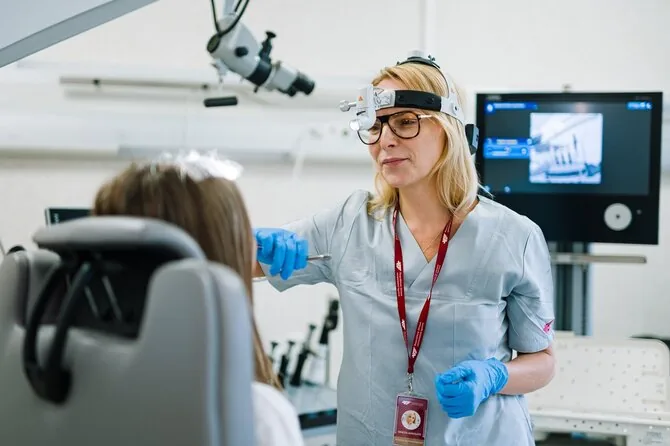
“First, during the otorhinolaryngologist consultation, we assess the nasal cavity – the Ear, Nose, and Throat department has a modern workstation with an endoscope that helps accurately determine the cause of the breathing disorder. If necessary, we can also prescribe additional tests, such as allergy testing or radiological examinations.
Depending on the diagnosis, we apply conservative or surgical treatment. For example, in cases of mucosal swelling, allergy, or chronic inflammation of the nasal mucosa, medication treatment is prescribed – sprays affecting the nasal mucosa, nasal rinses, allergy control, and other individually selected measures.
If a deviated nasal septum or enlarged inferior nasal turbinates are diagnosed, surgical procedures may be recommended – septoplasty, reduction of the inferior nasal turbinates, or a combination of these procedures. In cases of polyps or chronic sinusitis, modern endoscopic surgical treatment may be considered. The goal of treatment is not only to ‘open’ the nose but also to restore as natural and quality nasal breathing as possible and to return patients’ quality of life,” says Dr. E. Morozaitė.
Read more Police called for Gyčius Volkavičius and one of his three wives