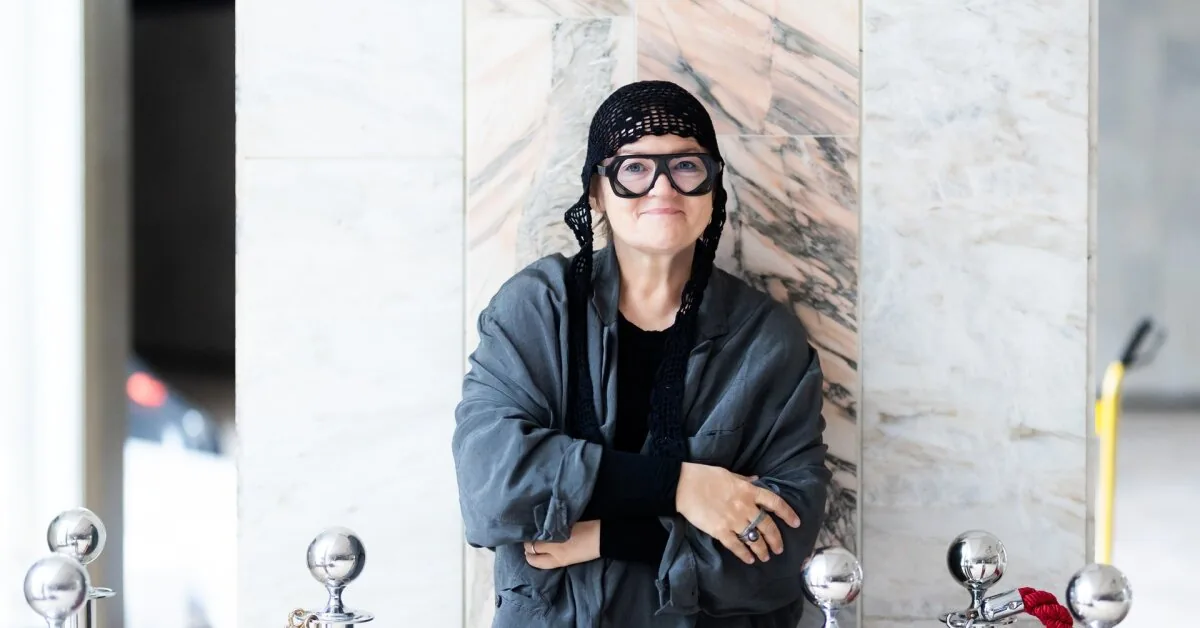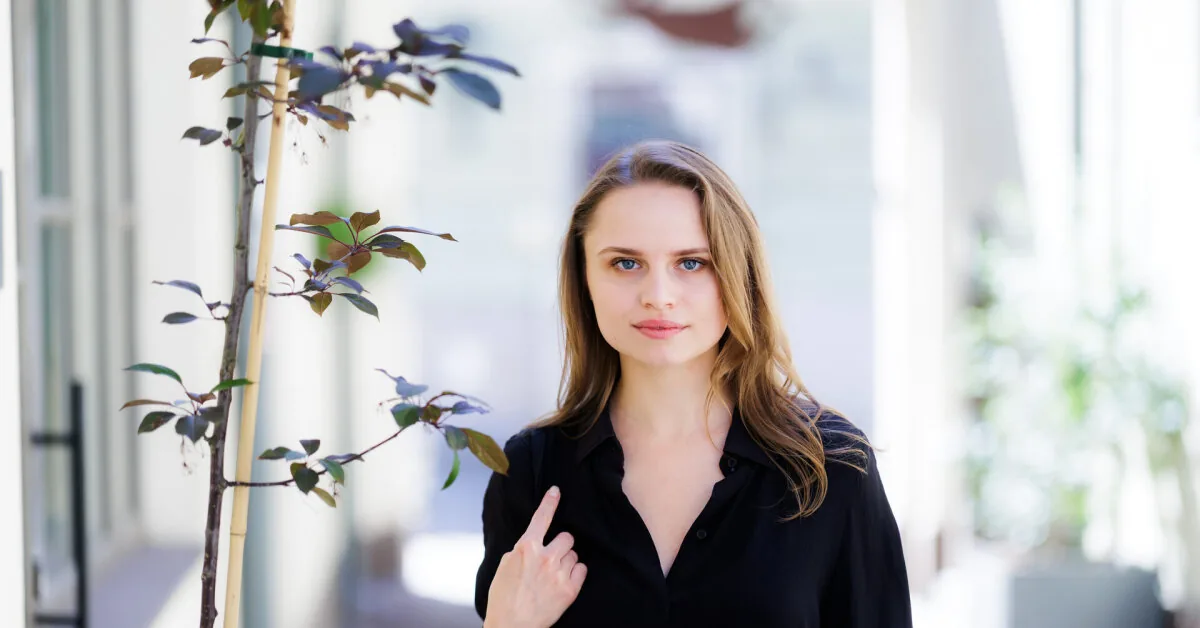
However, behind the fragile, fairy-tale image hides an incredibly strong, grounded, and purposeful personality. Andrėja grew up in a vibrant core of a family of creators, where art was daily bread, and authorities were within reach. Still, an early awakened desire to be independent and find her authentic voice pushed her forward – she started working while still in school. This determination led her to the most unexpected cultural spaces: at the Opera and Ballet Theatre, she painted huge photo walls, creating the illusion of stage magic with her own hands for others.
Read more Rare disease suffering Morta’s parents: «Her heart was 4 times bigger than it should have been»
Today Andrėja navigates among the great cultural waters of the country – her daily life flows working at the National Philharmonic. And yet, the same Preila wind and the ability to see miracles in everyday life live within her. About creative transformations, summer travels, and the ability to simply switch off – a conversation with Andrėja.
Artist Andrėja Puskunigytė is interviewed by Aneta Anra.
The Path to the Philharmonic
– Your work constantly balances between two states – sometimes you are the one who stays in the shadow: supervising the hall, painting scenography, creating photo walls that serve someone else’s vision. And sometimes you are clearly visible – as an independent visual artist with your own authorial voice. Let’s start with that first, invisible side. I am very interested in your work at the Lithuanian National Philharmonic. Tell us, how did you end up there? Did it happen right after school, when you started studying at the Vilnius Academy of Arts?
– I started working while studying in the second year. Before that, I often attended Philharmonic concerts myself. I had an acquaintance at the Academy who was already working there; we would meet and greet each other. At one point, I caught myself thinking that it was an incredibly impressive, somehow charming job. Half-jokingly, half-seriously, I said: “If a position opens up, I would gladly come.” It so happened that soon that position became available, and I dived in.
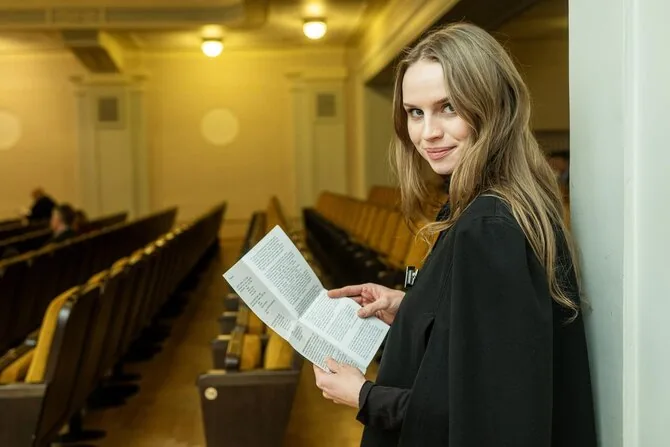
– Did you consciously want exactly this position – to be by the doors, in the cloakroom, in the hall? Or were you simply attracted by the Philharmonic space itself?
– I wanted exactly this place. I was fascinated by the idea of becoming that invisible space actor who can not only listen to top-level concerts but also be close to people. I felt that it was a very simple, I would say, ascetic occupation. At that stage of life, I really wanted a certain stable refuge where the requirements are clear and minimal – you have to be polite, pleasant, hospitably welcome the arrivals, and that’s it.
Moreover, at that time, a kind of diaspora from the Academy of Arts had formed at the Philharmonic. Several students from VDA worked there, many of whom had worked there before. A very beautiful community was created, united not by music but precisely by the art direction. I remember, when I first came, I asked a colleague how long she had been working there. She replied: “Already six years.”
At that time, it seemed incredible to me how one could stay in such a position – seemingly temporary, an intermediate stage of student life – for so many years. And today I am counting my fifth season and have not felt how time has passed. This job has become such a natural part of everyday life that I absolutely do not want to leave.
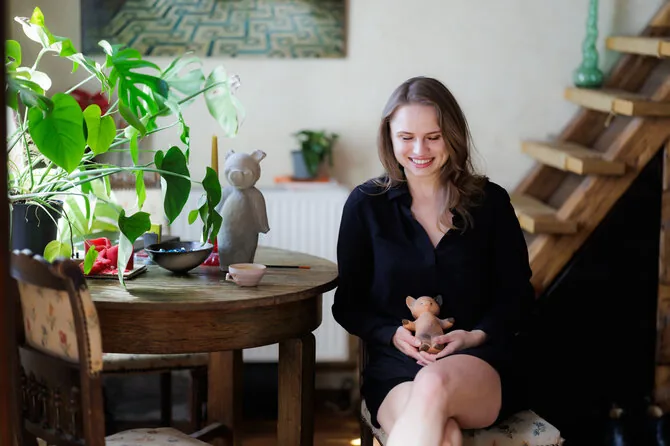
– Your family is very artistic. Your mother Patricija Jurkšaitytė is a famous painter, your father Marius Puskunigis is a television scenographer. It is likely that there was no financial hardship or insistent parental pressure to find any job as soon as possible. What motivated you to seek this independence?
– There was no huge necessity, but financial independence, even partial, has always mattered to me. Since adolescence, I tried to get involved in various projects, contribute at least minimally, just to have money I earned myself.
I understood perfectly that choosing a creative path would probably be financially winding. Therefore, the Philharmonic became a security guarantee for me, a kind of backup. I knew: even if I had no other orders or additional creative projects, this job would cover me. This allowed and still allows me to avoid creative compromises – I do not have to take on projects my heart does not desire just to survive.
– So, this job can be called very positive: after all, you come to a beautiful space, meet bright, cultured people, listen to a wonderful concert, and part with that space until next time. This allows you to save all your main creative energy for other things?
– Yes. This job does not psychologically burden the mind with extraneous matters. True, I also work in administration, so responsibilities increase a bit – I have to be reachable if something needs to be coordinated logistically, to pass information to the team. But this is a very small part of my work.
The essence is to warmly welcome people who come to the Philharmonic as to a celebration. At that moment, you exchange positive energy with them. Although the work during the concert is often intense, after it, I do not feel emotionally exhausted. The Philharmonic environment itself radiates a certain uplift. So I can confidently say that I rest at work, even if I have to perform many small tasks.
– What is your work schedule? Are you at the Philharmonic during every concert?
– I am at the Philharmonic for every concert, but it is mostly evening work. After completing all other daily tasks, I come here, and my day ends very beautifully.
I can confidently say that I rest at work, even if I have to perform many small tasks.
– Let’s try to visualize your professional daily life. Imagine: today is Friday, there will be a concert at the Philharmonic. What do you do, where do you change, and how do you prepare for the evening?
– We arrive half an hour before the main doors open to the audience. First, we have to inspect the space, check if everything is tidy and prepared. In our office, we put on uniforms and exchange the latest information. Since I am one of the team coordinators, I have to pass on management’s instructions about the upcoming evening: I inform how many visitors we expect, the event duration, order, which distinguished guests are coming, and what we need to prepare for.
And when the doors open and visitors start pouring in, the beautiful part begins. We warmly welcome everyone, help find seats, direct them to the café or other necessary points. Of course, we have to react instantly to incidents. It happens, though very rarely, that inadequate or intoxicated persons come. We are the ones who must notice this and politely but firmly ensure their escort out.
After the concert, everyone stands by the doors again and sees the audience off. And here a wonderful moment opens: although you are that “invisible actor,” after the event, people very often come up and sincerely thank us for the experienced evening. Then you feel that you also contributed to that good experience. Of course, sometimes there are complaints, but in the end, we absorb many pleasant emotions.
– Where are you during that solemn moment – the concert itself?
– Usually, I am in the hall. I supervise invited guests, check lists to see if everyone is in their seats, and, of course, observe the general order. It is both a great opportunity to listen to music and a necessity to react to the audience’s behavior.
When Unexpected Things Happen in the Hall
– There are hundreds of people sitting in the hall, and probably not everyone knows the unwritten rules of the concert hall. What unexpected situations do you most often encounter during a concert?
– Everything happens in the hall. As if on purpose, if important concert recordings are taking place, someone always forgets to turn off their phone, handbags fall, cloakroom numbers drop, or candy wrappers rustle. It is hard to fight such moments because you hear the echoing sound in the hall, but it is difficult to catch exactly where it comes from. I even have one recommendation for Philharmonic visitors: if you want to unwrap a candy, maybe it’s worth doing it in one quick move rather than slowly. Then the rustling lasts much shorter and distracts others less.
It is very pleasing that various people dare to approach classical music, and the concert can become an opportunity to learn more about audience etiquette principles.
A similar phenomenon is applause between parts of a piece. It is hard to control because mass psychology works here: it is enough for one person in the hall to start clapping, others think the piece is over, and the wave instantly gains momentum. Then half the hall applauds, and the other half sighs, realizing the integrity of the piece is broken. If it is seen that this happens in the first part of the concert, before the second part, the audience is subtly reminded to refrain from applause between parts – sometimes this works perfectly.
From my experience, the audience strongly depends on the concert itself and the program played. Some concerts more often gather a regular audience who know listening etiquette well. During such concerts, we have no problems. But there are events attracting a broader audience, who may be visiting the Philharmonic for the first time and simply do not always know the unwritten rules. But it is very pleasing that various people dare to approach classical music, and the concert can become an opportunity to learn more about audience etiquette principles.
– Have any special, quirky situations with the audience stuck in your memory over these five years?
– Yes, once we had a visitor we were informed about in advance by the administration. It was a concert of a foreign musician; the soloist confided that during tours in different countries, he often encounters a woman pretending to be his wife. This guest does not miss any of his concerts and tries in every way to sneak backstage after the event, falsifying her identity and close ties with the musician. Having received this information, we quickly strategized a defense plan in case we had to deal with the mentioned visitor. And indeed, after the concert, she appeared backstage, trying in every way to justify the need to meet and congratulate the soloist. We listened to the arguments and prudently escorted the guest out of the hall, but I must say it was not easy.
And if we talk about more serious challenges, sometimes at the Philharmonic, we have to deal with people fainting. Not long ago, during a concert of the Dutch pianist brothers’ duo in a packed hall, a girl felt unwell in the middle of the hall. She managed to leave with an escort to the foyer and began losing consciousness there. We called an ambulance. While the medics were on their way, the girl regained consciousness – and, being fascinated by the concert, firmly refused to go to the hospital and returned to listen to the second part. In such moments, you have to react quickly, with a cool mind, to help the person but not cause panic.
– Do you, the hall staff, undergo special training on how to act in such cases?
– Yes, we all take first aid courses, although in a real critical situation, that theory instantly evaporates from the mind. The best practice is to call paramedics and follow their instructions precisely until the team arrives. Later backstage, we even joke that the special, brilliant concert was to blame – the performers played so well that they simply “switched off” the person out of admiration.
And if we talk about more serious challenges, sometimes at the Philharmonic, we have to deal with people fainting.
– Do you meet many familiar people?
– Yes, often. And paradoxically, those who are not from the cultural field – they work completely different jobs but attend concerts as if with a subscription. Sometimes it’s the opposite – some distant acquaintances simply do not recognize me, do not connect that we met in another environment. Here I am just that somewhat seen hall employee for them – having an alternative identity at the Philharmonic.
At one time, concert photos were hung in the foyer. I saw a couple I often noticed in the hall because they made a big impression on me – such elegant, older people. Under the photo, I saw the surname – Pšibilskiai. I thought maybe they were related to my godfather Liutauras, who now lives outside Lithuania, but I knew his parents were here. I asked my parents, and they confirmed: yes, these are indeed the people. At one event, I decided to approach them and pretend I was their somewhat indirect relative. I think the unexpected meeting was very pleasant for them, as it was for me.
– Are there listeners who come up, talk, ask what you do in life?
– Yes, there definitely are. It is very nice that there are such interested people. They are often surprised to learn that neither I nor my colleagues come from the music world. But I really enjoy navigating between my specialty and what is not fully familiar to me.
– And where did music come to you? Why the Philharmonic, and not, for example, some theater?
– I think I feel good here because it is completely different from what I do in life – a completely different environment, a different logic of the place. When I have to take on the role of a scenographer myself, naturally, coming to the theater, I bring a certain professional perspective. I analyze visual solutions, which is very interesting, but it changes the relationship with how the work is experienced. And at the Philharmonic, it is good to be a guest, allowing yourself not to have a competent opinion, just to receive and enjoy what you hear sincerely and live. Here music has nowhere to hide; there is only sound and its source, and scenography becomes the space itself.
I really enjoy navigating between my specialty and what is not fully familiar to me.
– What concerts do you like the most?
– Mostly symphonic with the National Symphony Orchestra. I am extremely fascinated by the multidimensionality of these concerts when many different voices turn into one musical fabric. Sometimes I get to observe the rehearsal process, during which the dialogue between the orchestra and the conductor unfolds, bringing a new perspective of seeing/listening. Repeated musical phrases, subtle, and sometimes strict comments reveal a dynamic, precision-demanding, and all-concentrated path to the concert climax.
Opera Theatre Photo Walls
– Your other world is the Opera and Ballet Theatre, where you paint photo walls for premieres. How did you get there?
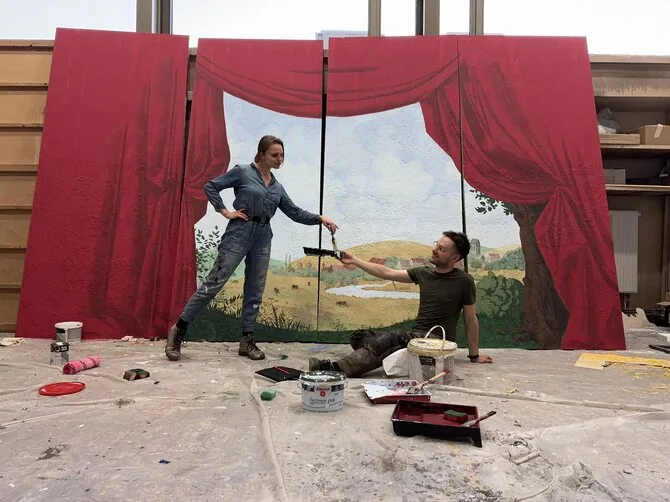
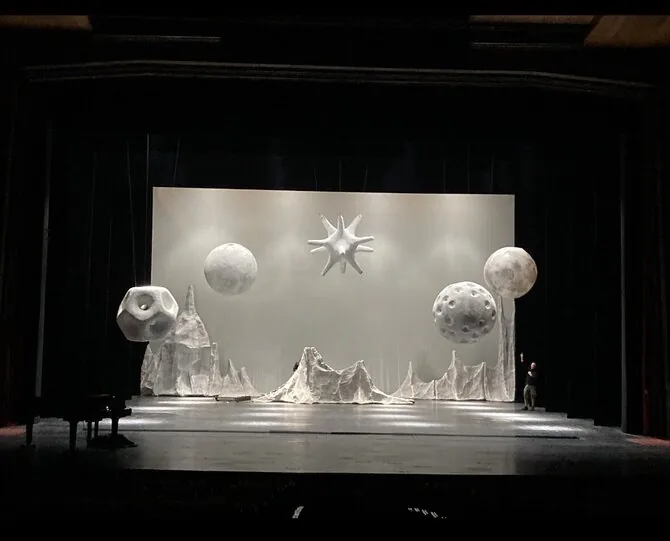
– It is more of a project-based job – I am invited when needed, preparing for premieres. The theater has a very beautiful, still alive tradition: hand-painted photo walls are prepared for premieres, whose design reflects the work and scenography. I ended up there quite unexpectedly – I was invited to create scenography for the musical performance “Dolce far niente” (Sweet Idleness). Gradually, I got to know the theater community, and the advertising department, learning that I paint, started inviting me to prepare photo walls.
Those walls are like a ticket to the theater for me. At the same time, it is a good opportunity to give my hands work, remember the times at M. K. Čiurlionis School of Arts, and return to realism.
It was also a wonderful opportunity to get to know the theater from the inside because it attracted me since childhood; then, of course, I wanted to be a ballerina. It is very interesting to observe what a complex apparatus it is and how beautiful it is when traditions are maintained, for example, painting huge curtains in the studio. Seeing this handwork, later you see the scenography itself in the performance differently – you understand that people fulfilled that picture stroke by stroke. The same goes for costumes: the viewer’s eye sometimes does not even notice that they are sewn from extremely high-quality fabrics brought from abroad with unique patterns.
Those walls are like a ticket to the theater for me. At the same time, it is a good opportunity to give my hands work, remember the times at M. K. Čiurlionis School of Arts, and return to realism.
– What does the process of painting the wall look like?
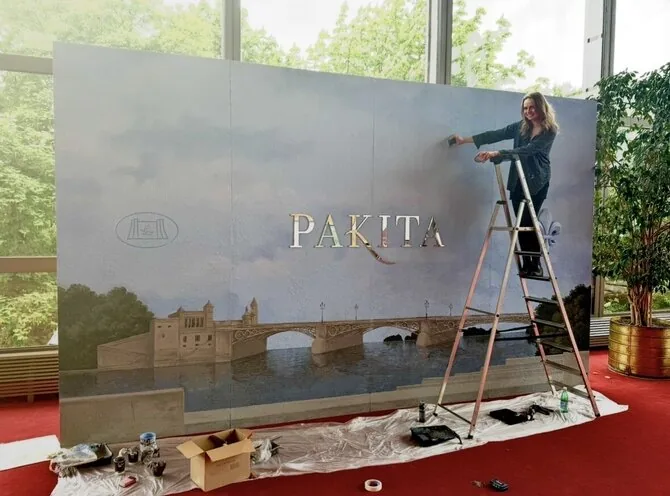
– Usually, we go straight to the visual things. I know the plot, the general story, but I go to talk in detail with the scenographer’s assistant, who describes the vision: what materiality is important for the performance, what colors. Sometimes we borrow additional elements from props so that the wall standing in the foyer becomes like an extension of the scenography, a kind of announcement of the performance. Although it is just a small detail in the context of the whole performance, it seems very important because it strongly represents the premiere – before each presentation, there is anxiety whether I hit the aesthetics. So far, everything has gone smoothly; I have not had to repaint yet.
– Where do you paint, and how big is the wall usually?
– Everything happens at the theater, in the theater props studio. The wall is usually three meters high and five meters wide: a stand made of several fragments, which is repainted layer by layer. My colleague and I joke that if we tried to peel off that canvas, under it we would find many past premieres. It somewhat resembles old advertising billboards in the city, where a poster was glued on top of a poster – there is even some kind of Buddhist temporariness and constant change moment.
My colleague and I joke that if we tried to peel off that canvas, under it we would find many past premieres.
On average, painting the wall takes about a workweek or longer, depending on the complexity of the picture. The schedule is completely free; we usually come after working hours when there are no other employees and stay until the theater closes, basically until eleven in the evening. It is a very interesting feeling when the building empties, and you remain the last actor in the theater. You just wait for some ghost in the empty corridor.
– You said “we” – who do you paint with?
– Sometimes with my boyfriend Jokūbas Adomonis, who also graduated from the Sculpture Department. We have various joint projects, work on film shoots, and have naturally formed a team. Besides, he himself is a mime artist at the Opera and Ballet Theatre – another of his roles. Sometimes he acts out a rehearsal or performance, then changes into work clothes, comes back to me, and we paint together. In this respect, he is probably even more rooted there than I am.
– Speaking of work, you have worked quite a lot with director Agnė Ambrozaitytė? Your latest joint work, which left a strong impression on me, was the mourning play “Tearful Words” shown at Menų spaustuvė – here you created scenography and video projections.
– You could say it is a coincidental tandem. We started when Agnė approached me while still studying at the academy, in Oskaras Koršunovas’s course, staging Anton Chekhov’s “The Seagull.” I myself was not fully immersed in the field of scenography yet, but she, being a beginner director, knew me a bit and asked for minimal help to visually solve her sketch. From that first job, it naturally happened that we keep working together, communicating, understanding each other.
– When you create scenography, do you feel like a less visible part of the performance? The audience often only sees the final result – actors, musicians, while the backstage and the people creating it remain in the shadow. Paradoxically, even children of recognized scenographers sometimes ask: “Daddy, what do you really do?” When they get the answer that “everything that is on stage,” they are sincerely surprised: “So you even made that chair yourself?”
– Yes, I agree, sometimes there is such a moment. But, for example, working with Agnė, we maintain an equal dialogue – she lets me into the directorial dialogue as much as I let her into scenography. Of course, after premieres, most of the audience from outside do not think about who created the scenography – that is the nature of this specialty, you are basically a backstage worker. But I accept it very naturally, perhaps because I also develop my individual artistic practice, so I do not feel wronged if I sometimes remain less visible in the theater – I realize myself elsewhere, and here I just allow myself to be a secondary actor.
Identity Between Several Worlds
– If I asked you – who are you? Which of your activities would you highlight the most?
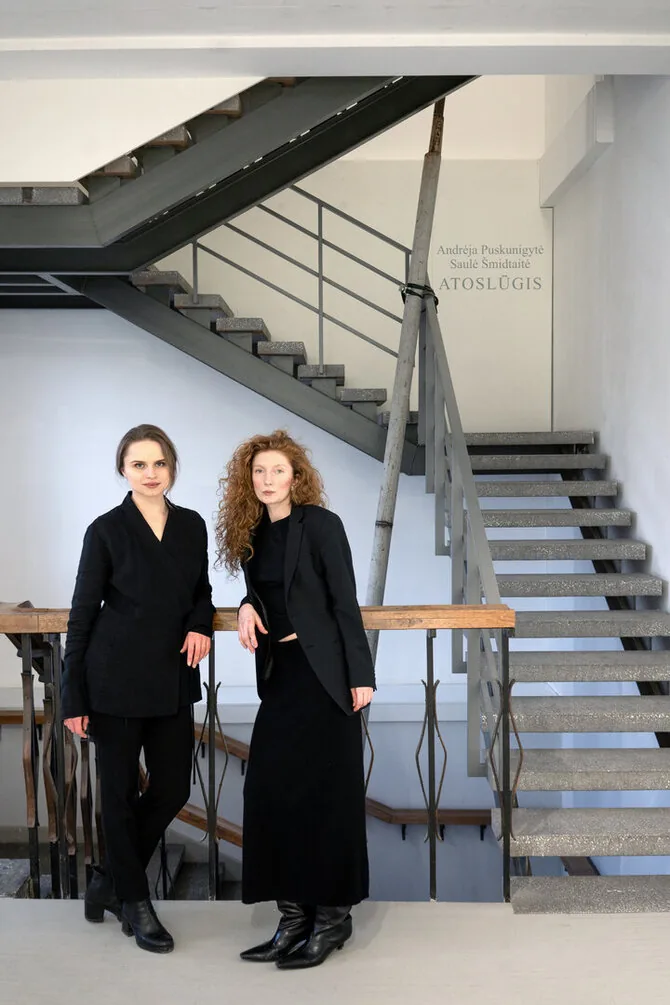
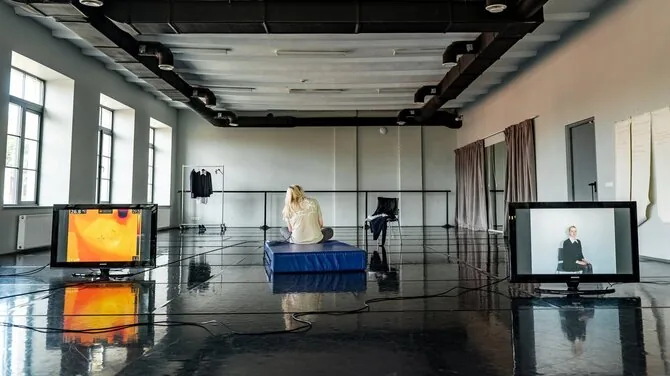
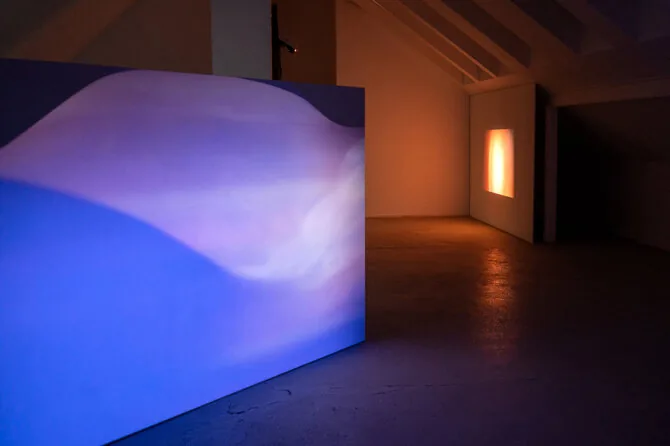
– I would say I am a visual artist. This term seems to me to encompass both the field of scenography and my personal creative practice, which mostly revolves around video and sculpture. However, the role of a Philharmonic employee is also close to me; I am glad that with some people, the connection was established precisely through this institution.
I am a visual artist. This term seems to me to encompass both the field of scenography and my personal creative practice, which mostly revolves around video and sculpture.
Sometimes I reflect on this doubling of my identity. It is really hard to present myself as a whole. For different needs, I have different portfolios ready; even on social networks, it is difficult to represent myself as a unified identity. On the other hand, for a young creator, this is a natural need to find their style and place in the market. Many of my friends engage in various activities and are not fully defined by one professional territory. I currently feel comfortable navigating between these roles: from the contemporary art field, theater spaces to commercial film art. I think you can find points of contact in different fields because you bring your unique perspective and experience to every new environment; everywhere, it is you.
– But you have many acquaintances in the art sphere, you grew up in an environment where countless guests constantly visited your home, and your mother’s exhibition openings took place. How much does this help, and how much does it hinder?
– I try to maintain as objective a relationship with this aspect as possible. True, from a young age, I personally got to know most of the well-known cultural figures, but I never wanted to abuse any privileges. Although I respect my family very much, it has always been very important for me not to identify only with my parents’ name; I wanted to work on my personal artistic expression, create autonomy in the cultural field. I believe that I get exhibition opportunities not because I am my parents’ daughter but because someone is interested in the content I create. This has always been a sensitive point for me.
Family and Preila
– From the outside, your family – you, your mother, your sister Sibilė – looks like a united, very strong creative core. How has your relationship with your mother changed over time?
– That relationship has transformed very beautifully. The teenage rebellions and questioning of authority were replaced by a completely different, horizontal dialogue. Today we communicate not only as mother and daughter but also as two creators, colleagues. We support each other a lot, especially during creative crises; sometimes I take care of her, sometimes she takes care of me. The age difference simply melted away in some places because we experience very similar joys, similar problems, and are in similar searches.
– Your mother is currently not only resting in Preila but also working intensively, painting iconographic paintings for churches. How does she find balance between this sacred creation and the everyday life by the seaside?
– My mother is really immersed in this painting – it is a sacred process requiring a certain depersonalization and huge discipline because iconography follows completely different laws than authorial creation. And the balance is helped by Preila itself and its everyday life. In reality, there is a lot of simple, physical work, real farming. When you get tired of thoughts or creative uncertainty, it is good to just throw yourself into everyday chores, work with your hands.
Over the years, Preila has become a place for people from various environments and contexts to gather.
– How much time do you spend in Preila yourself?
– Although conditions to be by the sea have been eased, paradoxically, the hustle and bustle of Vilnius often does not let go. But I still spend a week or two in Preila during the summer. It is a special place for me: as soon as I arrive, I somehow “switch off,” you can just do nothing, look at the horizon, clear your thoughts, and everything calms down. It is a huge, very valuable contrast to the city pace.
– What plans do you have for this summer?
– Until the end of June, I worked intensively at the Philharmonic, and after the festival, I will immediately go to the seaside. Later, we have a beautiful family tradition – all together, parents, I, my sister Sibilė, and my boyfriend Jokūbas rent a van and travel to France to visit old friends who were once our neighbors in Užupis. The car gives complete independence; we can choose the route ourselves, not rush, and stroll through French flea markets.
Leaving the parents in France with friends, my boyfriend and I plan to return to Lithuania in a completely different way – slowly, by trains. We want to find a new travel rhythm and continue this summer adventure.
Read more Champion evaluated Žalgiris’ newcomer from Nigeria: «A logical and interesting move»