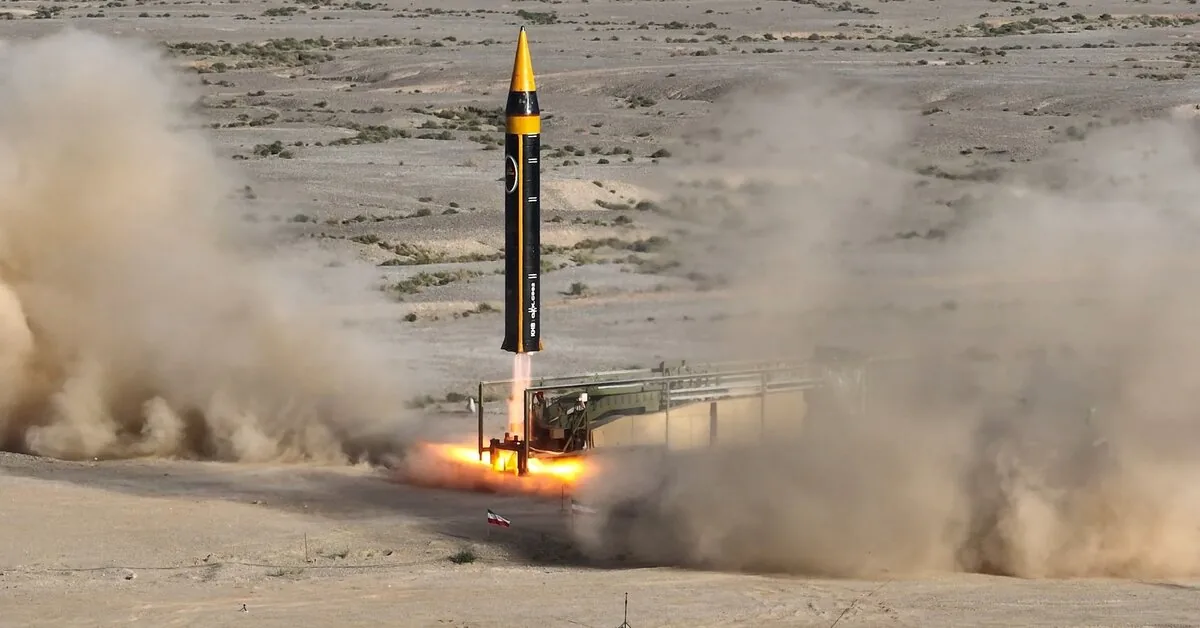
It is noted that Iran’s missiles “Ghadr,” “Emad,” and “Sejjil” can fly about 2,000 km, so, launched from northern regions of Iran, they could theoretically reach targets in Ukraine. Meanwhile, “Khorramshahr” is the longest-range missile of this class – during tests, it demonstrated the ability to cover up to 4,000 km.
Read more July 28 Horoscope: Saturn invites you to pause and evaluate your choices
The “Ghadr” and “Emad” missiles are based on the “Shahab-3,” which in turn originated from North Korea’s “Hwasong-7” missile, developed on the basis of the Soviet R-17 “Elbrus.” Both missiles are single-stage, use liquid fuel, and have a separable warhead weighing about 750 kg. Their launch mass is about 19 tons, and length is 16.6 meters.

The newer version of “Emad” uses a warhead with aerodynamic surfaces, which, according to Iran, can maneuver during flight. However, this slightly reduced the missile’s range – during 2021 tests, it flew about 1,800 km.
“Sejjil” differs from earlier models in that it is two-stage and uses solid fuel, allowing it to be prepared for launch more quickly. The missile is larger – its launch mass is about 26.6 tons, length 17.6 meters. At a range of 2,000 km, it can carry about 700 kg of warhead, and for shorter distances – up to 1,500 kg.
Experts pay special attention to the “Khorramshahr” missile, first introduced in 2017. It is believed to be based on North Korea’s BM-25 “Musudan” (Hwasong-10), which originated from the Soviet submarine-launched missile R-27.
“Khorramshahr” is a single-stage liquid-fueled missile with several modifications. The approximately 2,000 km range version can carry up to 1,500 kg warhead. Modifications with a range of up to 4,000 km, about which Iran has long remained silent, likely have a smaller warhead mass.
Additionally, Iran developed a special warhead with submunitions for this missile, which has already been used in attacks against Israel. Its characteristics essentially correspond to cluster munitions – it contains up to 20 separate combat elements that disperse within about an 8 km radius from the main warhead. This design is intended to destroy large areas and complicate the operation of missile defense systems.
Specialized missile defense systems such as THAAD, “Arrow-2,” and their newer versions are required to intercept Iran’s medium-range missiles. Meanwhile, the “Patriot” system’s capabilities to combat such missiles are limited and depend on many factors – missile speed, flight trajectory, and the warhead’s ability to maneuver.
Read more Azerbaijan continuing repression against media imprisoned journalists, NGO workers
Regarding “Khorramshahr,” experts note that interception success depends on the moment when the warhead with submunitions separates. Since this missile has been used rarely, the exact parameters of this process are currently unknown. To defend against such missiles, Israel has used “Arrow-2” and “Arrow-3” systems, and the US – THAAD and SM-3.
At the same time, “Defence Express” notes that Iran’s missile potential has significantly decreased due to large-scale strikes on Israel last year and this year, as well as Israeli and US attacks on Iran’s launch facilities, warehouses, production capacities, and missile component factories during Operation “Epic Fury.”
Iran’s threats to Ukraine – what is known
On July 27, the chairman of Iran’s parliament National Security Commission, Ibrahim Azizi, threatened Ukraine, stating that Tehran will not leave without response actions directed against Iran, and that Ukraine will “soon understand this.”
On the same day, Ukrainian President Volodymyr Zelensky stated that Iran is effectively already participating in Russia’s war against Ukraine by supplying the Kremlin with “Shahed” drones, their production technologies, and other weapons. The president also emphasized that Ukraine must act cautiously and prevent the opening of a new war front.
Tehran’s threats came after on July 25, Ukraine’s Security Service (SBU) reported Ukrainian drone strikes on the Russian missile boat “Molniya” (project 12418), as well as cargo ships “Port Olya 2” and “Begey,” which are subject to international sanctions and were used to transport military cargo between Iran and Russia.

On the same day, Iran’s Ministry of Foreign Affairs condemned the strike on the ship in the Caspian Sea and stated it reserves the right to defend its “national interests and security.”
On July 26, Iran’s Foreign Minister Abbas Araghchi also threatened V. Zelensky. He stated that the strike was a “gross violation of the UN Charter” and claimed that Israel gave the order to carry it out, aiming to involve Europe in its war.
Read more After Zelensky’s statement – Trump’s response: «I will ask Putin»