The Labor Code does not establish a separate right to a ‘smoking break’
R. Joskaudienė emphasized that the Labor Code does not contain a separate concept of a ‘smoking break’. Neither the duration nor the number of such breaks, nor the employer’s obligation to provide additional paid rest time to a smoking employee, is established.
Read more 220,000 people evacuated in France due to massive fire
“The State Labor Inspectorate, commenting publicly on this issue in 2025, also stated that smoking breaks are not an independent type of break established in the Labor Code. They are not automatically considered either lunch breaks or physiological breaks – except when an employee smokes while legitimately using an already granted break.

Therefore, the mere fact that an employee smokes does not give them the right to leave their workplace at their discretion, and the employer does not have an obligation to provide additional paid time to satisfy nicotine needs,” the lawyer explained.
What breaks must the employer provide?
Smoking breaks should not be confused with mandatory breaks enshrined in the Labor Code.
Physiological breaks are granted according to the employee’s needs. They are intended for essential human physiological needs, such as using the restroom or drinking water. Physiological and special breaks are included in working time and must be paid.
Special breaks are granted due to working conditions and occupational risks – for example, when working outdoors in very high or low temperatures, performing heavy physical work, work involving high mental strain, or work exposed to occupational risks. They are also part of working time.
A lunch break must be granted no later than after five working hours. It cannot be shorter than 30 minutes and longer than two hours. During this time, the employee can usually leave the workplace, and this break is not included in working time and is not paid.
If, due to the nature of the work, it is not realistically possible to provide an employee with a lunch break, the employer must provide an opportunity to eat during working hours – in which case this time is included in working time and is paid.
“Important: an employee cannot unilaterally decide that every desire to smoke is a physiological break guaranteed by the Labor Code. The VDI’s position is that smoking breaks are not intended to replace physiological breaks,” R. Joskaudienė emphasized.
When can an employee smoke?
An employee can smoke:
– during a lunch break, if smoking is not prohibited in the chosen location;
– during an additional short rest break set by the employer;
– at a time permitted by the employer and only in a designated place;
– without leaving the workplace in a way that would disrupt customer service, the production process, employee safety, or the work of other employees.
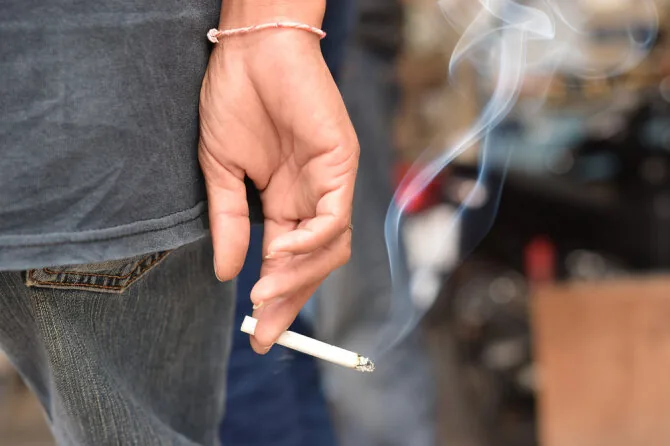
“The employer can stipulate in the internal work rules that smoking is allowed only during a lunch break, only at a specific time, or only with the direct supervisor’s permission. The employer can also stipulate that additional smoking breaks are not allowed or that all smoking on the employer’s premises is prohibited.
The VDI has stated that the employer has the right to establish permitted smoking areas, restrictions, prohibitions, and other smoking-related requirements in local normative legal acts. Employees familiarized with these rules must comply with them,” the lawyer said.
Is the employer obliged to provide a smoking area?
The law primarily obliges the employer to ensure the protection of non-smoking employees, clients, and visitors from tobacco smoke.
Article 19 of the Law on the Control of Tobacco, Tobacco Products and Related Products of the Republic of Lithuania prohibits smoking in workplaces located indoors. Special smoking rooms or areas may be provided in companies, but this provision does not automatically grant an employee an individual right to demand a smoking area or an additional break.
The prohibition also applies to electronic cigarettes. Furthermore, in educational institutions, social service institutions providing services to children, and healthcare institutions, smoking is prohibited not only indoors but also on their premises.
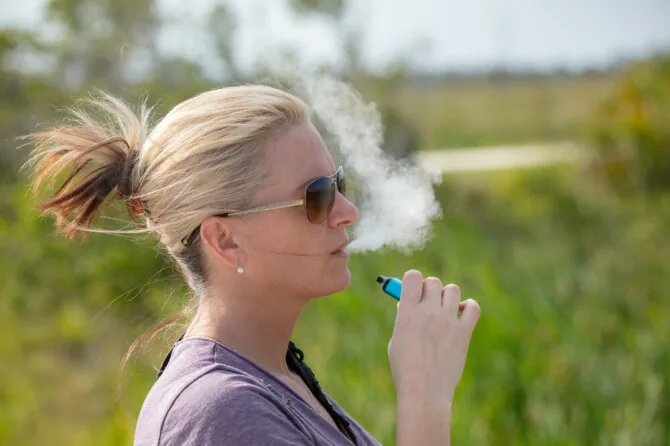
Thus, according to R. Joskaudienė, the employer’s duty is not to “create conditions for smoking,” but to ensure that employees and other persons are not forced to breathe air contaminated with tobacco smoke.
What should be stipulated in the internal work rules?
A legally sound and practically effective procedure should clearly answer:
– whether additional short breaks are allowed during working hours;
– how many times and of what duration they can be;
– whether they are included in working time;
– whether the employee’s time at work must be extended accordingly due to them;
– who and how permits leaving the workplace;
– who replaces the employee at that time;
– where smoking is allowed and what path can be taken to the smoking area;
– whether the same rules apply to electronic cigarettes;
– what consequences arise from non-compliance with the established procedure.
“From a legal and organizational perspective, a safer solution is to establish not a privilege only for smoking employees, but equal short rest breaks for all employees, clearly regulating their duration and accounting.
A cigarette should not become a ‘ticket’ to additional paid rest that a non-smoking colleague does not have,” R. Joskaudienė noted.
Read more Musician Juozas Šarkauskas, a member of the ensemble ‘Serbenta’, has died
Who is responsible for unworked time?
The employee must:
– comply with the work schedule and internal work rules;
– not leave the workplace arbitrarily;
– smoke only at permitted times and in a designated place;
– not leave clients, equipment, or the work process unattended;
– comply with employee safety and health requirements.
If an additional smoking break, according to the employer’s established procedure, is not included in working time, this must be determined in advance, actually recorded, and properly reflected in the work schedule and accounting. The employer should not, at the end of the month, arbitrarily calculate supposedly “lost minutes” and impose a monetary fine on the employee.
Deductions from an employee’s wages are only possible on the grounds established by the Labor Code or other laws. An arbitrary monetary sanction for smoking is not a legitimate disciplinary measure.
Can an employee be dismissed for going out to smoke?
In R. Joskaudienė’s assessment, non-compliance with the established smoking rules can be considered a violation of work duties. The employer can record it, request an explanation from the employee, and evaluate all circumstances.
However, a single short exit to smoke does not automatically mean lawful dismissal from work.
Article 58 of the Labor Code links the termination of an employment contract due to the employee’s fault with:
– a gross violation of work duties; or
– a second identical violation of work duties committed within the last 12 months, when the first violation was properly established and the employee was warned about possible dismissal.
When deciding on dismissal, the severity of the violation, its consequences, the employee’s fault, specific circumstances, their previous conduct, and work results must be assessed. Dismissal must be a proportionate, not an automatic, measure.
“The situation could be assessed differently if, for example, an employee arbitrarily left a dangerous device, cash register, security post, patient, or other object requiring supervision, and real consequences arose as a result,” the lawyer commented.
What did court practice show?
A significant situation was examined in the decision of the Panevėžys Chamber of the Regional Administrative Court on March 23, 2020, in administrative case No. eI2-481-283/2020.
An employee, after taking out the trash, went to smoke and slipped on an icy path on the company’s premises while returning. The employer claimed that the employee had no right to smoke during working hours and was acting in her personal interests.
The court upheld the VDI’s conclusion that the incident was work-related: it occurred during working hours, on the employer’s premises, and while the employee was under the employer’s authority. The court also found that the company had not established clear and consistent smoking rules, even though the employer knew that some employees smoked.
However, responsibility was not assessed unilaterally: the VDI found that the employee herself also violated internal rules by smoking in an undesignated area. At the same time, insufficient organization of employer safety control and an underestimation of the risk of slipping were identified.
This decision cannot be interpreted as recognizing a universal right for employees to smoke during working hours. Its essence is different: an employer cannot tolerate unclear practices for a long time and then claim ignorance when an accident occurs. In a labor dispute, not only written rules but also the actual organization of work are evaluated.
Practical examples
An office worker works from 8:00 AM to 5:00 PM, with a lunch break from 12:00 PM to 1:00 PM.
If additional smoking breaks are not stipulated in the internal work rules, the employee does not have an automatic right to leave the workplace four or five more times. They can smoke during their lunch break or at a time explicitly permitted by the employer.
A salesperson or customer service employee wants to smoke.
Even if the employer allows short breaks, the employee cannot leave the cash register or customers unattended. First, a replacement must be ensured, and the established departure procedure must be followed.
A hospital or school employee wants to smoke on the institution’s premises.
Smoking is prohibited by law in such areas. A lunch break does not override this prohibition. An employee could leave the premises only if, according to the work organization and the established break, they have the right to do so.
An employee working outdoors in hot weather is granted a special break.
The break is granted due to occupational risk and employee health protection, not because the employee smokes. When using it, it is also mandatory to comply with the smoking area and other rules established by the employer.
Read more Iran reports progress in talks with Oman on the management of the Strait of Hormuz