Commentators turned the conversation to weather modification
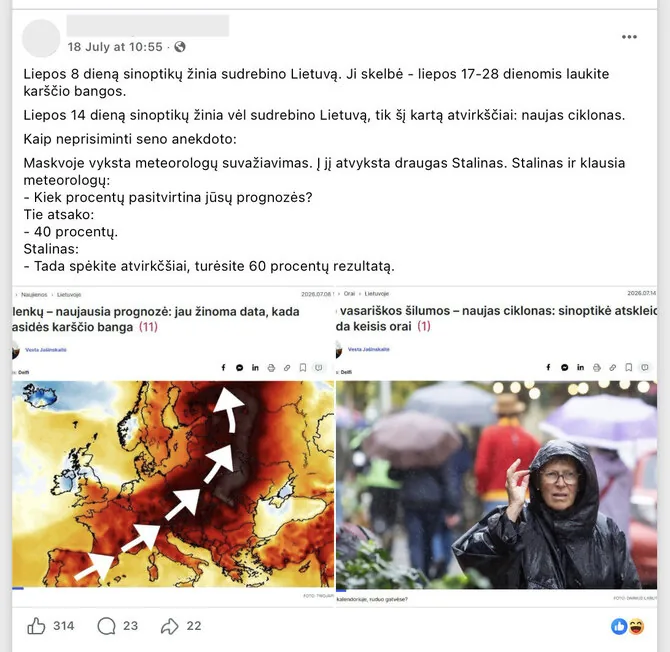
One Facebook user shared two screenshots of articles about the upcoming weather on Saturday, July 18, and commented on them as follows: “On July 8, the meteorologists’ message shook Lithuania. It announced – expect a heatwave from July 17-28.
On July 14, the meteorologists’ message shook Lithuania again, but this time in reverse: a new cyclone.”
After that, he also told an anecdote about the Soviet Union’s dictator Joseph Stalin, who allegedly taught meteorologists how to predict the weather so that their predictions would be as accurate as possible.
Also read: Are heatwaves, cold snaps, and other weather anomalies really artificially created?
Thus, it can be understood that the internet user was mocking meteorologists whose forecasts do not always come true. Commentators went even further – they began to explain that the weather is supposedly being deliberately changed. This is a conspiracy theory that has been circulating and remembered for several years.
“Weather has long been created. Those forecast “announcers” get info from the main station; no one in Lithuania has been observing anything for a long time. As they succeed in modifying the clouds, so it will be. They try to do one thing, but it doesn’t always result in causing some anomaly,” one woman stated.
A Facebook user, reacting to her words, agreed that “they adjust what they are ordered to”.
“For example, in Germany, within a radius of only 100 km, large hurricanes with hail passed through in one place, uprooting trees (as in other countries, the entire annual norm of precipitation fell (flooding, destroying fields and crops)), while elsewhere, not a drop fell for 6-7 weeks, there you have new technologies – geoengineering,” he wrote.
“There’s a lack of money for geoengineering. “Forecasts” become inaccurate…” another internet user continued in a similar vein. “This summer, summer was allowed in twice for 3 days, and everyone had to tremble in fear of its presence,” another commentator complained.
Also read: Catastrophic downpours are considered human work, but those truly responsible are not blamed
According to the woman, who apparently studied meteorology herself, “since the weather is being modified, forecasts need to be changed to new forecasts”.
Another commentator added: “Over the years, those forecasts are getting less and less accurate… they barely guess for the next day, and even then, not always correctly…”
Poles warned about the heat
The aforementioned Facebook user shared screenshots of two messages from the delfi.lt portal. The first, as he ironically quoted, spoke of an impending heatwave. However, neither the headline nor the user’s post mentioned that it was about Poland.
“The latest long-term weather models show that in just a week, the country (Poland – ed. note) could be hit by an extremely strong heatwave, and some calculations do not rule out temperatures of even 40-45 degrees,” wrote the portal’s journalist.
She emphasized that these are only long-term forecasts from the European Centre for Medium-Range Weather Forecasts (ECMWF) and US GFS models, which may change as the predicted period (in this case, July 16-20) approaches.
The text mentioned that long-term models also predicted warmer weather for Lithuania. However, not the same heatwave, but 24-28, at most 30 degrees.
Understand instantly
Summer changes its face: revealed how long significantly cooler weather will last in Lithuania
After a relatively calm Sunday – a sudden break: the new week will bring stormy weather
The weather will cool down next week, rain will water more often
Heavy rain waters Aukštaitija and Žemaitija, Vilnius mobilizes additional forces
“Meteorologists remind that forecasts made more than a week in advance are not final,” the text noted. “Different digital models often present varying scenarios, and temperature forecasts will become more accurate.”
Also read: Why Europe was covered by a heat dome: internet users groundlessly search for answers in Alaska
There were indeed several articles on this topic in the Polish media. The Polish radio portal, relying on the aforementioned GFS model, warned of a possible 45-degree heat, which would be a record for the country.
The TVN24 channel portal compared this July’s weather to a roller coaster, although European weather is supposedly “trying to maintain rhythm and style”.
The possible heat in Poland was also written about on the portal “Wiadomosci”, the website “Fani Pogody” and elsewhere.
Weather kept changing
The July 14 text quoted “Meteo LT” warnings about impending thunderstorms in Alytus and Vilnius counties and meteorologist Elvyra Latvėnaitė.
The rest of the country had summery weather – only localized short-term rains, light winds, and temperatures of 22-27 degrees were promised.
According to E. Latvėnaitė, Lithuania was then affected by the western edge of a cyclone, which is why summery downpours formed in some places, while in others, dark clouds only briefly covered the sky. That day, she wrote similarly on her Facebook account.
In several previous posts (since the aforementioned July 8), the meteorologist spoke about bad weather caused by cyclone “Bernadette III”, later rejoiced at the return of warmth. Soon after, E. Latvėnaitė began writing about stormy weather that was supposed to arrive from other European regions and affect Lithuania.
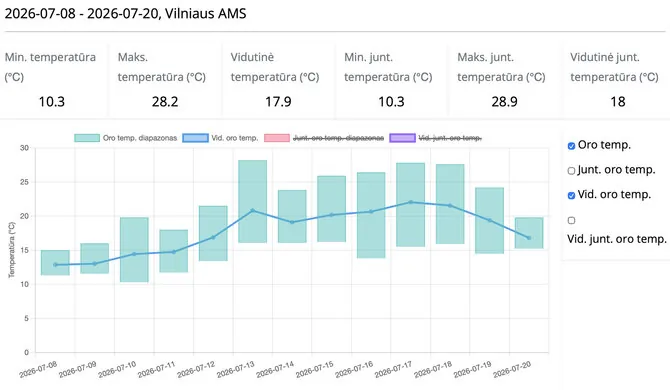
Since July 8, Lithuania has experienced fairly typical mid-summer weather with intermittent rains and thunderstorms. The average temperature during this period reached 17-18 degrees, with the highest daily temperature ranging from 18 to 29 degrees.
Historical data published by “Meteo LT” shows that the hottest day in the past couple of weeks was last Monday, July 13.
Thermometer readings in Vilnius climbed up to 29 degrees exactly on that day, according to information published on the “Time and Date” website. The heat was accompanied by rain, lightning, and thunderstorms.
Patents were again a sticking point
Another falsehood was mentioned in the comments to the aforementioned post about changed weather forecasts.
Also read: New evidence of geoengineering found: what do dozens of weather modification patents really mean?
One internet user shared a list of patents related to weather in one way or another. He claimed it confirms the implementation of geoengineering, as well as, as repeatedly asserted on social networks, the existence of so-called “chemtrails”.
The long list mentions weather modification devices and methods, but it proves nothing – the existence of a patent does not mean that the invention has actually been implemented. This post is related to the conspiracy theory that governments manipulate weather, even, for example, by creating devastating hurricanes.
Also read: Is the mysterious HAARP, supposedly causing natural disasters, really in the photo?
Also read: Was Milton, the strongest hurricane of the year, really artificially created?
15min verdict: lacks context. The post juxtaposed different forecasts – about the heat expected in Poland and the rain promised in Lithuania, so there is no basis to claim that meteorologists contradicted themselves.
The publication was prepared by 15min in cooperation with “Meta”, aiming to curb the spread of misleading news on the social network. More about the program and its rules – here.