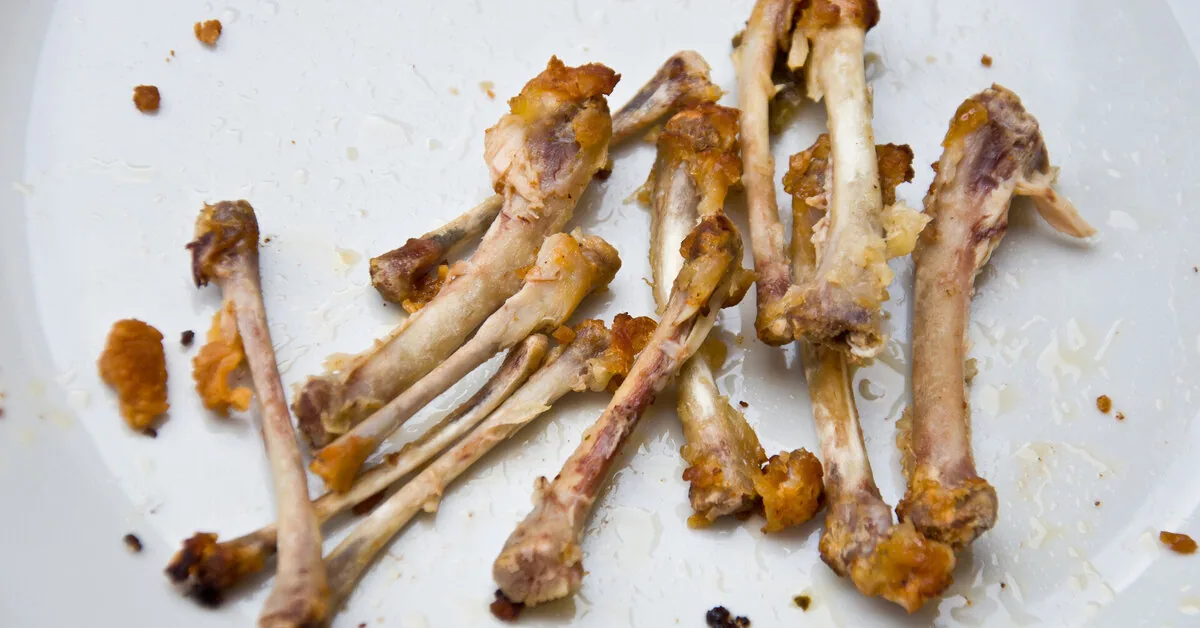
There are often claims such as “fish bones can be eaten,” “chicken bones are dangerous, but pork bones are not,” and so on. We also know that dogs like to chew bones, and various world cuisines have many recipes that use the meat near the bones or bone marrow.
Read more A new study reveals what happens in the brain when cannabis is used daily
“People often think that if some animals can chew bones, it is safe for humans to eat them as well. However, the main danger lies not in the chemical composition of the bones, but in their physical properties,” explains Mindaugas Matijūnas, a doctoral student at the Faculty of Chemical Technology at Kaunas University of Technology (KTU CTF).

According to him, our teeth are not able to effectively chew bones, so swallowing them can easily cause choking. Moreover, a partially broken bone has sharp branches that can damage the mucous membranes of the throat, esophagus, or stomach. This is especially relevant when the stomach is not empty, as the contents inside can press the bone even more against the mucosa. For these reasons, specialists do not recommend eating bones.
Why are the bones of different animals not the same?
Bones are a composite compound made up of a hard inorganic phase and a soft organic matrix. The hard phase consists of calcium and phosphate compounds, while the soft phase is collagen. The ratio of these components depends on the species of the animal, diet, and genetic factors, so even bones of animals raised under the same conditions can differ.
Scientists distinguish two main groups of animals based on bone differences – vertebrates and invertebrates. Although the chemical composition of their bones is very similar, the structure of the mineral phase differs. Vertebrate bones are dominated by hydroxyapatite, while invertebrates have amorphous calcium phosphate.
Amorphous calcium phosphate dissolves more easily, so the body can more effectively absorb the calcium and phosphate it contains. Meanwhile, hydroxyapatite is insoluble. Fish, birds, cattle, and pig bones mainly contain hydroxyapatite, so the differences in these animals’ bones are usually related not to the mineral but to the organic part and physical properties – size, thickness, or surface area.
Read more Tapinas assessed the chaos in the country’s basketball: «Brezhnev reincarnated into Balčiūnas»
What happens in the stomach?
Once in the stomach, the organic part of the bone is broken down by enzymes into amino acids. This process is called proteolysis. Since the composition of organic substances in the bones of different animals is not the same, the products formed during their breakdown also differ.
“The human body is not adapted to actively break down the hard phase of the bone. However, the acidic environment of the stomach can change the crystalline structure of hydroxyapatite into more soluble forms – monetite, brushite, monocalcium phosphate, or amorphous calcium phosphate,” says M. Matijūnas. Due to this process, some calcium and phosphates dissolve and can be absorbed by the body.
Can eating bones be beneficial?
Bones contain a lot of calcium, so the effect of this element is primarily noticeable. One gram of bone contains about 0.2–0.4 g of calcium. Dietitians recommend not consuming more than 1 g of calcium per day, so theoretically this limit can be exceeded by eating just a few grams of bone. Long-term excessive calcium intake can lead to hypercalcemia – a dangerous condition where the safe calcium concentration in the blood is exceeded.
However, scientific studies show that even consuming about 18 g of bone per day does not cause a significant response in the body. It has not yet been precisely determined what portion of the calcium in bones the human body actually absorbs.
From a scientific point of view, bones are not completely indigestible – some of the minerals they contain can be absorbed by the body. However, the main problem remains not the nutritional value but the physical risk. Due to the possibility of choking or damaging the mucous membrane of the digestive tract, specialists do not recommend eating bones. So, although eating bones is not necessarily harmful, the benefits of their consumption usually do not outweigh the potential risks.
Read more EU extended the price cap on Russian oil in an effort to reach a sanctions agreement