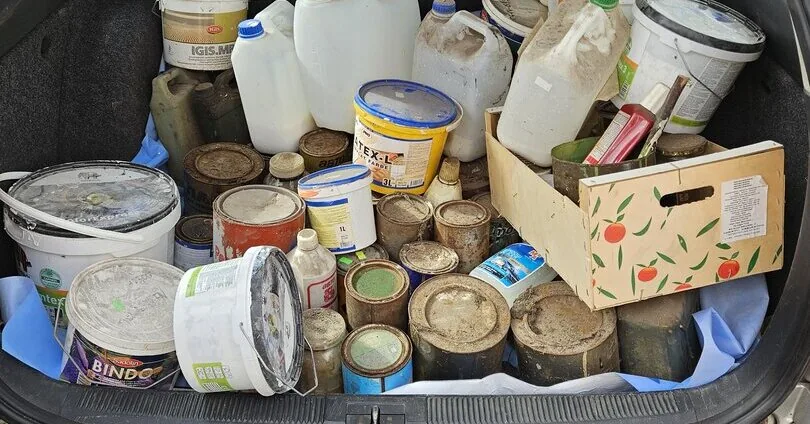
The most waste was collected in the Klaipėda district – more than 31 tons. In Šiauliai, residents delivered more than 12 tons, in Alytus – more than 8 tons. The largest share consisted of materials left after repairs, car maintenance, and household work: about 21 tons of paint and varnish waste, about 15 tons of oil waste, as well as contaminated packaging, wipes, sorbents, filters, and other materials that may pose a danger to the environment and human health.
Hazardous waste still enters the general municipal waste stream
According to the established procedure, hazardous waste generated in households should be collected by a round-trip method or delivered to bulky waste collection sites, the operation of which is coordinated by municipalities. However, in practice, such infrastructure alone is not always sufficient: some residents lack information, have to travel further to the nearest site, others do not have suitable transport or accumulate too little waste to plan a separate trip for it. Unfortunately, hazardous waste is still not collected at all or is collected inefficiently by the round-trip method in some municipalities.
For these reasons, hazardous waste remains at home or ends up in mixed municipal waste containers along with non-hazardous waste. If they are not identified and separated in time, such materials can contaminate the general waste stream, complicate sorting, and pose a threat to soil, pollute water, cause fires, or various hazardous chemical reactions.
“It is preliminarily estimated that improperly sorted hazardous waste in Lithuania may account for up to 3% of the total annual municipal waste amount – that would be up to 30 thousand tons per year. When such materials end up in landfills along with non-hazardous waste, the problem transfers to the entire waste management chain and becomes a public safety issue,” says Arūnas Dirvinskas, General Director of “Toksika.”
Clean-up campaigns help collect waste and change habits
According to him, clean-up campaigns organized by “Toksika” show that residents tend to responsibly take care of hazardous waste when they have a clear and easily accessible opportunity to hand it over. Pre-announced dates, convenient locations, and understandable information help collect larger quantities, especially in regions where the nearest waste reception site is not conveniently accessible for some people.
Such campaigns also highlight a simple but important lesson: when collection is organized considering residents’ needs, results are better. Convenience in this case is not an additional condition – it is one of the conditions for hazardous waste not to end up where it should not be.
A. Dirvinskas is convinced that these campaigns also act as practical education. Concrete examples – an old paint can, solvent residues, or an oil container – help residents better recognize which household materials are hazardous, how to store them, and where to safely hand them over. Such clarity reduces the likelihood that they will end up in the general municipal waste stream.
Clearer regulations are needed in municipalities
“Hazardous waste collection should not depend solely on individual campaigns. A clear, predictable, and easily understandable system for residents in municipalities would allow such waste to be handed over regularly,” says the head of “Toksika.”
Read more For air travelers – important changes: what changes await?
According to him, municipalities have the duty to ensure that hazardous waste generated in households is collected in ways accessible to residents, including collection by the round-trip method. However, practice shows that this duty is not implemented equally effectively everywhere: in some municipalities, residents are provided with clearer opportunities to safely hand over hazardous waste, while in others the system still resembles a formal service provision rather than a convenient service for residents.
“Today we carry out this work together with municipalities, but in the long run, more leadership should be taken over by the municipalities themselves. Residents should not have questions about where, when, and how to safely hand over hazardous waste generated in households. When the system is clear, people use it, and hazardous materials do not end up where they should not,” says A. Dirvinskas.
“Toksika” is one of the initiators proposing to improve or newly define the hazardous waste collection system from residents.
What residents should know
During campaigns, residents are reminded that old paints, varnishes, solvents, oil, car filters, chemicals, batteries, accumulators, electronics, medicines, pesticides, mercury-containing devices, asbestos waste, and contaminated packaging must not be thrown into mixed municipal waste containers.
Before handing over, hazardous waste should be stored tightly – preferably in original or clearly labeled packaging. Different materials should not be mixed, and damaged packaging should be placed in an additional container or bag to prevent spillage, scattering, and environmental contamination.
Before transporting waste to the collection site, it is worth checking what is accepted, in what quantities, and at what times – this will help avoid unnecessary trips.
Read more In search of Kurtinaitis’ successor for the Lithuanian national team – two strategists say «no»