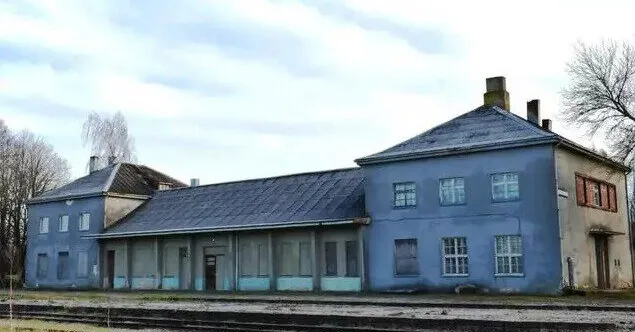
At that time, the Skuodas district municipality, having started a strict fight against abandoned plots, has included the former railway station area in the list of problematic objects. However, a fourfold increased land tax cannot be applied to this state-owned object, so the municipality can only demand that the area be properly maintained.
Read more ES imported a record amount of LNG from the Russian Yamal complex
Rumors about demolition
Recently, there have been talks in Skuodas that the old railway station may be demolished. However, “LTG Infra” does not confirm such plans at the moment.
“The entire Skuodas station complex located by the Skuodas railway line is currently unused but not closed. This means that the buildings formally remain in operation, although no real operations are carried out there,” the company’s communications partner Domas Jurevičius told VE.lt.
According to him, the Skuodas station building belongs to a group of objects whose future is still being evaluated.
“Decisions about its fate will be made considering the legal status, infrastructure needs, and rational use of the property,” said D. Jurevičius.
The company also claims that the area is maintained as needed.
“We understand the municipality’s and eldership’s remarks, so we will continue to strive to ensure that the area is maintained according to the applicable requirements,” he stated.
However, such answers raise more questions than provide clarity for local residents. In their opinion, it is hard to understand why, despite investing hundreds of millions of euros annually in railway infrastructure, the station building, which is over a century old, is left to decay.
Problematic object
Skuodas town elder Ieva Gembutienė says that the former railway station area has been among the city’s problematic objects for several years.
According to her, the auxiliary buildings are in poor condition, and the station building itself clearly spoils the cityscape.
However, the situation is somewhat alleviated by the fact that the station is on the outskirts of the city, so it does not catch the eye daily as abandoned buildings in the city center do.
This year, the Skuodas district municipality decided for the first time to fight more strictly against owners of abandoned territories. Nearly a hundred objects were included in the preliminary list of abandoned plots. Their owners are first warned and given 30 days to tidy up, and if they fail to do so, a fourfold higher – 4% – land or land lease tax rate is applied.
However, this measure applies only to private owners and state land lessees. The increased rate does not apply to state-owned objects such as the railway station area.
Nevertheless, the eldership can demand that the area be maintained, and administrative liability may be applied for neglecting its maintenance.
The end of history
The history of the Skuodas railway dates back to the First World War, writes krastogidas.lt. The Bajorai–Skuodas–Priekulė railway line was laid in 1915 by the German army for military purposes. On September 20 of the same year, the first steam locomotive arrived in Skuodas, and soon the railway station began operating.
This railway line connected the Klaipėda region with Latvia and became one of the most important transport arteries in the region. Until 1932, the main railway route connecting the temporary capital Kaunas with the seaside ran through Skuodas.
Later, after a direct Kretinga–Klaipėda railway section was laid, the importance of Skuodas began to decline.
Historical sources indicate that the current brick station building was constructed in the fourth decade of the 20th century. Different sources mention the years 1930 or 1936.
The beginning of the end of the Skuodas railway history was March 23, 2001, when the last passenger train passed through the town.
In 2009, freight transport on the Darbėnai–Skuodas section was also discontinued.
Since then, various levels have repeatedly discussed the possible revival of the railway, the establishment of a tourist route, or other uses of the station for public needs. However, none of the plans have turned into real actions.
Read more „Bigbank“ lends 20 million euros for the „Nativo Resort & Spa“ project in Palanga