






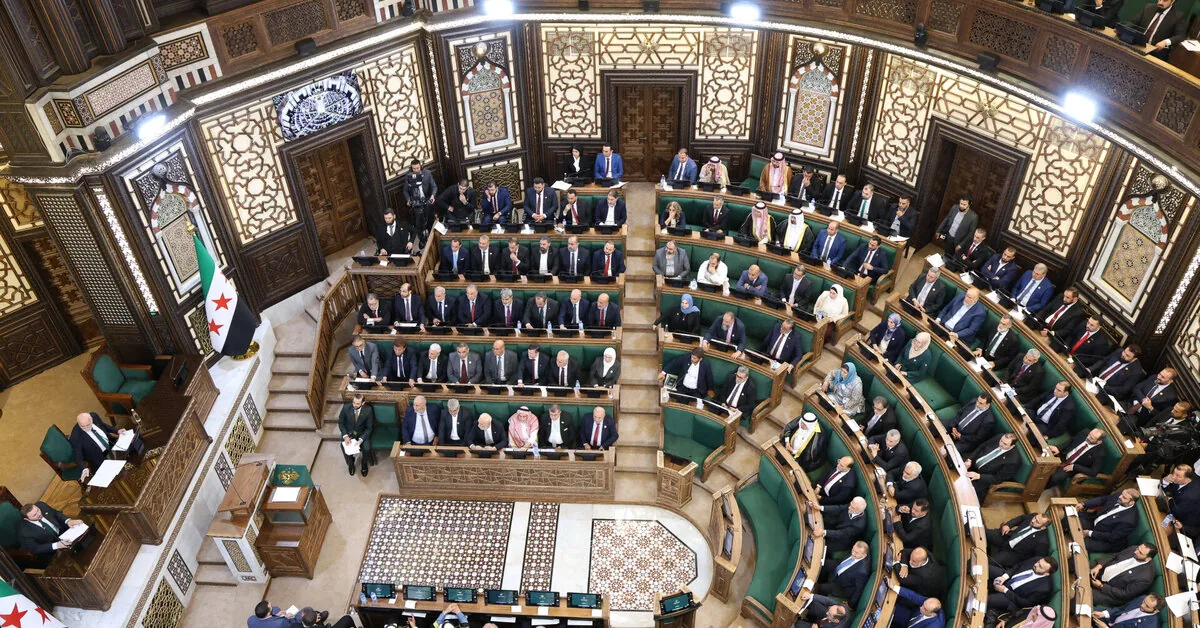
This parliament is tasked with drafting the country’s new constitution and laying the foundations for democracy after decades of authoritarian rule.
Read more Gargždai continue to create miracles in the Lithuanian league: rose to second place
The new Syrian authorities dissolved the country’s formal legislative body after overthrowing longtime ruler Bashar al Assad in December 2024, and adopted a temporary constitutional declaration for a five-year transitional period.
Last October, in a process criticized as undemocratic, local committees appointed by the election commission – itself appointed by President Ahmed al Sharaa – began selecting two-thirds of the 210 new parliament members.
The remaining 70 members were appointed last week by President A. al Sharaa.
The session on Sunday began with 206 members present, except representatives from the southern Suweida province, where the majority are Druze, and one member who died before the first parliamentary session.
Suweida has still not elected its members following sectarian bloodshed there last year, although A. al Sharaa appointed two representatives from this province.
The selection process earlier this year took place in Kurdish-controlled northern and northeastern lands, when Damascus took control of those territories and signed an agreement to integrate Kurdish institutions into the state.
Representatives took an oath and elected Abdelhalim al Awwak, a legal expert from Hasakah province and one of last year’s constitutional declaration drafters, as parliament speaker with 99 votes.
“An important stage”
In his opening speech, A. al Sharaa urged lawmakers to be “examples of responsibility and competence and contribute to building a culture of dialogue, the rule of law principles, and respect for institutions,” adding that the country is writing “a new chapter in its history.”
Claudio Cordone, Deputy Special Envoy of the United Nations (UN) for Syria, called the first parliamentary session “an important stage in the country’s political transitional period” and added that they “will closely monitor its work and are ready to support it.”
During its 30-month mandate, the parliament is expected to perform several tasks – primarily establishing a committee to draft the constitution, approving the budget, proposing and amending laws.
However, analysts say significant challenges remain regarding the independence of the legislative authority and the separation of powers.
Syrian residents criticize the parliament formation mechanism, noting the absence of direct elections and insufficient representation of women.
Civil society organizations also condemned the concentration of all executive power in A. al Sharaa’s hands, with no prime minister.
Insufficient representation of various Syrian religious and ethnic groups was also criticized.
Political scientist Ibrahim al Asil told AFP news agency that one cannot judge the parliament before seeing how it works.
“The parliament can fulfill its role by passing legislation and overseeing the government’s work,” especially by creating and amending laws, he said.
The parliament has “the opportunity to build its independence, which requires the president to step back and allow it to manage its own affairs,” added I. al Asil.
“Parliamentary independence from the executive is a key factor for its success,” he emphasized.
Read more How often do married couples have sex? The results of the study will surprise you