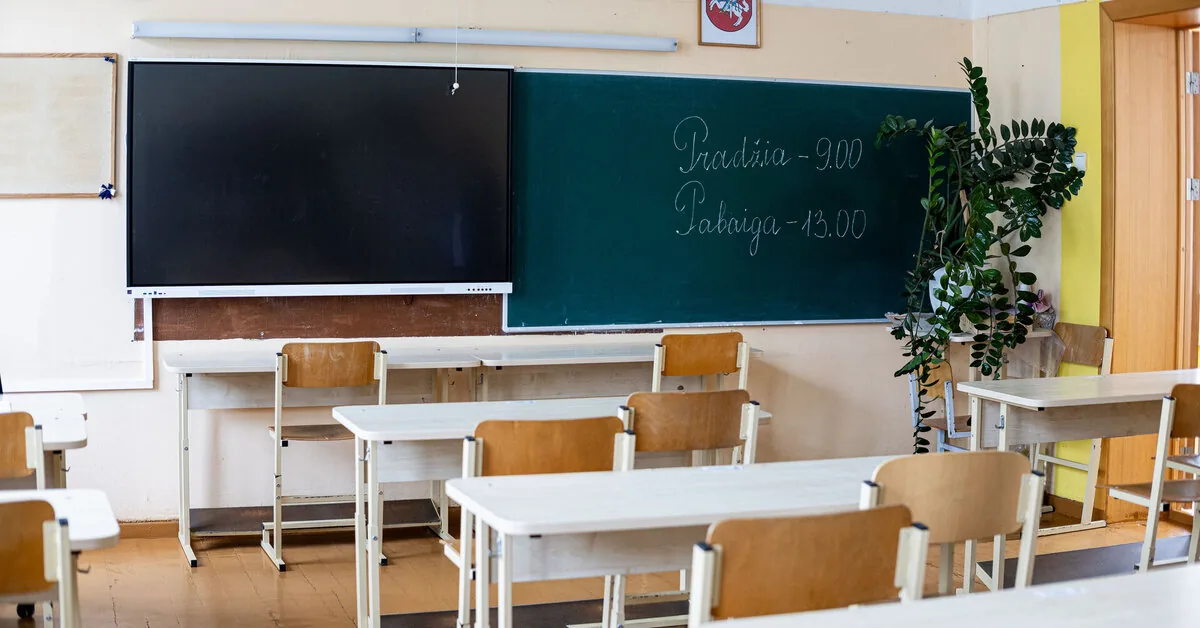
Organizations warn that the abolition of the minimum student achievement requirement threatens not only the future of some children but also the competitiveness, democratic, and national resilience of the entire country.
Read more Nvidia to create AI-based robots for shipbuilding in Japan
On July 16, the organization “Education #1” together with more than 30 partners submitted an appeal to the President of the Republic of Lithuania, Gitanas Nausėda, requesting to veto the amendment to the Education Act adopted by the Seimas regarding the significance of the PUPP in acquiring basic education.
The amendment adopted by the Seimas abandons the requirement that a student completing the basic education program must have achieved at least the threshold level of Lithuanian language and literature and mathematics achievements. That is, to have received a positive score in the Lithuanian language and mathematics PUPP. Thus, it would be possible to obtain a basic education certificate without proving that the student has basic reading, text comprehension, writing, and calculation skills.
The organizations signing the appeal emphasize that the response to insufficient achievements should be additional support and an individual gap reduction plan. The adopted amendment does not provide for any of these measures.
“By removing the minimum bar, the child’s knowledge gaps do not disappear – they just become less visible. The student receives a certificate and moves on to a more difficult level of education with the same gaps, and later into adult life. The state must not turn a blind eye to insufficient achievements but timely identify which child needs help and ensure that they actually receive it,” says Laura Masiliauskaitė, head of the organization “Education #1.”
Among the organizations supporting the appeal to the president are school and teacher associations, student and pupil organizations, higher education institutions, business associations, and public organizations.
Gaps are transferred to higher grades
The appeal to the president emphasizes that the upper secondary education program in grades 11–12 is based on the knowledge acquired in basic education. Therefore, a student who has completed grade 10 without even reaching the threshold level in Lithuanian language or mathematics finds it harder to understand more complex content and prepare for state maturity exams.
Large differences in student preparedness also complicate teachers’ work. More class time must be devoted to addressing previous basic gaps, slowing down the learning pace of the entire class, while stronger students have fewer opportunities to deepen their knowledge and learn according to their ability level.
“By removing the PUPP threshold score, a student will be able to complete basic education and continue studying without reaching the minimum achievement level. However, merely removing the legal barrier does not eliminate learning gaps. Instead of providing the student with real help and ensuring they acquire the necessary basic skills, the system simply transfers the problem to the next stage of education,” notes Martynas Dikšaitis, president of the Lithuanian Student Union.
The organizations also point out that the basic education certificate should confirm the actually acquired at least minimal competencies. Abandoning the threshold achievement level requirement would link education acquisition more to the time spent in the education program than to the actual learning outcomes achieved.
In addition to abandoning the PUPP bar, on July 14, the Seimas also abolished the requirement, which was to come into effect next year, to pass three state maturity exams to obtain a secondary education certificate.
“This week, in one day, we lowered the bar for both tenth graders and graduates – this is no longer an isolated decision but a direction that will have long-term consequences for Lithuania’s competitiveness. The bar removal is presented as concern for children, but in reality, it is an imitation of concern: by removing the requirement, we do not solve the problem but only transfer it to the eleventh grade, to exams, and ultimately to the labor market, where the gaps can no longer be fixed. Abandoning requirements without offering any help in return is not protecting children but postponing the problem, for which the same children will pay later,” says Prof. Dr. Dalius Misiūnas, rector of ISM University of Management and Economics.
Read more Unexpected twist: Russia turned to India with an unusual request
The abilities of the entire society decline
Gaps not addressed in school in time have long-term consequences for the entire country. According to the OECD 2023 adult skills survey data, 44% of Lithuanian adults have low reading or numeracy skills. This is significantly higher than the OECD average of 31%, with 23% in Estonia and 37% in Latvia.
Low basic skills reduce people’s opportunities to participate in the labor market, earn higher incomes, retrain, and engage in lifelong learning. Weak reading, information evaluation, and problem-solving skills also reduce society’s resilience to disinformation and its ability to act amid rapidly changing technologies or crises.
The appeal to the president also emphasizes that the decision to link the acquisition of basic education to at least the threshold PUPP achievement level was made back in December 2022. Students, parents, schools, municipalities, and state institutions were given almost a four-year preparation period.
The requirement is abandoned just before it comes into effect, before it has been fully applied and without assessing practical results. According to the organizations, such a fundamental rule change complicates the planning of the education process and weakens trust in the education system.
“The proposal to abandon the threshold level is fragmentary, does not address the fundamental educational problems of students experiencing learning difficulties or having lower achievements, and is not supported by long-term research and systematic impact analysis. Such a decision creates conditions for short-term reactions to the situation but does not address the real reasons for improving academic achievements – early support, individual progress monitoring, strengthening learning assistance, and consistent formation of a learning culture,” notes Dainius Žvirdauskas, president of the Lithuanian School Leaders Association.
Instead of abolishing the requirement – concrete help for the student
In the appeal submitted to the president, the organizations ask not only to veto the adopted amendment but also to initiate systemic solutions that would allow early identification of children experiencing learning difficulties.
It is proposed to create a national early warning system that, based on student achievement checks and other data, would timely identify students, schools, and municipalities at the highest risk of learning gaps.
Also, at the national level, to provide a system of targeted support measures that, upon identifying learning gaps, would ensure timely, individualized, continuous, and data-driven assistance to students and schools.
“Let us not start measuring the success of the education system by the number of papers (certificates and diplomas). Let us strive for higher education quality. Let us create a system that not only provides papers but also imparts knowledge and fosters values,” urges Vytautas Šilinskas, head of the Investors’ Forum association.
The organizations supporting the appeal hope that President Gitanas Nausėda will assess the possible consequences of the adopted amendment and return the law to the Seimas for reconsideration.
Even before the Seimas vote, criticism of the decision to abandon the PUPP threshold level was expressed by the Lithuanian School Leaders Association, the Lithuanian Association of Progymnasiums, Gymnasiums, and Basic Schools, the Lithuanian Association of Municipalities, and other organizations.
Read more Inga Ruginienė introduced her team: here are the people who will work in it