









In a world dominated by artificial intelligence and spreading propaganda, critical thinking becomes very important, especially for children who spend a lot of time in front of phone or computer screens. Educational strategies in schools, communities, and homes become an integral part of how a child learns to evaluate news and information. Representatives of Alytus Vidzgiris School and Anykščiai Youth Club share how critical thinking is developed in these spaces.
Read more Latvian Minister of Social Protection dismissed for drunk driving
Emotions versus facts
“Our students today, along with us older ones, grow up in a very intense flow of information – social networks, video platforms, artificial intelligence, short videos shape our view of the world. We notice that some students can quite quickly filter information, but critical thinking skills are not yet strong enough to fully resist false or propaganda information. Especially younger students often tend to trust what they see online if it is presented persuasively or emotionally. Therefore, the role of the school becomes very important – we must teach not only knowledge but also the ability to think, ask questions, and verify facts,” says Artūras Čiurlionis, director of Alytus Vidzgiris School.
The head of Anykščiai Youth Club, attended by 14–18-year-olds, Gintarė Varnaitė also emphasizes that some young people still lack stronger critical thinking skills. Due to the large amount of information, young people often find it difficult to select reliable sources, maintain attention, and consistently analyze information. Therefore, it is important to constantly strengthen their ability to evaluate content responsibly and consciously.
According to her, information evaluation differs by age groups. For 14–15-year-olds, it is usually more difficult to critically evaluate information and recognize misleading content because they are more likely to trust information presented on social networks.
Meanwhile, 16–18-year-olds are more often able to analyze information sources, ask questions, and evaluate presented content more critically. However, the interlocutor emphasizes that these skills also depend on individual experience, interest, and motivation to delve into the topics studied.
Practice instead of theory
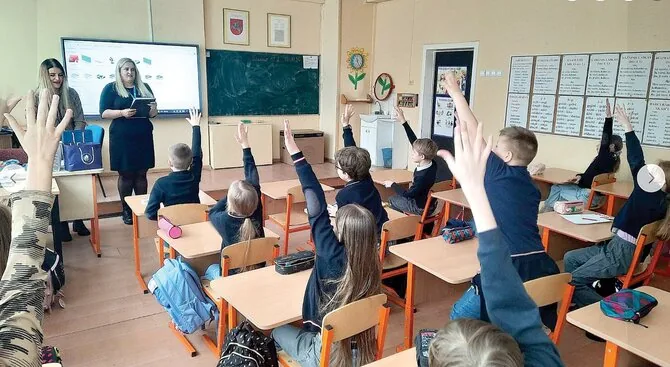
To develop critical thinking, children need many practical tasks that encourage the ability to distinguish true information from misleading. At Vidzgiris School, much attention is paid to project work, problem-solving, and group work.
There is also discussion about safe behavior online, the impact of social networks, and responsible information consumption. Parents working in various services are also invited to school to share information and valuable insights; for example, recently mothers working in the police and the General Help Center visited.
“According to teachers, one of the most effective methods is practical tasks. For example, students receive several news items or online posts and must determine which facts are reliable and which raise doubts. They learn to look for multiple information sources, analyze headlines, recognize emotional impact or manipulation. During life skills lessons, we show educational videos from YouTube and other platforms about how scammers call and try to extort money, fake advertisements, etc. We also use discussions, situation analysis, debates where it is important to justify one’s opinion with facts,” the director explains.
We must teach not only knowledge but also the ability to think, ask questions, and verify facts.
This is integrated into Lithuanian language, history, computer science, citizenship education lessons, and class hours. According to the interlocutor, analyzing examples of fake news, online scams, fake messages, or misleading social media posts helps better understand how easy it is to be misled. But most importantly, students should learn not to fear the internet but to be able to navigate it safely and responsibly.
Similarly, Anykščiai Youth Club also highlights practical tasks as the most contributing to distinguishing reliable information from misleading. “The greatest impact comes from methods where young people themselves compare different information sources, analyze content, and learn to critically evaluate information presented on social networks and in the media,” says G. Varnaitė.
According to her, real examples and current situations are used in the educational process. Discussions cover fake news, cases of propaganda, misleading information created by artificial intelligence, and various scam schemes.
Read more Air danger in Lithuania canceled: latest information announced
The especially important role of parents
However, challenges are not lacking, and one of the biggest for both children and adults is the very rapid spread of information and its large volume. The director notes that children often receive information faster than they can process it. Constantly searching for something new, time seems to fly by, and the feeling of boredom, which is necessary for the body to recharge, disappears.
“Another problem is emotional content, which works stronger on social networks than facts. We also see that some students find it difficult to concentrate for long, delve deeper, read longer texts; every 10 minutes they want something new and new. Developing critical thinking requires consistent work, patience, and cooperation between school and family,” says A. Čiurlionis.
Therefore, the role of parents is very important. However, they often rush a lot and have many tasks, so it is very difficult to invite them to school.
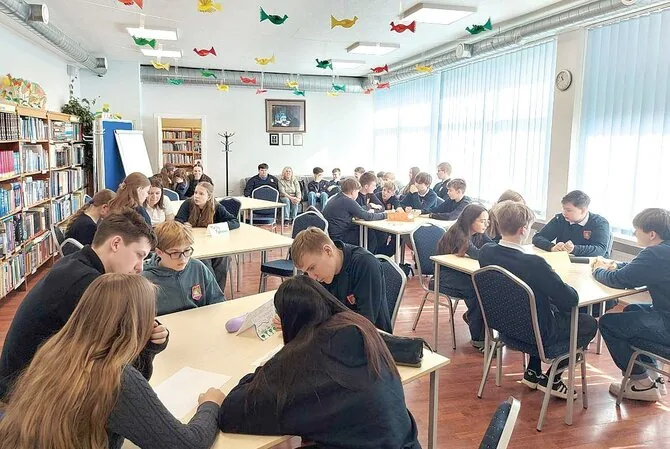
“From this year, we have formed a new self-government structure in which the Parents’ Council has started to play an important role. Therefore, we cooperate more intensively with parents by organizing lectures, discussions about children’s safety online, sharing recommendations on how to talk with children about information on social networks. But most importantly, children should be encouraged at home to ask questions, discuss, and not be afraid to doubt. When parents are interested in what children watch or read online, critical thinking naturally strengthens,” says A. Čiurlionis.
The school director shares three simple tips for students and their parents:
First – do not rush to believe everything you see online. If the information is very shocking or evokes strong emotions, it is worth checking it additionally.
Second – always check who published the information. Reliable sources usually clearly indicate the author, date, and are based on facts.
Third – compare information in at least several sources. If only one unclear page writes about an event, that is already a signal to be cautious.
Thus, critical thinking at a young age is more than intellectual exercise – it is the foundation for personal freedom and resilience. In the modern era, where algorithms often try to think for us, the ability to pause and ask “why?” becomes a true superpower. By giving young people space to make mistakes, search, and find their answers, we help them become not only informed citizens but also masters of their own destiny.

The project “Fake? Check it!” is partially funded by the Media Support Fund. 9,000 euros allocated in 2026.
Read more The probable air hazard in Vilnius County has been canceled