








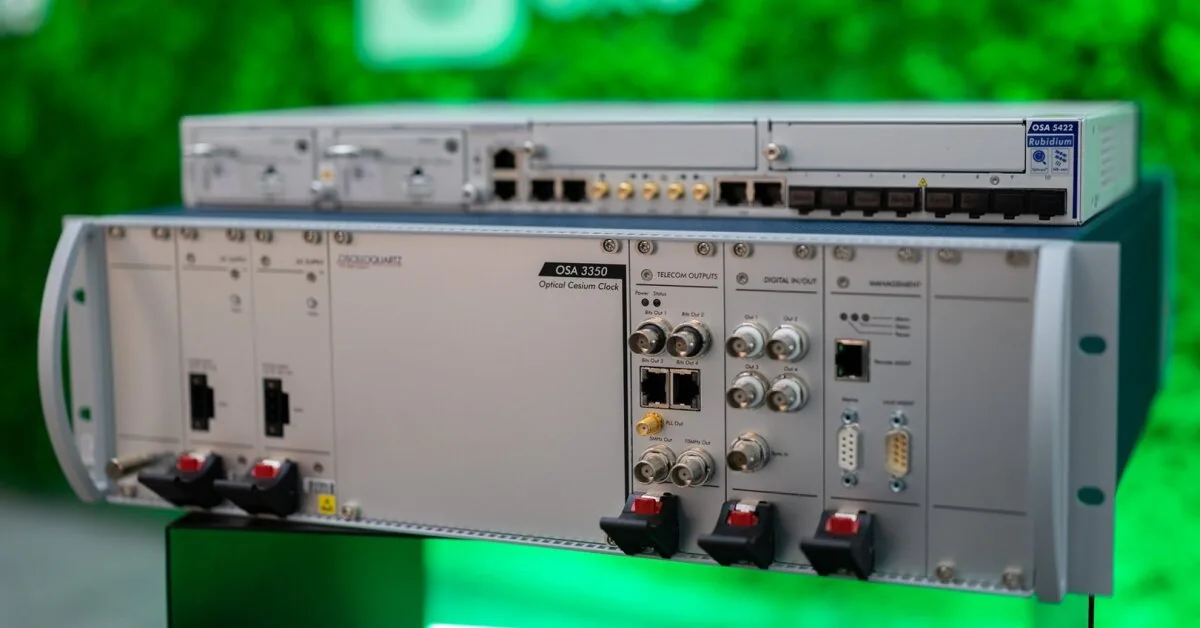
“An atomic clock is a highly precise time measurement device that determines time based on atomic vibrations. Such accuracy is needed in the mobile network not so that we see the exact time on phone screens, but to ensure the smooth operation of the communication network. All communication towers must operate precisely synchronized with each other – for this, they need a common and very accurate time source,” explains Arūnas Mickevičius, CEO of Bitė Lietuva.
Network resilience today is important not only for uninterrupted communication – it is also a matter of national security.
Usually, the mobile network receives accurate time from GPS satellites. Russia deliberately interferes with these signals in the Baltic region – it suppresses or falsifies them. In one case, the GPS signal may become unavailable; in another, the network may receive unreliable information. The atomic clock does not stop the GPS interference itself, but when GPS is unavailable or the information is falsified, it helps the network maintain accurate time.
“Due to the geopolitical situation, we can no longer rely solely on an external GPS time source. Although customers probably won’t notice the effect of the atomic clock in everyday situations, its value becomes apparent when the GPS signal is disrupted. The atomic clock allows the network to have a precise time source independent of GPS. Because of this, even if the GPS signal disappears for a longer period, we can maintain synchronization of communication towers and ensure stable 4G and 5G connectivity for the people of Lithuania,” says the head of the digital services company, A. Mickevičius.
Read more Employment Service: older employees are becoming an increasingly valuable asset for employers
Bitė has acquired a Swiss company Oscilloquartz’s OSA 3350 cesium atomic clock along with additional equipment. The total investment in one atomic clock exceeds 110 thousand euros. Bitė will invest in several such atomic clocks, further increasing the network’s resilience. Because of this, even if the GPS signal is completely lost, the chosen atomic clock can maintain time with an error no greater than 100 nanoseconds for at least 40 days. Under normal conditions – up to 60 days.
“One nanosecond is a billionth of a second. A person does not notice such a short time difference, but such accuracy is very important for the mobile network,” says the CEO of Bitė Lietuva.
This is Bitė’s first atomic clock, which will become the central precise time source for the entire company’s mobile network. Almost 1600 company communication towers across the country will be synchronized by the time it transmits. The equipment is already installed – full deployment across the entire Bitė network is planned for October.