However, you can still safely observe this spectacle using certain household or homemade items.
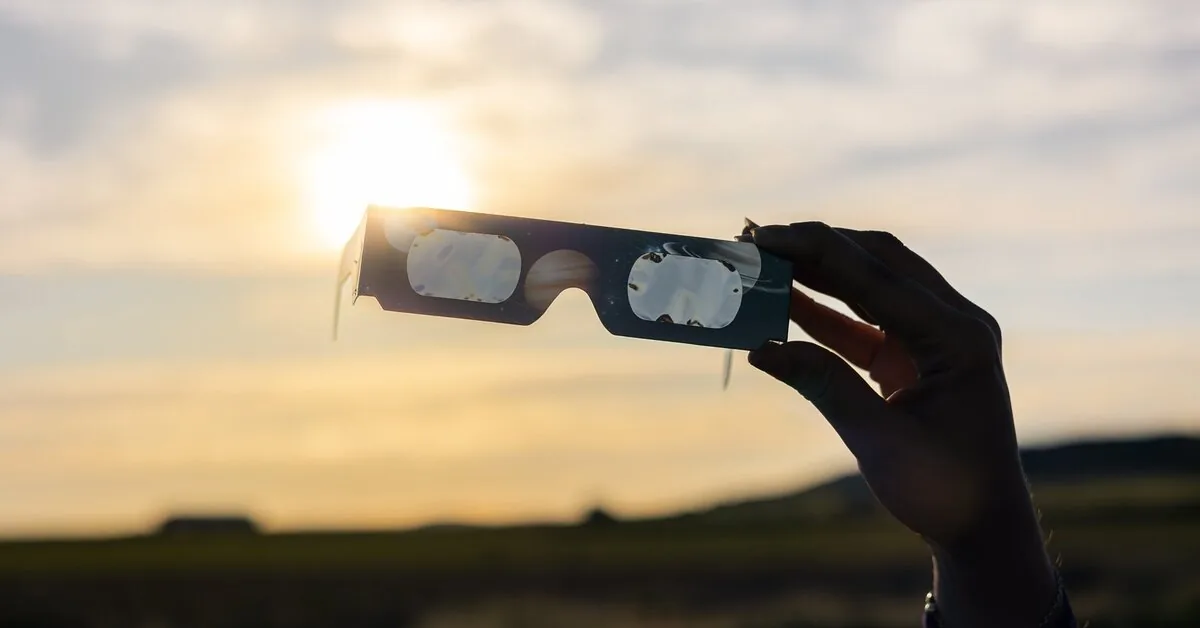
Experts warn that enthusiasts should not look directly at the Sun without special glasses. You should also not be tempted to use sunglasses or dark protective glasses instead.
According to the Royal Astronomical Society of the United Kingdom, they often do not provide sufficient protection from UV rays when looking directly at the Sun, so you can seriously damage your vision.
Here are some observation methods you can try if you don’t have special glasses:
Projector from a cardboard sheet: cardboard, paper, and pen
An astronomy group advises making a projector – all you need to do is poke a hole in a cardboard sheet. You can do this by piercing the center of the sheet with the tip of a pen.
Hold the cardboard in one hand and a clean sheet of paper in the other, turning away from the Sun.
Then hold the cardboard above and the paper sheet below so that the image of the Sun appears on the latter.
This projector will show a miniature copy of the Sun and the shadow cast on it.
Colander – find one in the kitchen
Instead of using it to drain vegetables or pasta, you can use a kitchen colander to create a similar effect to the small hole projector, writes BBC.
Ophthalmologist Dr. David Jones from the Royal Cornwall Hospitals Trust says this is his favorite way to observe an eclipse.
“If you point the colander at the Sun and, protecting your eyes, turn away from it, you will be able to see not one but a hundred images of the Sun at once.”
Demonstrating this technique on social media, he holds a clean sheet of paper behind the colander.
This creates a kaleidoscope of images showing the Sun and the shadow cast on it during the eclipse.
Read more F-16 fighter jet crashed in Turkey
Homemade camera projector – cardboard box, foil, paper
This method is superior because the cardboard box blocks ambient light and only lets through rays coming from the eclipse side.
Cut a sheet of paper the size of the bottom of the box. Open the top of the box and glue this sheet to the bottom – this will be the screen where you will see the eclipse.
Close the box and seal it tightly with adhesive tape. Cut a small square on one side of the top so you can see the paper at the bottom of the box with one eye.
Cut another identical square on the other side of the top. Cut a piece of foil large enough to cover this opening.
Glue the foil and pierce a hole in the very center with a pin or needle.
Stand with your back to the Sun and look through the open square hole with one eye.
When you align the hole in the foil with the Sun, you should see its image on the screen at the bottom. Here you will also see the eclipse itself.
Can I use a phone?
There may be a temptation to observe or film the eclipse with a mobile phone – either by pointing it at the Sun or recording video, but NASA advises against this.
“To photograph a partial solar eclipse, the camera must be protected with a special solar filter – just as you protect your eyes with viewing glasses (also called eclipse glasses),” NASA advises.
The agency also warns that phone sensors pointed directly at the Sun can be irreparably damaged: “This is especially true if you use any magnifying lens with the phone.”
To better see the solar eclipse, experts from the Royal Astronomical Society advise choosing a higher location with a clear view of the western horizon.
Read more Intelligence agents and criminologists teamed up against two Dzūks
Whatever you decide to do, never look directly at the Sun.