Currently, when examining new projects, one can find more economical options in residential districts, historic housing in the Old Town, and new construction projects near the Danė River, while prices in exclusive properties have already reached the level of the prestigious segment.
Read more Visit of the CŽA Director in Moscow – a possible warning to Putin
At the same time, Klaipėda is becoming more interesting not only to local residents – people from other Lithuanian cities are also looking for housing here, as well as buyers considering a second home by the seaside.
“Klaipėda is a seaside city and seems like an attractive place to live for many, but in the housing market, emotional choice is not enough – the final decision is determined by the specific characteristics of the property, the quality of the building, and the location,” says Jūratė Bertašiūtė-Kučerova, a property appraiser at Inreal.

There is no longer a single Klaipėda housing market
Just a few years ago, the Klaipėda housing market could be quite simply divided: the center and Old Town – more expensive, residential districts – cheaper, new construction – more expensive than old housing. Today, such a scheme is too simplistic.
Two apartments of similar size and age can cost very differently.
One may be just a few minutes’ walk from the Old Town, the other in a district where the buyer will have to value the possibilities of a car, public transport, or infrastructure more.
The difference is further highlighted by the condition of the building, renovation, energy efficiency, environment, parking possibilities, and even what can be seen out the window.
“There is no single general price level in Klaipėda that equally reflects the entire city. Different areas have different attractiveness, and this is reflected in housing prices,” notes J. Bertašiūtė-Kučerova.
One of the clearest examples is the Old Town. The historic environment, architecture, limited supply, and advantages of the city center create a value here that cannot be explained solely by the number of square meters of the apartment.
Prices for old housing in the Old Town usually range around 2,500-3,500 euros per square meter, but the final price depends on the specific location, building condition, renovation, and the characteristics of the apartment itself.
Meanwhile, prices in new construction projects usually range around 2,500-4,000 euros per square meter, and in exclusive locations or higher segment projects, they can be much higher.
Inreal notes that this is also evident from specific market offers: prices in “Bastionų namai” reach about 2,900-3,800 euros per sq. m, in “Trinyčių rezidencija” about 3,300-4,300 euros, in “Miško jūra” about 3,000-3,200 euros. The “Memelio miestas” and “Teatro namai” projects already stand out with a completely different price level – respectively about 6,000-7,000 and 5,500-6,500 euros per sq. m.
However, specialists emphasize: these figures are not a direct comparison of one project or the entire market. The price of new housing also depends on the sales stage, level of finishing, and the specific apartment.
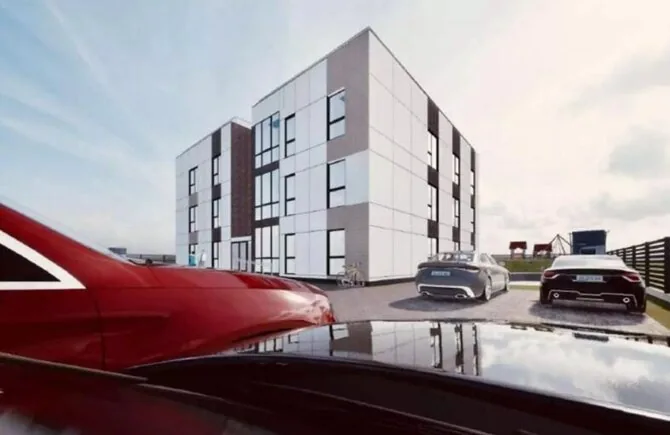
Not only locals are coming to Klaipėda
The head of “Memelio miestas,” Justinas Striška, says that currently the majority of buyers are still local residents, but there are also people who buy housing in Klaipėda as a second home.
According to him, some buyers intending to purchase housing by the sea increasingly include not only Palanga or Nida in their list of choices.
Klaipėda is becoming an alternative that allows having the seaside but also offers much more city life.
The attractiveness of the port city is especially evident off-season, when seaside relaxation can be combined with cultural programs and other city advantages.
It’s not just the sea. Klaipėda has culture, concerts, events, restaurants, entertainment, and the Old Town.
“Klaipėda is really starting to exploit a reserve here that it did not have before,” says J. Striška about the second home segment.
In his assessment, Klaipėda can become a real alternative for those looking at Palanga or Nida but wanting city infrastructure. For such a buyer, it’s important not only to have holidays by the sea. They want the property to be used in other seasons as well.
This gives additional activity to the Klaipėda housing market.

Luxury not at any price
Another important change is the buyer themselves.
J. Striška notes that buyers increasingly know what they want. However, in the project he represents, this does not always mean a desire to install as many additional features as possible. Often it is enough to clearly show what has already been done and what value the project itself offers.
But one need has become very clear – a larger home, especially in the higher-class segment, when the property is purchased to live in.
According to J. Striška, people increasingly want larger spaces, so in “Memelio miestas” there are already cases where buyers are offered to combine apartments to form a larger apartment with more rooms.
This is logical: housing is purchased not only to fit furniture. People work from home, lifestyles change, and buyers in recent years often have already changed more than one home – rented or owned. Therefore, they realistically imagine their needs for the home where they plan to live longer.
Is overheating a risk?
Another question increasingly raised by participants in the Klaipėda real estate market: has too much new housing started to appear in the city?
J. Striška draws attention to market statistics – the number of built and unsold homes is growing faster than sales. Rough estimates suggest that there are already over 1,000 built but unsold apartments in the Klaipėda new projects market.
There is an objective explanation for this – many previously postponed projects appeared on the market at the same time. This is especially visible in the city center, where investment activity is very high. However, the current situation is distinguished by projects competing for very different buyers.
According to J. Striška, for higher segment housing, not only the price per square meter or the number of rooms is important. Location, architecture, lifestyle concept, and exclusivity are sold here.
Therefore, the number of unsold new apartments alone does not tell the whole story.
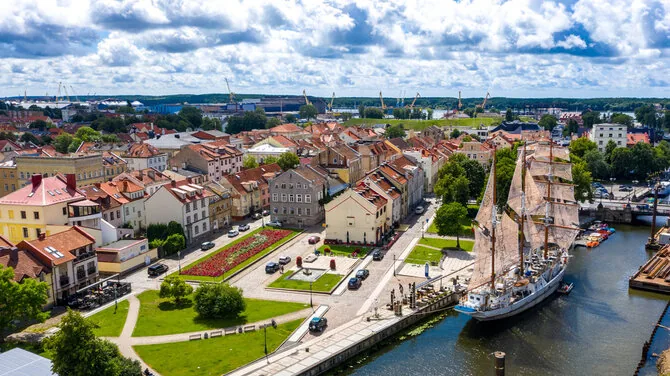
The buyer no longer wants just square meters
This trend is also noticed by Vita Žutautaitė, head of Eriado. According to her, Klaipėda now offers much more choice for a person who previously could only consider one alternative – moving out of the city to the suburbs.
“Previously, you could choose to move to live outside Klaipėda, to a district, but now there is a choice within the city itself. People value the advantages of quality of life and want everything to be within reach,” says V. Žutautaitė about the changing buyer attitude.
According to her, Klaipėda has finally followed the example of the capital, and residents are beginning to return from the suburbs to the city.
This fundamentally changes the purpose of new projects. Housing in the center becomes an alternative not only to an old apartment in the same district but also to an individual house outside the city. A person may want more space but at the same time does not want to give up city conveniences.
That is why in new projects, the apartment size is increasingly not the only important factor. The buyer evaluates comprehensively what is beyond their door: whether there are shops, schools, cafes, parks, a river, the Old Town, public transport nearby, and whether it is convenient to walk.
In other words, not only housing is sold – a place to live is sold.