







The chief forester of the waste and environmental management company “Ekonovus,” Tomas Valiauskas, says that after heavy rains and strong winds, people often mistakenly think the danger is over.
“If it rains heavily, the soil becomes saturated with water, and the roots lose their support. Sometimes a tree does not fall immediately – it can stand for several days or even weeks before finally toppling over without any wind. We have seen more than one such case,” says the chief forester.
Even a completely green tree can pose a danger
According to the specialist, one of the biggest mistakes is to think that only dried-out trees are dangerous.
“A green tree does not mean it is safe. We have inspected trees in Belmonte after rain. One of them looked completely healthy – green, growing on flat ground, not on a slope. While we were inspecting it, it simply fell over. There was no wind. It turned out that the rain had washed away the roots,” recalls T. Valiauskas.
That is why after heavy rains or storms, specialists advise carefully inspecting the trees growing in your yard.
What signs should you pay attention to?
According to the chief forester, you should first assess the tree’s top and crown.
If the top starts to dry out, dead branches appear in the crown, or the tree leans against a building, you should not delay.
Another important sign is the soil around the trunk.
“If after a storm one side of the soil near the trunk becomes softer or raised, it may mean that the roots have already shifted. The tree loses stability, although this is hardly visible to the naked eye,” explains the specialist.
Deteriorating tree condition can also be signaled by fungi growing on the trunk, abundant shoots sprouting from under the crown, or two large tops that may split in the future.
Rain makes the tree much heavier
Not everyone knows that after prolonged rains, the weight of a tree increases significantly.
“The tree absorbs a lot of moisture, so its mass can increase by about 20–40 percent. Due to the additional weight, the risk that the tree will break at its weakest point or fall over increases,” says T. Valiauskas.
According to him, people whose plots have trees growing on slopes, near buildings, parking lots, or power lines should be especially careful.
Storm-related work increases
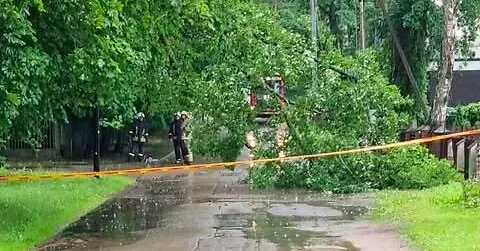
The chief forester says that after stronger storms, emergency tree removal work increases almost immediately. Usually, it is necessary to remove dangerously leaning, broken, or threatening trees.
The chief forester of “Ekonovus” and his colleagues maintain the park areas of Vilnius city as well as the Pavilniai and Valakupiai forest districts, so they encounter the consequences of storms almost after every strong wind.
According to T. Valiauskas, people are often surprised why sometimes seemingly healthy, green, and large trees are removed. However, their condition is determined not only by what is visible from the outside. Trees are weakened by root damage caused by fungal diseases, trunk rot, various pests, which cause the tree to lose strength even though its crown still looks lush.
In such cases, specialists first look for ways to save the tree – pruning it, reinforcing it with special joints, or applying other maintenance measures. If it is determined that the tree poses a real danger to people or property, sometimes the only safe option is to remove it before an accident occurs.
Still, he says, most accidents could be avoided by assessing trees before a storm.
“A specialist can notice things that an ordinary person usually does not see – assess the condition of the roots, the tree’s growing location, center of gravity, wind directions, determine if the tree has enough space and nutrients. Sometimes it is enough to professionally prune the crown or reinforce the trunk with special joints, and the tree can be saved,” says chief forester T. Valiauskas.
He reminds that it is not recommended to visit the forest when the wind blows stronger than 15 meters per second, and after storms, it is worth carefully assessing the condition of trees not only in forests but also in your own yard.
“Most often, people seek help only when a tree falls on a greenhouse, car, or building. However, the safest and cheapest way is to notice the problem earlier, before an accident happens,” emphasizes the forester.