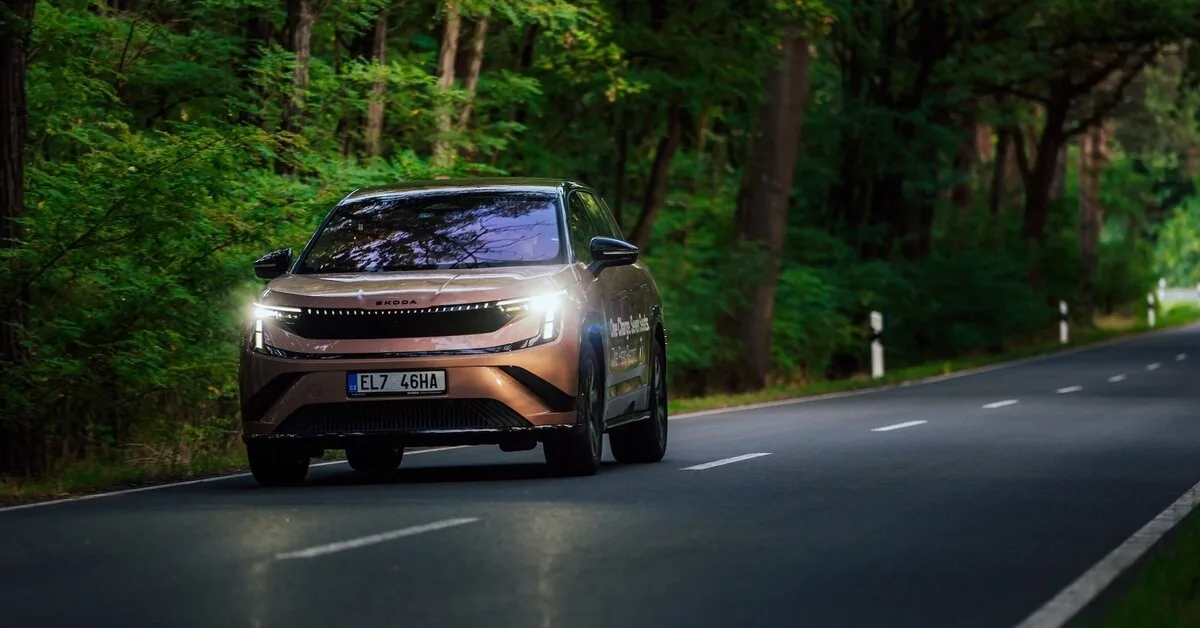
Marek Jež and Jakub Krs believed that the „Peaq“ could exceed the officially WLTP cycle determined range, which for the model with the largest battery capacity is more than 640 kilometers. The WLTP methodology is set by legislation and designed to reflect real driving conditions as accurately as possible. However, the engineers chose a different path – a real route through three countries.
Read more High EU official cancels visit to Serbia over glorification of war criminal
„Our goal was to demonstrate the limits of the technology’s capabilities. To achieve the maximum distance, we carefully selected the most suitable route and, of course, the appropriate driving style,“ says Jakub Krs, the head responsible for the „Peaq“ battery system. „An ordinary driver would probably never drive like this – they would use the full dynamics of the „Peaq“, the infotainment system, and comfort features,“ adds Marek Jež, the project manager of „Peaq“.
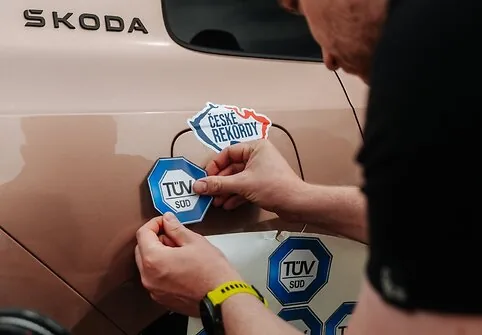
Production car and sealed charging port
The record was set using a completely standard serial production „Peaq 90“ with a 91 kWh (86 kWh usable capacity) battery, a 210 kW electric motor, rear-wheel drive, 19-inch wheels, and standard low rolling resistance tires. Before the start, only one additional procedure was performed – the charging port cover was sealed. The drive was officially monitored by the certification body „TÜV Süd“, and representatives of the Czech record book were also awaiting the result.
The final destination chosen was the Netherlands. The route from Mlada Boleslav, where the „Peaq“ is produced in the main „Škoda“ factory, ran through Germany. For the trip, less congested secondary roads were deliberately chosen, and the best option was found with the help of artificial intelligence. Reaching Amsterdam itself, about 850 kilometers away, would have been a great achievement, but Jakub Krs hoped before the start to exceed the 900-kilometer mark.
Constant speed – the most important condition
The crew left Mlada Boleslav on Tuesday, August 25, at noon. Initially, the drivers switched approximately every two hours, more frequently at night. From the Czech Republic, the „Peaq“ headed to Saxony: the road wound through sunflower fields and tree-lined avenues along the Spree River, and the crew also crossed the Elbe.
Half of the energy stored in the battery was consumed between Braunschweig and Hanover, when it was already dark. The „Peaq“ continued driving at an almost constant speed – this is the decisive factor in achieving low energy consumption. „Smooth driving at a constant speed is one of the most important conditions for achieving maximum range,“ agree both drivers. This means not only maintaining the chosen speed but also avoiding sudden acceleration, intense braking, or a complete stop, after which regaining speed requires additional energy.
Reconciling these requirements with real traffic in three countries was the biggest challenge of the entire trip. The final result was also influenced by regenerative braking, during which the electric car recovers some energy. However, if the regenerative braking is too intense, the car slows down unnecessarily, so less energy is recovered than is later needed to maintain a constant speed.
City traffic and the decision to drive to the sea
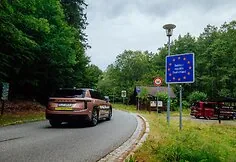
At dawn, the crew took a short rest, and after sunrise crossed the German-Dutch border. Along the roadsides, there were more traditional red brick houses and cyclists, who are very numerous during the morning rush hour in Dutch cities. The optimism gained at night had to be tempered. „750 kilometers done, 170 left,“ reported Marek and Jakub. Driving in city traffic with intersections and traffic lights literally drains the battery energy – it is the complete opposite of smooth driving.
Longer flat stretches outside the cities again reduced consumption and improved the remaining distance forecast. The situation became so favorable that during a stop at the „Škoda“ dealership in Amersfoort, Marek and Jakub began to consider extending the route. „Instead of stopping in Amsterdam, let’s drive all the way to the sea,“ they decided. This decision added about 50 kilometers to the initial plan.
The last percentage points of the battery charged in Mlada Boleslav were used driving along the coastal road near the Zandvoort beaches – on the other side of the road, the grandstands from last weekend’s „Formula 1“ Grand Prix were still being dismantled. On Wednesday afternoon, the crew knew the goal was reached: 936 kilometers and only 9.2 kWh/100 km energy consumption. This is not only the longest distance ever covered by a „Peaq“ or any seven-seater electric SUV but also officially recognized as a Czech record in the category „Longest distance driven by an electric car on a single charge“.
The result exceeded even the drivers’ own expectations
After connecting the car to the charging station, both drivers admitted that the „Peaq“ exceeded their expectations – none of them expected such low consumption and such a distance before the trip. They were also surprised by the interest of their colleagues: they followed the test via a live data stream from the car. „They were messaging us throughout the trip, and in the morning they were the first to connect again,“ says Jakub Krs and adds that many colleagues were betting on the final distance.
Asked how to drive economically, both drivers share lessons from the trip. „The weather helped us too. We would never have achieved such a result in rain and on a wet road,“ admits Marek Jež. „And I would advise taking care of entertainment in the car,“ Jakub Krs adds with a smile, recalling the long hours behind the wheel.
Read more Expecting a visit from US envoys, at least three people were killed in Russian strikes in Ukraine