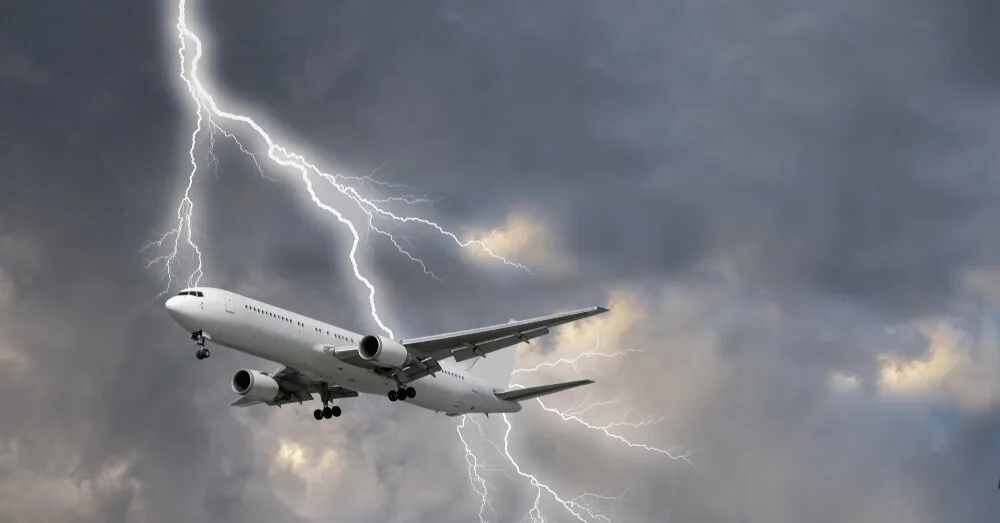
Lightning strikes an aircraft once a year
Planes regularly fly near storm clouds or directly through them, where air masses are heavily electrified.
According to aircraft manufacturer Airbus, operational aircraft are struck by lightning on average once a year, which is about once every 3000 flight hours.
To put it clearly, a plane would need to complete about 250 full round-trip flights between New York and Los Angeles (counting 12 hours for each trip) before statistically being struck by lightning.
Protection – Faraday cage
Although a discharge of thousands of volts sounds frightening, it has no effect on passengers, explains rd.com.
This is because all passenger aircraft are designed on a principle known in physics as the Faraday cage.
The metal aircraft structure acts as an excellent electrical conductor.
When lightning hits the fuselage, the electric current simply runs along the outer surface of the plane and safely exits through the tail or wingtip in the sky, without reaching the interior cabin.
Aviation experts provide a simple analogy: imagine the plane as a sealed tin can under a running stream of water – the outside gets wet, but the inside remains completely dry.
For this reason, even if a passenger touches metal seat parts inside during a lightning discharge, nothing would happen to them because the electric current flows only on the outside.
Read more England reached the semifinals, but tension erupted: Tuchel’s criticism angered Bellingham
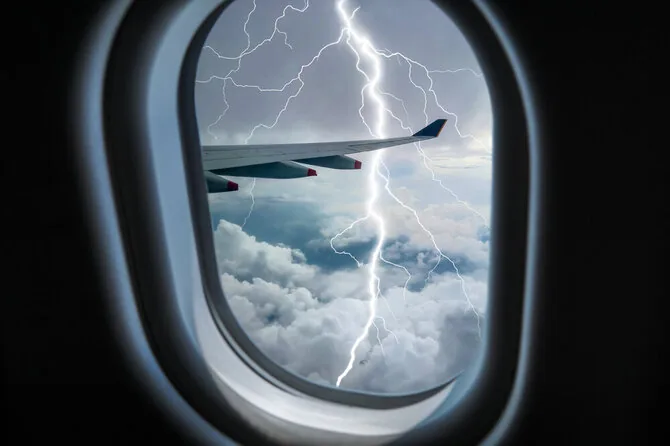
Hollywood myth versus strict engineering
One of the biggest aviation-related myths often seen in movies is that a lightning-struck plane immediately explodes or its engines completely fail. According to engineers, the likelihood of such a scenario is practically zero.
Although in very rare cases an electrical discharge can cause temporary disruptions in navigation instruments or radio communication systems, all modern aircraft have redundant systems and backup devices.
If structural damage is suspected, the standard safety protocol applies – to leave the storm area and land at the nearest airport.
For passengers during the flight, a lightning strike usually manifests only as a bright flash of light, a louder crack, and slight turbulence.
Finally, after each such event, the aircraft does not perform any further flights until mechanics on the ground conduct a thorough multi-stage inspection.
For example, Airbus applies very strict system and external surface inspection rules that ensure only technically flawless aircraft take to the air again.
Read more The Ukrainian army struck a Russian oil refinery and 10 tankers