According to Vytautas Simutis, a broker at the real estate marketing company “NTligence,” not only buyers’ expectations but also the perception of prestige have changed in recent years: “If previously the most important thing was to have as much action around as possible, today buyers prioritize quality of life – peace, privacy, greenery, and a slower pace,” says V. Simutis.
According to the broker, two different Palangas are spoken of not only figuratively. In different parts of the resort, the intensity of development, the amount of greenery, and the overall city structure clearly differ.
Within a radius of about 300–500 meters around J. Simpson Street, the built-up area accounts for about 20–30%, while green spaces, parks, squares, mature trees, inner courtyards, and undeveloped plots occupy as much as 70–80% of the territory.
For comparison, in the urbanized part of Palanga, the built-up area averages about 35–45%, and in the central part of J. Basanavičius Street – even 60–80%. In other words, one part of the resort is dominated by buildings and intense movement, while the other by greenery and open spaces.
This difference is also reinforced by Birutė Park – one of the largest historical park areas in Lithuania, covering 101.3 ha, formed at the end of the 19th century.
Next to the park, the scale of historic villas remains, there is no dense commercial development, and a large part of the area consists of protected greenery and cultural heritage objects. Because of this, this part of the city maintains a different character even during the summer season compared to the most active resort zones.
Not only the environment but also the pace of life differs
According to V. Simutis, these urban differences are clearly reflected in the daily atmosphere of the resort. “Palanga has two very different faces. One side is noisy, seasonal, and oriented towards mass entertainment. This is J. Basanavičius Street, famous concerts, night bars, and crowds of people flooding in summer. The other part is much calmer and even cultural: dominated by dunes, pine forests, Birutė Park, cozy galleries, smaller cafes, and a much slower seaside rhythm,” he says.
According to the broker, that is why today buyers increasingly look not just for a good address but for an environment that truly allows them to rest.
“Quality rest by the sea today is defined not only by the distance to the dunes but also by the experience itself – how a person feels in that environment. Proximity to the sea remains important, but for many, just being in the center is no longer enough. If everyday life in the big city is noisy and fast, rest becomes valuable only when it provides a sense of silence, space, and slowness,” says the broker. Asked where in Palanga such an environment can still be found even in the height of the summer season, he first highlights the vicinity of Birutė Park and the southern part of the resort.
“Even during the season, true silence can be felt in Birutė Park – the rustling of pines, the sound of the sea beyond the dunes. There is much less rushing here. It is one of the few places in the resort where people more often choose not to entertain themselves but simply to be with themselves and nature,” says V. Simutis.
The example of peaceful Palanga
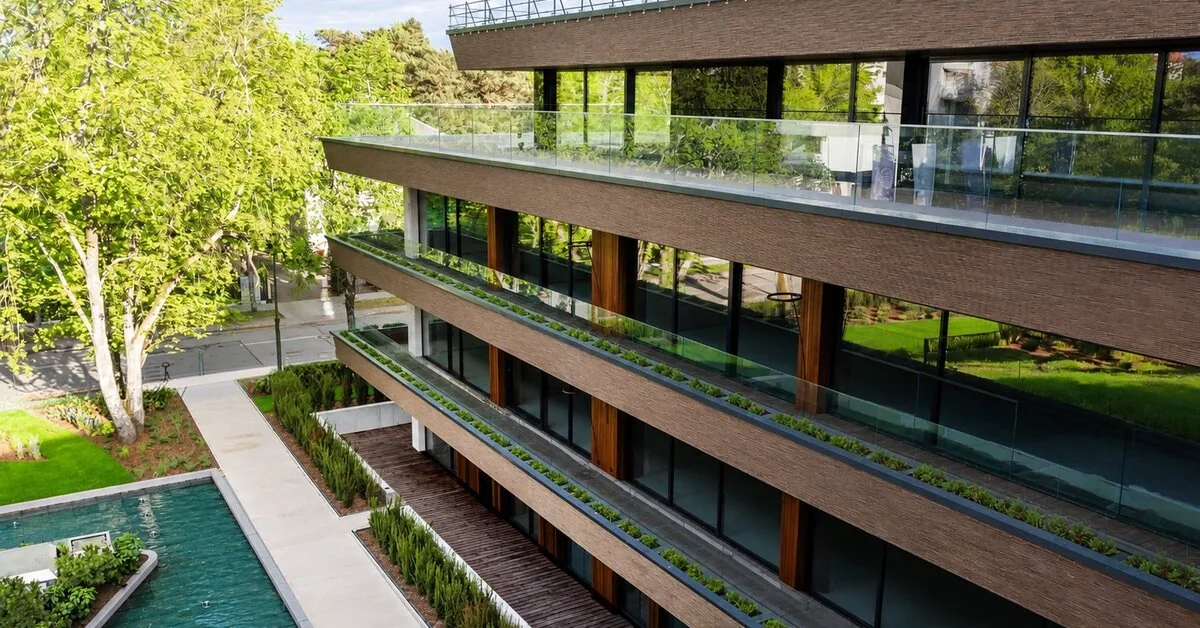
According to V. Simutis, projects developed in such places today best reflect the changing priorities of buyers. One of them is “Water Forms,” located on J. Simpson Street, near Birutė Park, pine forests, and the sea, but also allowing walking access to the most important city infrastructure.
“J. Simpson Street is one of those locations where several essential elements come together: privacy even in the height of the summer season, pine forest surroundings, and just a few minutes’ distance to the sea or Birutė Park. Such places in the resort are truly rare today,” says the broker.
The project includes 33 apartments with large private terraces, concierge services for residents, and architecture using Croatian limestone, Japanese handmade clay tiles, and Brazilian Ipê wood. A space based on the principles of a Japanese garden is being created in the inner courtyard.
However, according to the broker, for top-class buyers today, the most important thing is not individual solutions but the overall experience created by the place. “In this segment, buyers are very sensitive to details: architectural aesthetics, materials, artistic accents. It is important to them not that their home is visible to everyone, but that it matches their personal pace of life.
The top-class buyer no longer wants just a beautiful facade. They seek the feeling that when they arrive by the sea, they can truly ‘disconnect,’ and the home becomes the opposite of the exhausting daily pace,” summarizes V. Simutis.
Read more Hussites fired ballistic missiles at a Saudi Arabian tanker