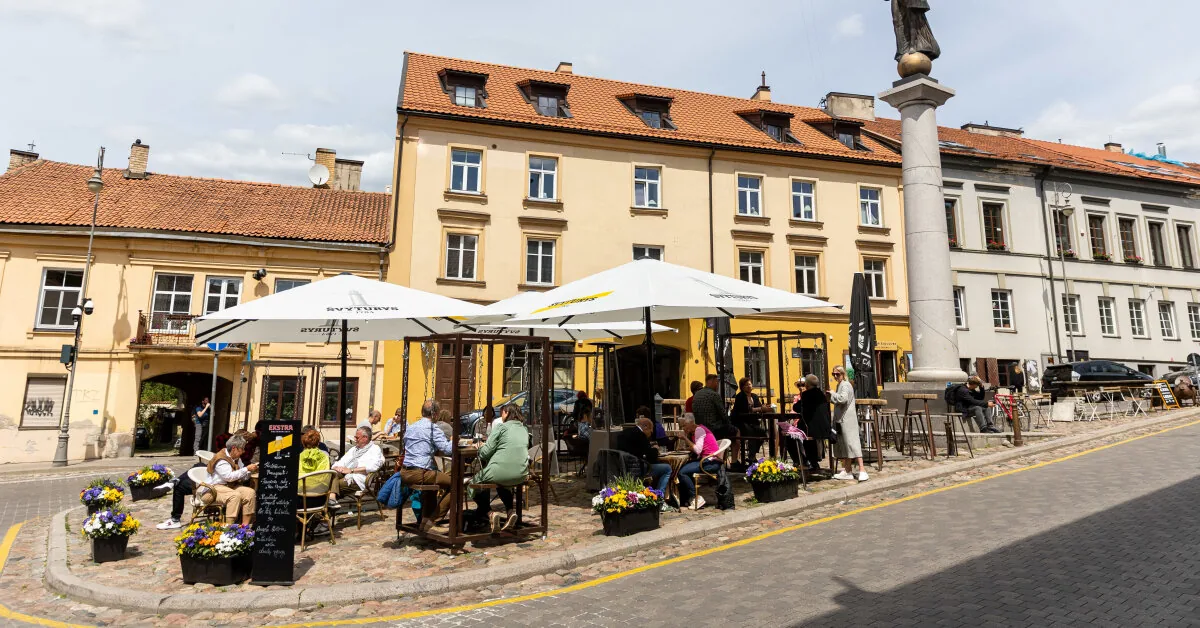
In the first half of 2016, the average price of new construction housing in Užupis was about 2600 euros per square meter, and 91 apartments were offered on the market. Today, the average price in this prestigious district of the capital reaches 5063 euros per square meter, while the supply consists of only 32 homes. Thus, over the decade, prices have almost doubled, and buyers’ choices have decreased nearly threefold.
Read more Vygantas Manto’s step caused a storm – Jolanta Naruševičiūtė took legal action
During this period, the structure of the supply itself has also changed. A few years ago, people looking for housing in Užupis could choose from several larger projects, but by the end of 2023, the last remaining apartments in “New Moon” and “Vilniaus Monmartas” were sold.
Since then, the only larger and actively sold project in the district has become the low-rise housing quarter “Užupio Personos” developed by “EIKA Development” on Filaretų Street, where buyers can currently choose from only 17 remaining homes. In recent years, several smaller-scale projects have also been developed in Užupis, but they have not created a significant supply in the market.
“In Užupis, we face a situation where there are far more people wanting to live here than opportunities to offer new housing, which drives prices up. Plots suitable for new development appear very rarely on the market, so when a new project emerges, buyer interest does not take long to appear. From an investment perspective, Užupis remains one of the best real estate investments in Vilnius,” says T. Žiaugra.
Paupys further strengthened the district’s attractiveness
Over the past decade, not only housing prices have changed, but also Užupis itself and its immediate surroundings. One of the most notable changes was the development of the Paupys district, which added new restaurants, shops, daily services, leisure spots, and public spaces to the Užupis neighborhood.
While Paupys grew, Užupis preserved what sets it apart from other central Vilnius districts – historic architecture, small streets, a strong community, and a unique character full of art and cultural traditions. Over time, driven by positive infrastructure changes, buyer interest in the district has only increased further, which also contributed to the price growth.
“Today, Užupis’s value is created not only by its history or the prestige of the district’s name. The transformation of Paupys has added services necessary for everyday life and quality public spaces to the surrounding area, while Užupis has preserved authenticity, closeness to nature, and a strong community. Such a combination would be very difficult to replicate in a newly created district,” says T. Žiaugra.
The district’s attractiveness is also strengthened by its location – Užupis is surrounded by the Vilnelė River and green spaces, and the Old Town, Bernardinai Garden, Kūdrų Park, and Paupys are reachable within just a few minutes on foot. Residents of the district can use the city center’s infrastructure while maintaining privacy, closeness to nature, and a slower pace of life.
The supply shortage is expected to persist in the future
Significant growth in the supply of new housing in Užupis is unlikely in the coming years. The district occupies a small area, and much of it is already built up, so even with high demand, new projects cannot start as quickly here as in the expanding parts of the capital.
In many cases, new development in Užupis is only possible by reconstructing existing buildings or converting already formed territories, but projects are complicated by the area’s historic character, hilly terrain, heritage protection requirements, and the need to integrate new architecture into the existing environment.
These circumstances mean that from finding a suitable plot to offering new housing to the market can take several years, and small-scale projects add only a few dozen homes to the supply. According to T. Žiaugra, the current situation is not a temporary market fluctuation but a long-term phenomenon.
“Even if the opportunity arises to develop a new project, supply in Užupis will not grow quickly. Every decision here requires more time, and new projects are usually smaller due to the territory’s specifics. It is likely that this supply and demand imbalance will persist in the future, so the value of every existing home here will only continue to rise each year,” concludes T. Žiaugra.
Read more Cars don’t fit in the city: are Klaipėda drivers to blame?