

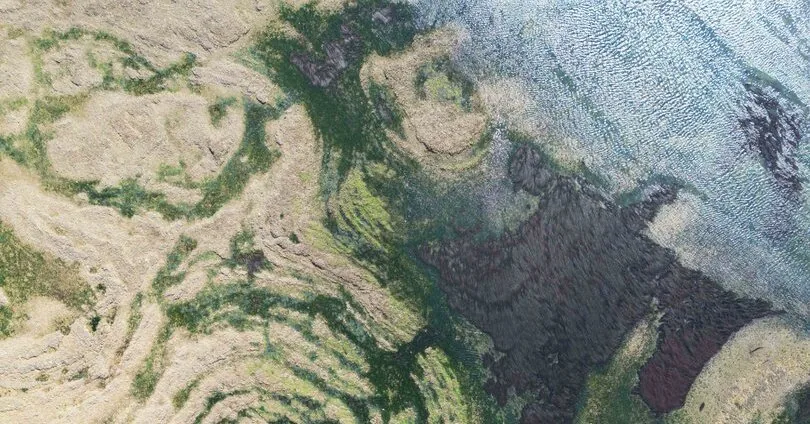
From wandering through foreign countries was born P. Šliaupa’s photography series “What Birds See”. This weekend it will be opened at the “Merkinė Factory” in Merkinė. The photographs born from the artist’s travels through Lithuania, France, Vietnam, Argentina, and Bolivia explore the landscape – a constantly changing, living fabric where natural processes and traces of human activity intertwine.
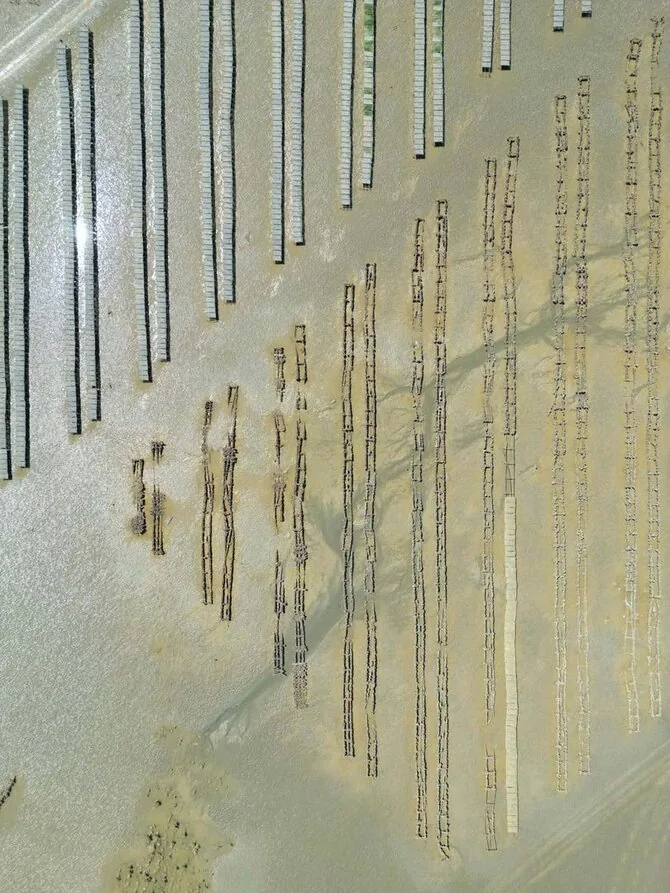
The mechanical eye of the drone reveals geometry that we usually do not notice – repeating paths and traces, infrastructure networks, compositions of animal figures, ornaments formed by water and minerals. These images become a kind of fossil of our times – fragile testimonies about the constantly changing relationship between humans, technology, and living earth.
Before the exhibition opening, Laisvė Radzevičienė spoke with P. Šliaupa.
– The exhibition title is “What Birds See”. But there is no question mark in it. Are you asking if you are looking for another perspective on the world?
– The title does not offer a single answer; it invites you to look differently. The bird’s gaze allows seeing not objects, but broader landscape connections that resemble networks of cells, capillaries, tree roots, or microscopic biological structures and how different processes intertwine into a living fabric.
– You spend many summers in Barteliai village, Varėna district. What has the Dzūkija landscape given to your creativity?
– Dzūkija taught me slow looking – the ability to stay longer in a place, observe and notice its subtle changes. Walking on sandy pine hills, I began to better understand and imagine the geological processes hidden here: after the glaciers retreated, huge lakes lay here, later wind and meltwaters formed sandy dunes. Living in the forest allowed me to feel that the landscape is not just a background for human activity – it has its rhythms, memory, and certain activities.
I liked being in the village – I used to go fishing with my father, mushroom picking with my grandmother. When it was mushroom season, she would pick mushrooms every day, then sell them and travel the world. As a child, I was also impressed that my grandparents constantly did real work in the village and invited me to join. All those tasks seemed very important.
There were many children in the village, some had homes here, some came from Vilnius, Varėna, or Matuizai, and we invented all kinds of activities. Life was lively, and the company by the Merkys River gathered from different homesteads.
When I was still studying at the Vilnius Academy of Arts, I relieved study stress by the Merkys. I would sit and watch the water, then I started photographing, noticing that the river looks different from different places, it constantly changes. Starting to film the water, I discovered abstract, mysterious, enchanting motifs that became part of my paintings.
Childhood and later summer experiences in Barteliai shaped my sensitivity to light, seasonal changes, and small, often unnoticed changes that constantly happen around us.
– Looking at the photographs, it is hard to tell if it is a river, ice, salt flats, or perhaps human-made infrastructure? Did you want the viewer to be confused and think when looking at the photos?
– I am interested in the moment when the viewer briefly encounters a vision that changes, not a specific image. Then the landscape becomes not a geographical place but a space of experience.
– You photograph with a drone – a technology often associated with control and surveillance. Is the drone a tool for listening for you? What do you hear in the landscape?
– I hear the collision of different time layers. Natural processes often happen slowly, while human interventions leave sudden cuts. The drone allows seeing, feeling these rhythms and the tension arising between them.
– Your works almost lack a horizon, which means – also the usual reference point for us…
– The horizon gives us a sense of security – it helps understand where we are. Without seeing it, the viewer becomes less certain about their position. There is an opportunity to look at the landscape not as an image but as a structure, texture, process.
– The photographs were created in Lithuania, France, Vietnam, Argentina, and Bolivia. From a bird’s flight perspective, does the world look similar everywhere?
– Certain systems repeat from above – river networks, paths, erosion forms, human-made structures. But at the same time, the unique materiality of each place stands out: colors, surface textures, geological layers, signs left by climate and human activity. I am interested precisely in this tension between order and randomness – between universal processes that repeat in different parts of the world and the unique history of each landscape.
Read more ES accuses «Temu» of obstructing inspection in Ireland
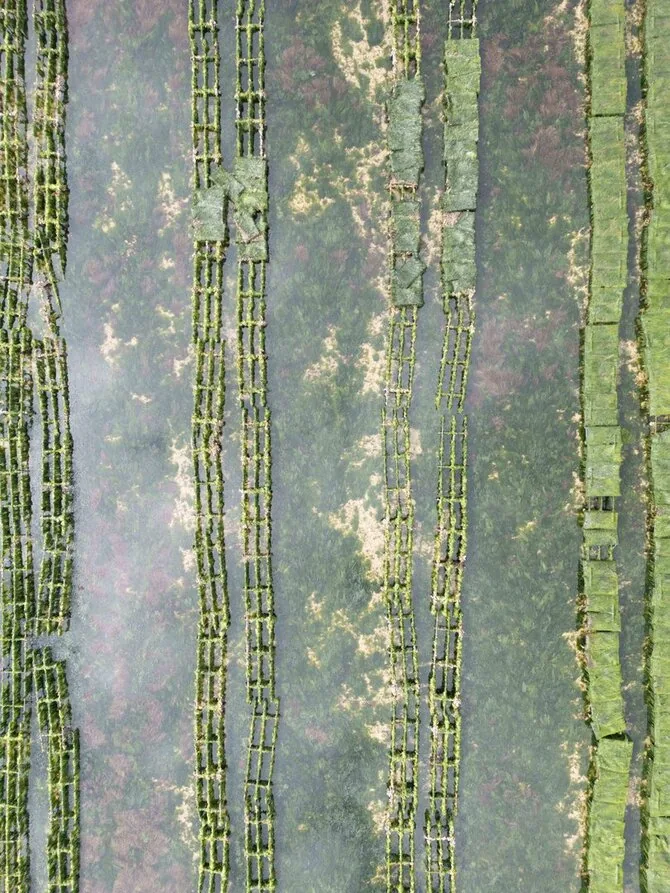
Sometimes frozen dinosaur shapes, animal figures, or even faces appear in the ice over a frozen lake, which you would never notice while walking. Elsewhere hidden natural patterns, invisible processes, and structures emerge, visible only from the drone’s perspective.
These moments are often related to pareidolia – a psychological phenomenon where the human brain recognizes familiar objects, animals, faces, or other meaningful shapes in random, irregular images, forms, or sounds. I am interested in this boundary between what we actually see and what our imagination adds – the moment when the landscape becomes not only an external image but also a mirror of our perception.
– You have said that sometimes you have to wait hours for the right light. How do technology and patience fit together?
– Technology is often associated with speed, true, but in my practice, it requires patience. The drone can take off in seconds, but the right light, fog, blizzard, rain, shadows have to be waited for hours, days, weeks, months. Isn’t such tension between fast technology and slow observation interesting?
– One of the exhibition’s ideas is that these images become fossils of our times. What traces will future people find about our epoch in them? Will they see a builder or a destroyer?
– I think that humans both build and destroy at the same time. Every construction becomes a transformation, sometimes destruction. I am interested in how these traces of human activity are inscribed into the longer history of the landscape.
Future people will probably see a period when past humans became a geological force. They will find infrastructure networks, mining marks, agricultural geometry, signs of climate change, hints of extinct animals and plants. Perhaps these images will also testify to our desire to see everything, map, and control.
– You are a painter, sculptor, media artist. Why did you choose photography for this exhibition?
– While traveling, filming, and preparing new works, I always photograph – it is an inseparable part of my creative process. But this material usually does not become a work – it remains an auxiliary tool, archive, or part of research. In this exhibition, I wanted to show another side of my creativity – images that existed for a long time only in the process of observation and research.
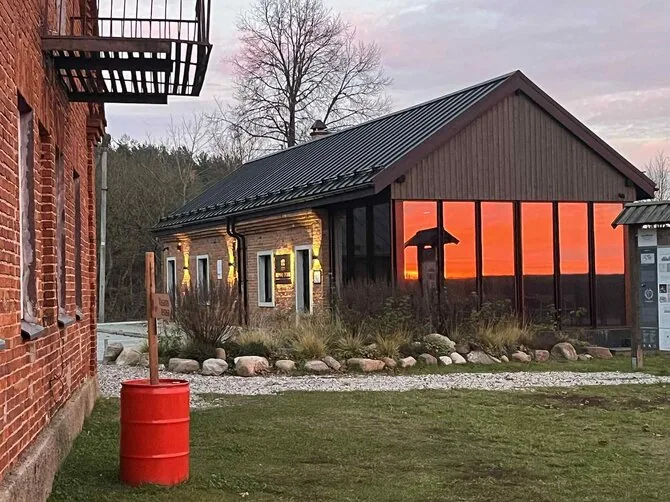
The photography medium suited this exhibition very well because of the space’s specificity. In the environment of the “Merkinė Factory,” on the hillfort, facing the open landscape, the bird’s flight view becomes a natural continuation of the place experience. Even more – in this place, the collision of different time layers – nature, industry, community, and history – is especially felt. This is also close to the exhibition, where I explore the constantly changing relationship between humans and landscape in different parts of the world. The local space becomes a kind of link between a specific place and a broader world context – between what is close, familiar, and what is distant, unknown.
The glass architecture of the factory is also important to me, naturally connecting inside and outside. It allows experiencing the exhibition not as a closed exposition but as a dialogue with the environment. We exhibit the photographs double-sided – different compositions open up when viewed from inside and outside, so the image constantly changes; the viewer’s movement from outside to inside also becomes part of the exhibition.
– When photographing from a bird’s flight, do you yourself not feel diminished?
– There is a feeling as if you gain new powers – your eye seems extended, you can see the world from many previously unreachable perspectives. But at the same time, your scale changes: from above, a human becomes only a small part of the landscape. Losing the “extended eye” – the drone – you return to the usual gaze from the ground, and the world seems to narrow.
From above, it becomes clearer how fragile and temporary nature is, how strongly human activity changes it. The landscape, which up close seems spontaneous and unchanging, from above reveals a complex living fabric where natural processes and human traces intertwine. This distance not only diminishes the human but also allows seeing that it is precisely humans who are responsible for the environment.
– Is there a place in Dzūkija that you still dream of photographing from a bird’s flight?
– I would very much like to photograph over the Čepkeliai bog, but it is a reserve area located in a border zone. I imagine the unseen marsh structures, subtle patterns, textures that open up there. Perhaps the fact that it is inaccessible gives this place even more mystery and attraction.
P. Šliaupa’s exhibition “What Birds See” will be held from August 1 to September 1 at the “Merkinė Factory” (Gardino St. 28, Merkinė). The exhibition can be seen from outside every day, at any time. From inside – on Saturdays and Sundays from 12 to 6 pm.