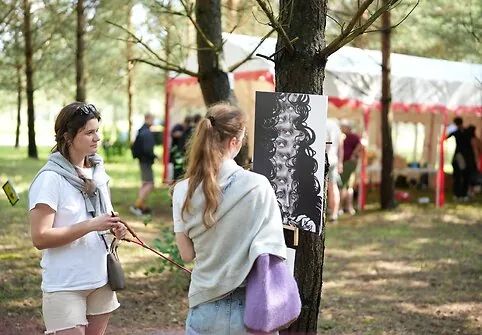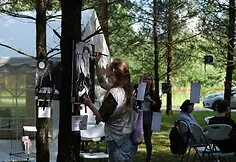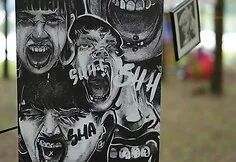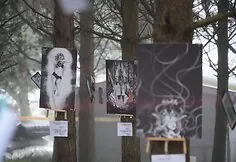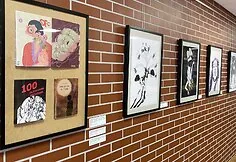



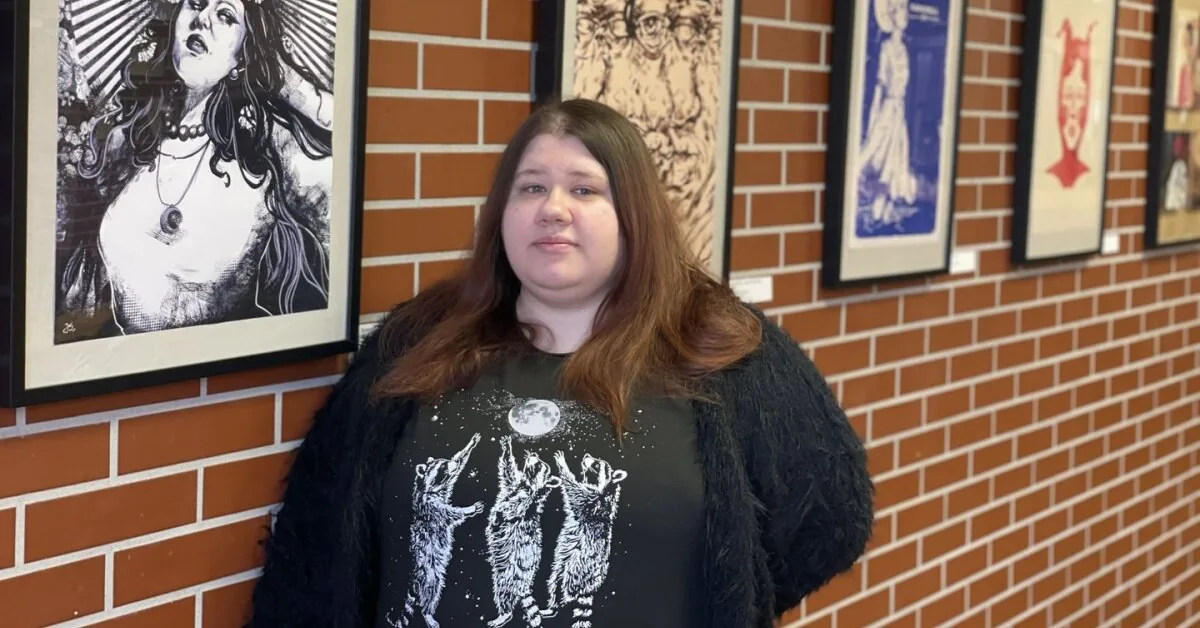
“When exhibiting my works in group exhibitions or festivals, I used to like standing somewhere in a corner and watching how people react to what I show. I like it not when the work is praised, but when the exhibition visitors are surprised or outraged,” the artist smiles.
Read more After the opponents’ stunt – the outraged head of «Šiauliai»: «This is disrespect»
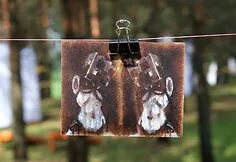
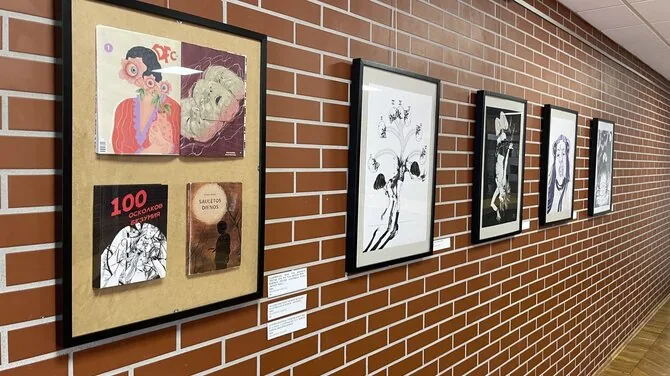
For a long time, the theme of erotica occupied a prominent place in her drawings, but grotesque has accompanied her since school days. Andželika is drawn to chaos, paradoxes, and the unexpected beauty hidden within them.
“A beautiful work is not always remembered by a person as much as one that shocks them. And sometimes it’s easier to express yourself through various strong emotions,” she says.
Drawing since childhood
Currently, Andželika works as a designer at the Kupiškis Cultural Center, and she dedicates her free time to creativity, books, old films, and music. Most often, post-punk plays on her playlists, which, as she says, probably somehow transfers into her creative work.
Andželika grew up in Kupiškis until first grade, then lived in Panevėžys for a while, and later returned to her hometown, where she finished school.
Although she loved drawing and illustrating from a young age, for a long time Andželika did not think that art would become an important part of her life.
“In school, I really didn’t think I would tie my life to it. In adolescence, I even abandoned drawing and thought I would never do anything with it again,” she recalls.
However, in Kupiškis, she met more young people who drew – they gathered in youth spaces, sharing their creativity.
“That’s how I started drawing again, rediscovering myself. And the people around me, who noticed my works, encouraged me to take creativity more seriously,” Andželika says.
Failed exam did not stop her
After finishing school, Andželika prepared to enter the Vilnius Academy of Arts. However, her first attempt was unsuccessful – although she loved books, she failed the Lithuanian language exam, so she could not get a state-funded place.
After a year, she retook the exam and began studying graphic design at Vilnius College of Technologies and Design.
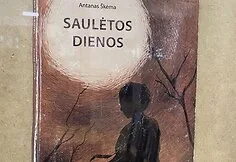
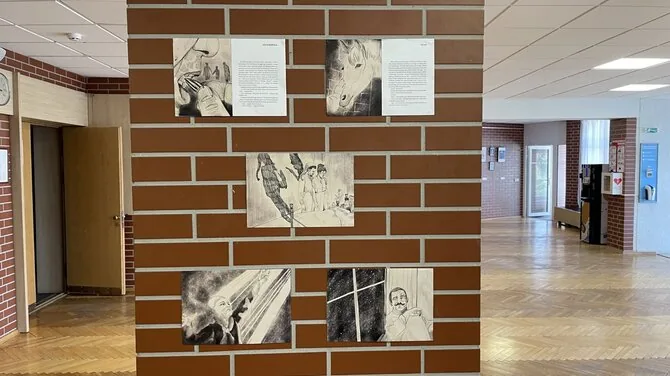
For her final project, Andželika chose to illustrate one of her favorite writers Antanas Škėma’s book “Sunny Days.”
“Illustrating a work that you like and that inspires you is simply a gift. Then you feel free to create,” she says.
Antanas Škėma is important to Andželika for another reason – it was in his works that she discovered the grotesque and irony that still fascinate her.
“Grotesque appeared in my life back in school when I started reading Škėma. I was very fascinated by the irony in his works. I have read ‘The White Sheet’ more than once, and each time it seems I see something new,” the artist says.
From Vilnius and Norway – back to Kupiškis
After studying in Vilnius, Andželika did not stay long. For a while, she went to Norway to earn money, later returned to the capital, but could not find long-term work there.
So four years ago, she returned to Kupiškis.
“At that time, there was certainly no great joy. I worked jobs unrelated to creativity, spent a lot of time drawing. But little by little, I tamed the city again. Maybe that’s why a job appeared that I really like,” Andželika says.
Now she works as a designer, and after the workday, she continues to draw, create illustrations, and participate in exhibitions.
“Living solely from creativity would be difficult for me. Not only because of financial instability. Now drawing after work is a relief. I’m afraid that if I were obliged to constantly draw and create on commission, it would no longer bring such pleasure,” she reflects.
An exhibition where it was possible to be angry
Most often, Andželika participates in group exhibitions and festivals with her works. She did not immediately dare to hold her own solo exhibition.
Read more Donald Trump urges Ukraine to stop attacking Russian oil refineries
She held her first solo exhibition in Kupiškis but did not widely publicize it. A very different interactive exhibition was presented last year at the city festival.
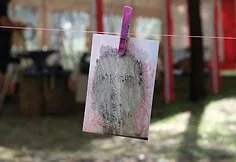
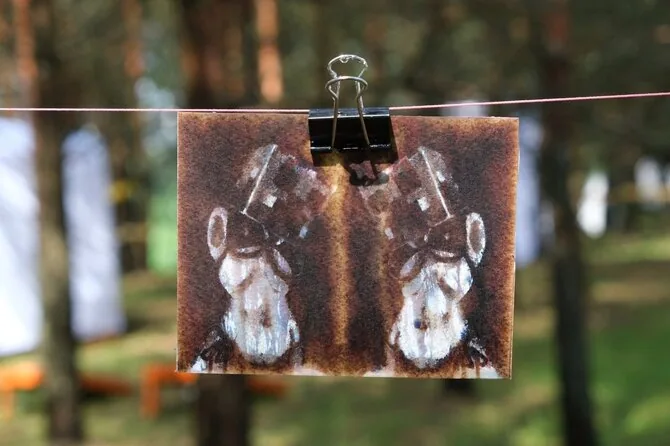
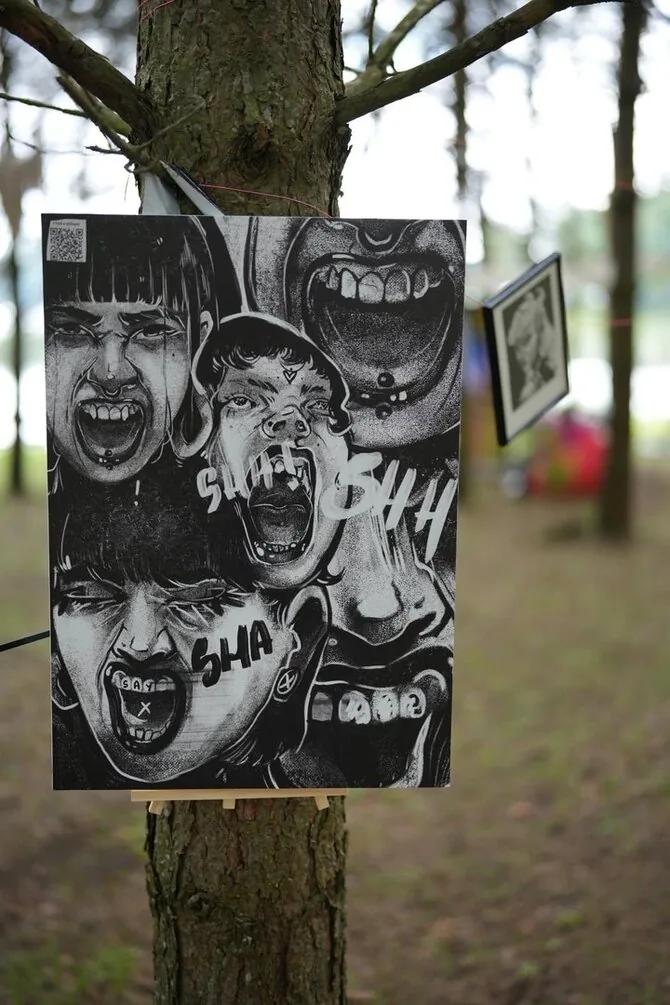
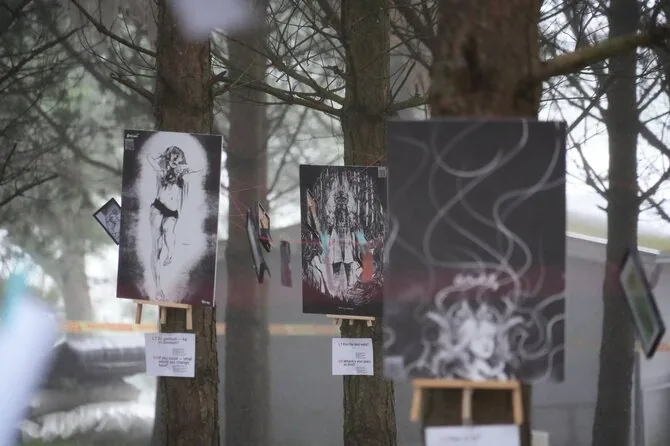
“I created ten provocative works and allowed people to draw on them. I called the exhibition ‘Here you can be angry.’ I wanted people to be able to vent and somehow react to what they see,” she says.
At first, visitors approached the works cautiously.
“People didn’t know if it was really allowed. But later they got really involved,” Andželika laughs.
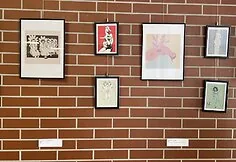
This year, she held another exhibition presenting works created over several years. She named the exposition “Grottesco” – not by chance, because grotesque is one of the most important parts of her creativity.
“I like grotesque not only in literature but also in cinema. One film that strongly influenced me is Alejandro Jodorowsky’s 1973 film ‘The Holy Mountain.’ What may shock or repel other people fascinates and inspires me,” she says.
Andželika introduces herself in her work under the pseudonym “Joshephi” not by chance. This name was born from an old film reel.
“I watched a 1932 film where the main character was named Joseph. That name stuck with me somehow, so I slightly changed it, and Joshephi was born,” she says.
Erotica, chaos, and unexpected beauty
There is quite a bit of erotica in Andželika’s works, but it is only one of the themes that allow the artist to provoke and test the viewer’s limits.
“I like drawing erotic works. They inherently have a certain spice of provocation. I usually observe people’s reactions from the side, but sometimes I have to discuss what exactly caused the emotion in a person, why they got angry or outraged,” the artist says.
Her creativity is inspired by very different sources – works of other artists, old films, books, and music. Spontaneity also plays a big role.
“I don’t think you should sit and wait for inspiration because you might never get it that way. I do a lot impulsively. Of course, an idea definitely doesn’t come by force. Often some thought just comes from the subconscious, and then I go to draw,” Andželika says.
She constantly experiments with different techniques. Earlier, she drew more traditionally on paper, but now she often starts the creative process by hand and later transfers the work to the computer.
“I draw a sketch, scan it, and then finish creating in the digital space. I like trying different ways and not limiting myself to one technique,” she says.
Drawing artists will not lose their value
Speaking about the future of creativity, Andželika admits with curiosity but also a certain dose of skepticism to the establishment of artificial intelligence in creative fields.
“Nowadays, sometimes those who simply use artificial intelligence try to call themselves creators. However, I believe that people who truly draw and create will not lose their value. In creativity, not only the final result matters but also the person, their experience, thoughts, and what they put into the work,” she says.
Andželika hopes to hold more exhibitions in the future. Although she calls herself modest, today she can confidently say that her creative path is unfolding successfully.
“I don’t draw just for myself, so I want to show my works to people. I hope there will be more exhibitions and opportunities to share what I create in the future,” she says.
Having returned to Kupiškis four years ago, Andželika now looks at the city differently. Here she found not only a job she likes but also a space for her creativity, which does not necessarily have to please everyone.
“If a work evokes something in a person, even if it is anger or outrage, it means it did not leave them indifferent,” Andželika concludes.