






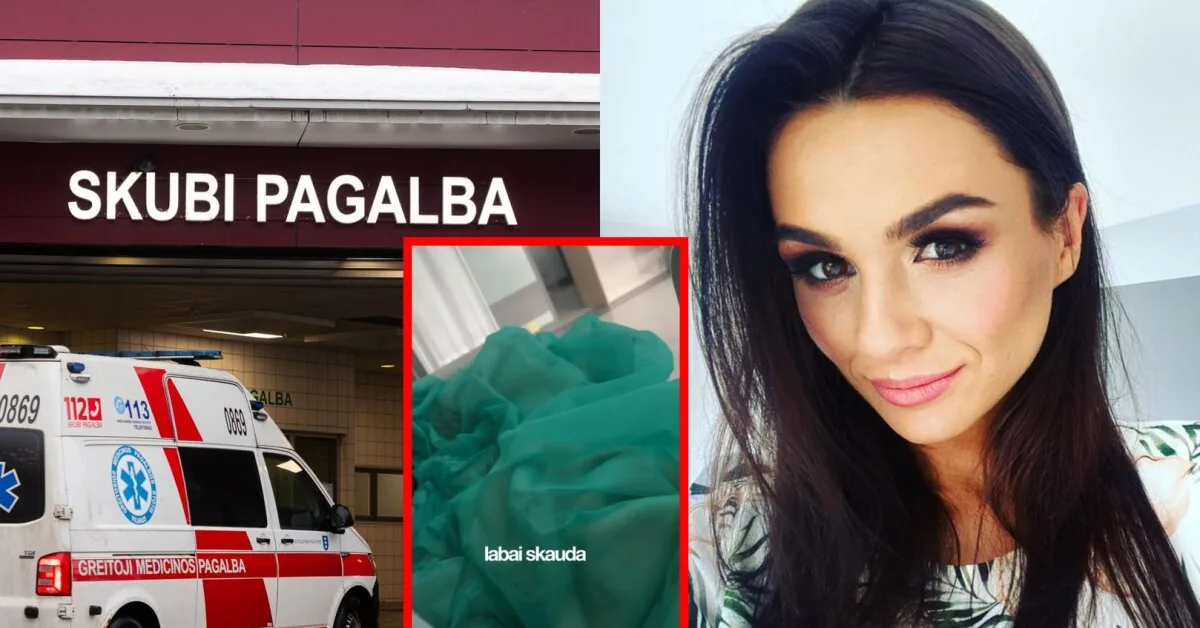
As previously reported by the portal Žmonės.lt, a post by Teacher Veronika spread on social networks, in which she described the behavior of the staff at Santaros Clinics.
Read more Near Riyadh airport, an Aramco fuel tank is on fire: air hazard declared
The woman spent the night in a shared ward of the Emergency Department and praised the evening staff. However, according to her, everything changed in the morning when another shift came: the staff allegedly swore loudly, discussed colleagues, and when patients asked them to at least do it more quietly, they ignored it and even reacted mockingly.
Veronika Naumovaitė-Kazilionė said she has already contacted the institution’s director about this.
When the portal Žmonės.lt contacted Santaros Clinics about the situation, the institution provided its comment.
“We are very sad and sorry about such a patient experience. We sincerely apologize for the unpleasant moments experienced. Respect, compassion, and empathy at Santaros Clinics are what we strive to follow every day, so we unequivocally view any disrespectful or unethical behavior negatively. We understand that patients come to the hospital seeking help, so supportive communication is no less important than medical assistance, and sometimes a kind word becomes the main medicine.
We immediately discussed this incident with the employees of that shift and received written explanations. The employees admitted that inappropriate language was used during communication, although there was no intention to offend anyone deliberately. We are currently conducting an investigation of the situation and will make appropriate decisions.
Santaros Clinics is currently undergoing a major organizational transformation. Our main motto is ‘With you. For you,’ but we are a large institution uniting more than 8,000 employees, so the desired changes do not happen as quickly as we would all like.
We clearly see and understand where improvements are needed, so we act systematically. Our organizational psychologists constantly conduct training for employees on respectful communication, conflict and stress management, which accompany medical work daily. Based on the best practices of other organizations, we are preparing a unified communication standard for the entire hospital team. We aim for every person who turns to Santaros Clinics to experience attentive and respectful behavior in our daily activities,” commented Santaros Clinics.
Žmonės.lt reminds that Veronika Naumovaitė-Kazilionė published a post in which a fragment of a conversation with the staff can be heard, and a letter she sent to the director of Santaros Clinics can be seen.
“I thought for a long time whether to make these voice recordings public, but I decided not to stay silent. Because I do not like disrespect and injustice.
I spent this night at Santaros Clinics because my test results were poor, although I was already feeling better.
First of all, I want to sincerely thank the doctors of Santaros Clinics for their care, professionalism, and assistance provided.
And now, the sadder part.
I had to spend the night in the Emergency Department. Of course, a shared ward is not the most pleasant rest, BUT THE EVENING STAFF, remember this, was absolutely wonderful. Warm, kind, caring nurses. They took excellent care of me and other patients. I am very grateful to you. You are amazing!
BUT…
Everything changed when the morning shift arrived.
The nurses came to work already clearly dissatisfied. Well, I thought, maybe it’s a tough morning. Anything can happen.
From about 7–8 a.m., loud discussions about colleagues began. The topic was sick leaves, that many colleagues took them and now those left will have to work more. All this was discussed loudly, not avoiding swear words.
Okay. Emotions, morning… I still didn’t pay attention.
Later, personal life stories, jokes, and conversations began, in which swear words sounded practically every other sentence. My ears started to hurt. But I was still silent.
After a while, an older woman very nicely and politely asked:
Girls, could you please be a little quieter? I have a bad headache.
And she heard an answer something like this:
So what? I have a headache too. This is our workplace, can’t we talk?
The woman fell silent.
My blood was boiling, but I still tried not to give in to emotions.
After a few minutes, laughter, loud conversations, and even stronger swear words started again.
The older woman ONCE AGAIN very nicely asked:
Girls, I kindly ask you…
And then I couldn’t stand it anymore.
I intervened and said that we are in a public medical institution where sick people lie, so such communication, loud swearing, and reaction to a patient’s request are neither professional nor ethical.
The charming ladies suddenly fell silent and began nodding their heads as if to say “it wasn’t like that.”
I will definitely not allow an older person to be humiliated or treated disrespectfully just because they may not dare or cannot always stand up for themselves.
Let’s remember one simple thing: one day we will be that age too. And then we will also want basic respect and humanity.
Do you think that’s all?
UNFORTUNATELY NOT.
Another nurse comes and asks:
What was that?
And the colleagues answer her:
This one from bed 10 filmed it and is explaining to us (that’s me)
Well, then I had to explain to her what respectful communication and basic culture are.
I have already written about this situation to the general director of Santaros Clinics. He is currently on vacation, but I hope to receive a response and hope that the morning shift will be reminded of the basic rules of professional ethics and communication with patients.
But I also very much hope that the evening shift will be PRAISED.
Because those people were wonderful. Caring, warm, professional, and meticulous in their work.
So this post is not about everyone being bad. On the contrary. In one night, in the same place, I saw two completely different examples.
And finally.
No matter what job you do.
No matter how hard your day was.
No matter what mood you came to work in.
RESPECT EACH OTHER.
Especially where people come when they are in pain, scared, or just really need another person’s help,” wrote V. Naumovaitė-Kazilionė.
Read more Parents reached 100 years: will you live that long too? The study provides the answer