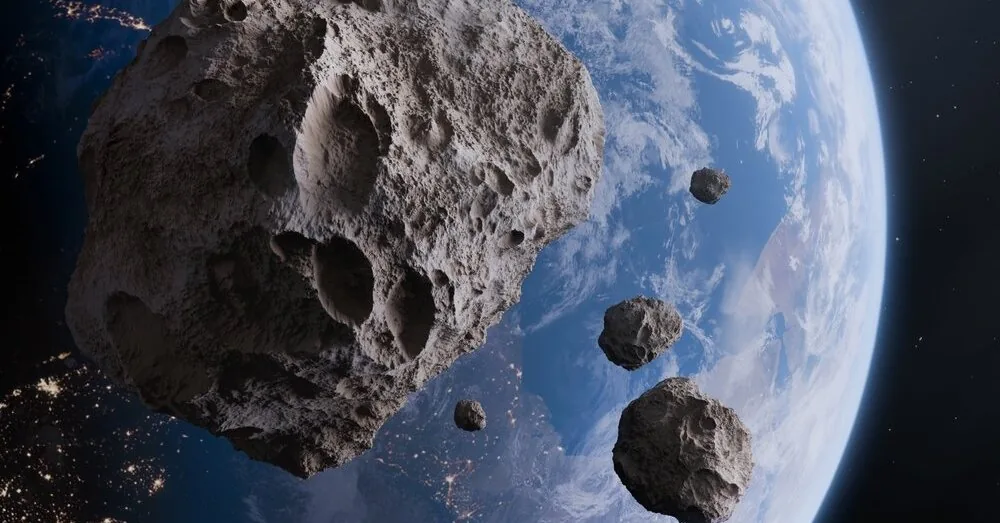










When astronomers look into space and observe planets orbiting other stars beyond our Solar System, called exoplanets, they expect distant worlds to follow certain rules.
Read more Poland has again raised fighters due to Russian strikes on Ukraine
For example, rocky planets like Earth and Mars should remain small and compact. Meanwhile, massive planets like Saturn, Jupiter, or Neptune accumulate huge layers of gas atmospheres and swell to the size of gas giants.
GJ 523b – a newly discovered exoplanet located 87 light-years from Earth – seems to break these planetary rules.
In a study led by Max Kroft, a scientist at the University of Wisconsin–Madison, astronomers used NASA’s Transiting Exoplanet Survey Satellite (TESS) and a ground-based telescope in Arizona, USA, to learn more about this unusual world.
This is the first exoplanet discovered and cataloged by scientists from the Wisconsin Center for Origins Research (WiCOR) project.
What they found puzzled the scientists a bit.
Mega-Earth?
To understand why GJ 523b is such a rule-breaking exoplanet, imagine 23.5 Earth masses packed into a planet only 2.5 times larger than our home planet.
Typically, a planet with a radius 2.5 times that of Earth is classified as a “sub-Neptune.” These are planets sized between Earth and Neptune, enveloped by a thick layer of gas atmosphere.
GJ 523b is incredibly massive relative to its size. Since such a large mass is concentrated in a relatively small space, astronomers call such worlds “mega-Earths” – a class of extremely dense and massive rocky exoplanets.
This discovery came after WiCOR scientists began searching for so-called “Hycean” exoplanets – a hypothetical type of exoplanet that may have a vast ocean and a life-supporting atmosphere.
M. Kroft and his team used the ground-based WIYN Observatory in southern Arizona to study the planet candidate in more detail, which had previously been detected by NASA’s Transiting Exoplanet Survey Satellite (TESS).
This candidate was eventually named GJ 523b.
Why is GJ 523b so unusual?
According to standard planet formation theories, GJ 523b in its current state should not exist at all.
Read more At the ceremony, the first F-35 fighter jet was handed over to Germany by the USA
This is because when a forming planet’s rocky core reaches about 10–20 Earth masses, its gravitational pull should act like a cosmic vacuum cleaner, attracting huge amounts of gas from the surrounding protoplanetary disk. This is a cosmic disk of gas and dust supplying the planet with materials needed for further growth.
Typically, such a planet would grow into a huge gas giant, similar to Jupiter or Saturn.
However, it seems that GJ 523b crossed this threshold but somehow remained a planet made almost entirely of solid rock and metal, with very little or no gas atmosphere at all.
So what is going on?
At just 170 million years old, GJ 523b is a real youngster compared to the planets in our Solar System, which is about 4.5 billion years old.
This means it has not been around long enough for a huge atmosphere to have gradually evaporated.
Measurements show that GJ 523b orbits its host red dwarf star in a very tilted, almost polar orbit, completing one revolution in just 17.75 days.
So how did it become so dense and grow to such a size, yet still remain a rocky planet?
One theory suggests it formed from the collision of two massive protoplanets. During such a collision, two heavy iron and rock cores could have merged, and the impact might have blown away the outer gas layers.
Another possibility is that GJ 523b initially formed with a thick gas layer, but strong radiation or flares from its young and active host star could have stripped these gases away.
Read more Marinated tomatoes according to the 3–9–10 formula with oil: a classic that never disappoints