





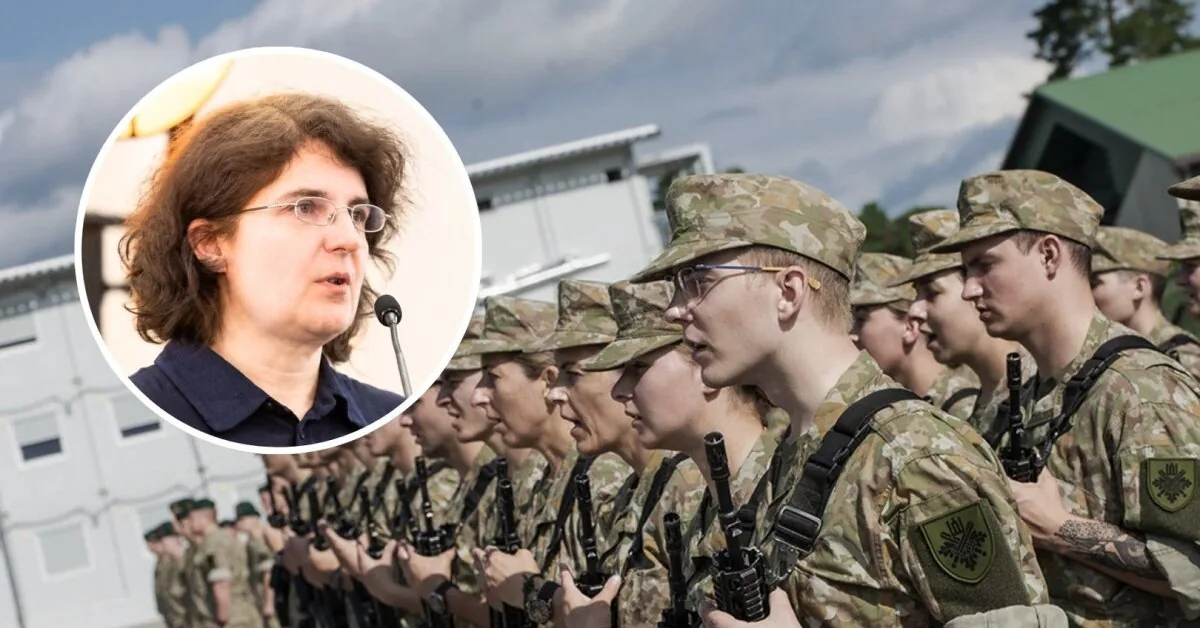
This year, several thousand more young people expressed a desire to perform mandatory initial military service than the army was able to accept.
This situation has sparked discussions on how the state can more quickly transition from partial to universal conscription. The “Universal Defense” association proposes that the state set 2030 as the final date for universal male conscription.
About conscription 15min spoke with Aine Ramonaite, professor at the Institute of International Relations and Political Science at Vilnius University.
– Does the growing number of young people volunteering to serve seem to you like a sign that youth attitudes towards national defense are changing? And is the state making enough use of this willingness?
– Our research showed that the youth in Lithuania have a considerable willingness to defend the country – greater than that of older people and greater than in other countries. We compared the willingness to defend the country in Lithuania, Latvia, and Taiwan. In Latvia and Taiwan, the trends were somewhat different – young people were not as willing as in Lithuania.
Why did the numbers increase this year? Because additional efforts were made by the Ministry of National Defense.
People start to accept that universal conscription may come, youth come to terms with the idea that they may be called up. Now the option to come as a volunteer is very attractive because you better control the situation – you don’t just sit and wait to be called, but you plan your life more in advance, for example, after finishing school.
On the other hand, conditions are better. Those who choose voluntary service receive more money. This can be a rational decision because young people nowadays want to have more control over their life trajectory. This choice gives them the opportunity to do so, instead of unexpectedly receiving a draft notice.
– Is the state able to take advantage of this?
– Our data previously showed that people view this positively and believe it is a duty to defend the country, and they would like to contribute in various ways, but they always lacked specific knowledge about what exactly to do.
It seems to me that the army is slightly changing its mindset. Previously, there was a cautious approach, especially regarding civilians or even members of the Riflemen’s Union – that war is a matter for professional soldiers, and it is important for society not to interfere with the military. Now that thinking is gradually changing, especially because warfare itself is changing a lot. Perhaps different skills are needed than before, when everything is shifting to drone warfare.
I think the army’s ability to engage society is also gradually growing. It’s just unclear whether it is growing fast enough. The question is which grows faster – society’s willingness or the army’s ability to integrate,
– Does the state, by encouraging young people to serve voluntarily, also take responsibility to ensure that this willingness is not disappointed?
– The answer lies in the question itself. Of course, it does.
It is interesting how the army and the Ministry of National Defense plan this. It is obvious that they made efforts to increase the willingness to serve because at one point there was a certain shortage they wanted to fill. But did they then plan what results those efforts would yield and how much funding and organizational capacity would be needed to implement all this?
Read more „We have no other choice“: Lebanese leader spoke about the agreement with Israel
If they did not calculate these things, somehow overlooked them, did not calculate at all, or calculated incorrectly, then it is a bit frustrating.
I think this is simply a temporary mismatch. Once they see the situation, they somehow address it. It often happens with us that actions are a bit delayed.
It seems to me that now we are in a transitional stage where the increased willingness is not yet fully activated, but I think it will be resolved soon.
– Could universal conscription without exceptions have a positive effect on reducing social division and creating stronger interpersonal bonds?
– When universal conscription was abolished, General Kronkaitis said it could have negative consequences.
Now we can think about possible positive consequences. The army is exactly the place where people see and meet different people than they are used to.
Usually, people live within their own circles, befriending people similar to themselves. And if universal conscription were without exceptions, including for those studying at universities, then people would have the opportunity to meet people from different regions, from different social classes, and establish closer connections.
The army and service are a certain challenge; more complex situations arise that unite people. When people go through difficult situations together, those relationships remain deeper.
We have spoken to people from the Soviet era. Often friendships from army times remain lifelong friendships. Even if people were from other “Soviet republics,” sometimes this experience maintained relationships long enough.
This is one way to form broader social capital among different social groups and could reduce polarization. One of the things that increases polarization is that people have no opportunities to interact with those who have different views. Then various stereotypical perceptions arise, which often diverge from reality.
In the army, a person would be forced to be close to people who are different from them and understand that they are actually the same people, perhaps with similar interests and character traits.
Then the bogeyman created in your mind disappears when you see live examples of people who think differently.
Read more 25 political prisoners released from Belarus will be transported to Lithuania