



Why were skulls chosen specifically and how do art and history experts evaluate this decision? 15min discussed this with historian Zigmas Vitkus, art critic Agnė Narušytė, art historian Sigitas Parulskis, and director of the Vrublevskis Library of the Lithuanian Academy of Sciences, Sigitas Narbutas.
Read more EC President Ursula von der Leyen will deliver the annual address
About the sculpture
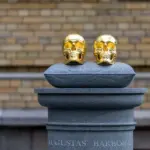
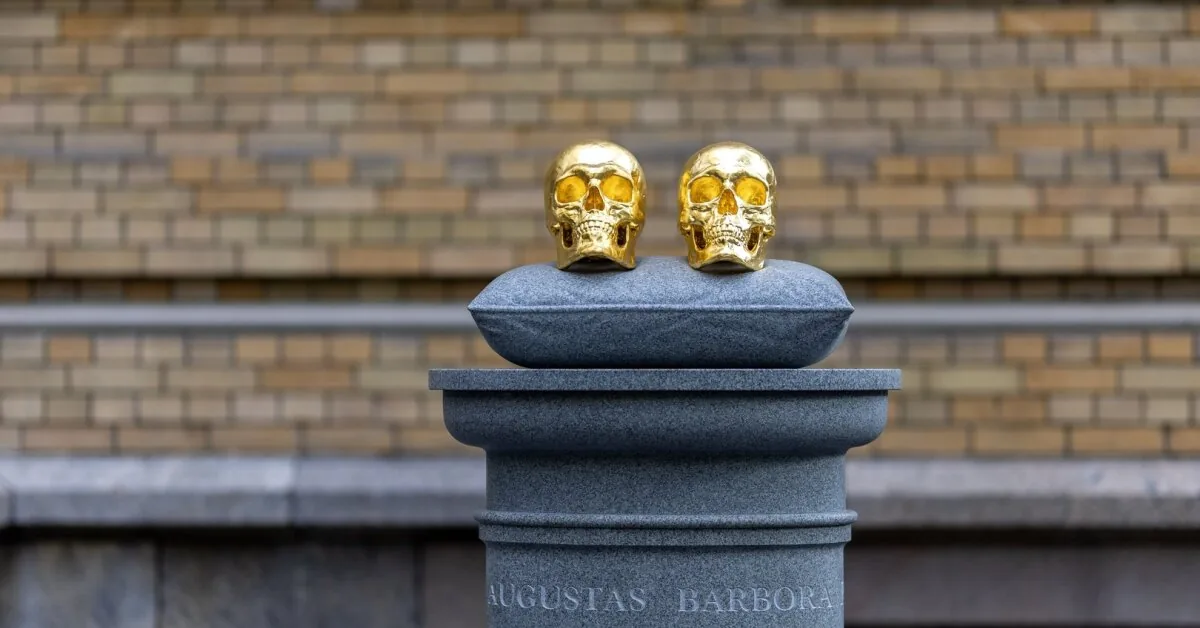
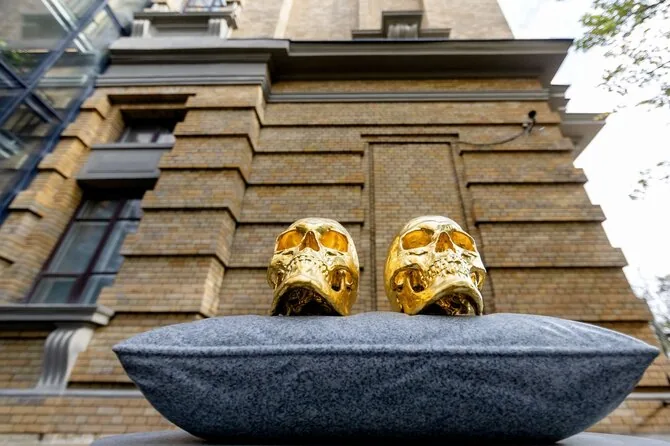
The author of the sculpture “Žygimantas and Barbora” is sculptor Gediminas Piekuras, architect – Aušra Gvildienė.
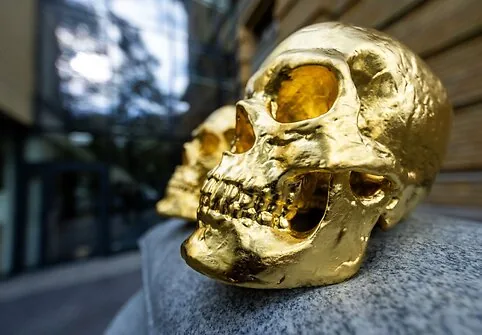
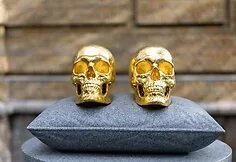
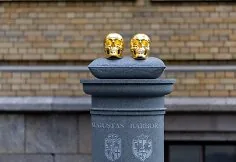
The sculpture was created following a creative competition held in 2024. G. Piekuras and A. Gvildienė’s project was selected as the winner.
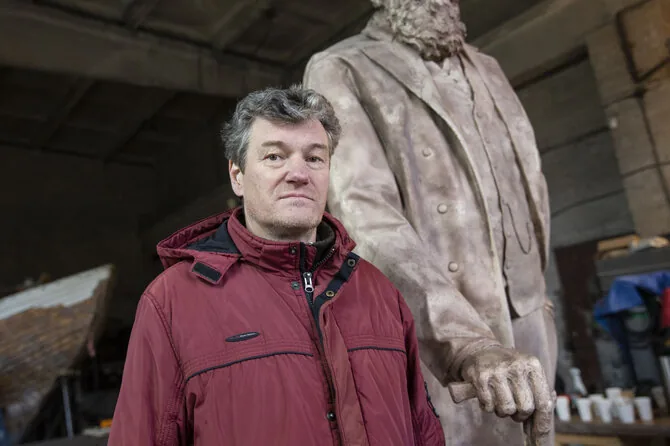
The implementation of the sculpture cost 60 thousand euros. According to the Vrublevskis Library, the project was realized through the initiative of the library community and private sponsors. Among the project sponsors are Birutė Butkevičienė, Vidmantas Martikonis, Augustinas, Dominykas, and Kristijonas Vizbarai.
Even before the project was implemented, its evaluation emphasized the unconventional approach to the historical couple. The commission members regarded the idea as universal, speaking about death and immortality, and the decision to abandon traditional depictions of historical figures was considered one of the project’s distinctive features.
At that time, commission member Valdas Puteikis evaluated the project as a universal artistic idea, “without sculptural clichés,” speaking about death and immortality. He also emphasized the work’s courage and resilience over time.
“Among all the competition participants, Gediminas Piekuras’s work stands out for its courage to speak about eternity. And to speak about it universally. To speak upliftingly, but without pathos, without exaltation, and without grandeur clichés. <…> At first glance, it provokes, raises many questions, so I am sure it would awaken curiosity and intrigue both Vilnius residents and visitors, but at the same time, this work would become understandable to Lithuanians, French, Brazilians, and Japanese – which is a feature of the lasting value of an artwork, as well as its resilience to time and historicity. It is clear that the work would easily withstand the test of time,” said V. Puteikis at the time.
Now, almost two years after the competition, the work has been placed in the recently renovated courtyard of the Vrublevskis Library and has sparked considerable discussion.
Why are Žygimantas and Barbora – skulls?
On September 10, during the unveiling of the work, the Vrublevskis Library of the Lithuanian Academy of Sciences called it a “double-towered cathedral,” which contains the love story of Žygimantas Augustas and Barbora Radvilaitė, the memory of the Lithuanian state, and the golden age of Vilnius.
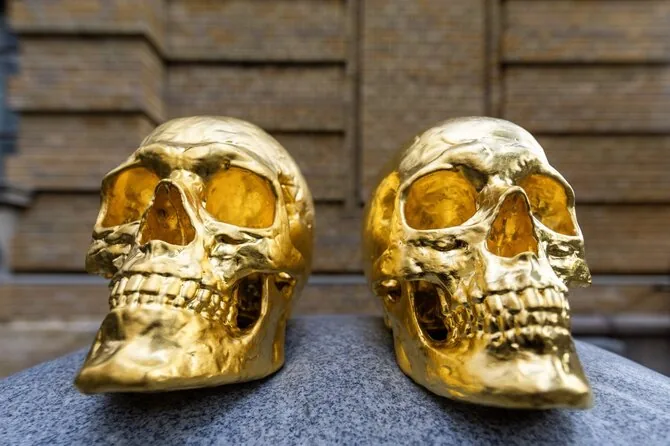
The sculpture’s opening ceremony began with Björk’s song “Ancestress,” and the library highlighted the phrase in it: “My skull is my cathedral.”
According to the library, this choice was not accidental – the song’s motif is connected with the memory of ancestors, and the skulls in the sculpture became a symbol of memory and what remains after a person’s death.
The idea of the work is also explained by the Lithuanian Artists’ Association (LDS), which contributed to the competition’s conditions and organization. According to them, the skull in Western art tradition often reminds of “the temporality of life, death, and finiteness,” while gold gives this symbol another meaning – “value, light, survival, and permanence.”
Therefore, according to LDS, the two golden skulls become not only a symbol of death. They should speak about the connection between two people that remains even after their lives end.
The main idea of the work, according to the association: “Love is immortal.”
Kamilė Gogelienė, chairwoman of the Historical Memory Commission of Vilnius City Municipality, also associated the sculpture with memory.
I am glad that such works adorn Vilnius’s public spaces.
“A wonderful artwork commemorating one of the most famous couples of the Grand Duchy of Lithuania and their love story. The sculpture not only decorates the library space – it invites one to pause and look anew at our history, at love and death. I am glad that such works adorn Vilnius’s public spaces,” K. Gogelienė wrote on the social network Facebook.
However, not everyone viewed the skulls the same way.
Experts’ view – not just a symbol of death
After the sculpture’s presentation, there was no shortage of critical reactions. Historian Aivas Ragauskas, interviewed by LRT, called the symbolism of the skulls too universal and doubted their connection specifically with the love story of Žygimantas Augustas and Barbora Radvilaitė. In his opinion, the combination of gold and skulls alone does not sufficiently convey the story of the specific historical couple.

However, experts’ opinions differed.
15min spoke with historian Zigmas Vitkus from Klaipėda University’s Baltic Region History and Archaeology Institute, who views the sculpture favorably. In his opinion, the work should not be judged solely by whether Žygimantas Augustas and Barbora Radvilaitė are immediately recognizable in it.
If there had been a pretty, figurative sculpture depicting a couple lovingly looking at each other, it would, of course, be correct but uninteresting, provoking few thoughts.
“An unexpected, surprising work. And indeed multilayered. As soon as it was unveiled, I immediately sent a message to people whose opinions I value, and we immediately had a lot of discussion. It speaks to us about life and death, the fragility of life and eternity, royalty, pride, and vanity, because ‘remember that you will die.’ Also, the couple’s intimacy, until death,” says the historian.
According to him, a specific historical context can also be found for this interpretation.
“As we know, Žygimantas Augustas kept vigil for weeks at his dying wife’s bedside, then accompanied her coffin on foot and horseback from Krakow to Vilnius, and even requested to be buried in Vilnius. On the way to Vilnius, the king’s entourage saw much death because an epidemic was raging in the country.”
Z. Vitkus believes that for this reason, it is not necessary to retell Žygimantas and Barbora’s story in the usual romantic way.
“If there had been a pretty, figurative sculpture depicting a couple lovingly looking at each other, it would, of course, be correct but uninteresting, provoking few thoughts. Various classical, romantic images of Žygimantas and Barbora are well known to us; you can find them in textbooks, museums in Vilnius, Molėtai, Dubingiai, but here the sculptor looked differently. In my opinion, this is commendable.”
Here the sculptor looked differently. In my opinion, this is commendable.
Similarly, art critic Agnė Narušytė, although so far only from photos, evaluates the sculpture.

“Generally, it is more interesting to me than typical character sculptures,” A. Narušytė told 15min.
Meanwhile, art historian Ernestas Parulskis suggests looking at this work from another angle. In his opinion, “Žygimantas and Barbora” can be classified as an urban souvenir – a popular and relatively recent phenomenon, especially crystallized in European cities at the end of the 20th century.
“Of course, the origins of the phenomenon go back much further, but this refined version, which includes three essential elements – a plot related to the sculpture’s location, a form suitable for photographing and sharing on social networks, and the compactness of the work – has formed and crystallized over the past few decades,” E. Parulskis told 15min.
In his assessment, Vilnius’s newest example has these elements.
“The library courtyard was probably once part of the Radvila Palace, the two golden skulls definitely catch the eye, and the small size of the sculpture forces almost every passerby to come closer, examine the artifact more carefully, and, well, photograph and post the trophy on social media.”
Read more Psychologist on anxiety after the danger signal: by trying to calm down this way, we make a mistake
E. Parulskis also pointed out another, in his opinion, very valuable feature of this work – the sculpture was funded by private patrons.
“If all private or community initiatives to erect sculptures in the city were like ‘Žygimantas and Barbora’ – professionally and impressively created, small, erected with private funds in small courtyards with limited visiting opportunities (when the library is closed, the courtyard is closed), the horror of visual city pollution might even disappear. Or, more precisely, weaken,” said the art historian.
The horror of visual city pollution might even disappear.
Z. Vitkus, in turn, believes that diversity in monument culture is healthy, and stranger forms of expression can provoke public dissatisfaction.
“In monument culture, as in a meadow, if we use its metaphor, diversity is healthy; both sweet and bitter grasses fit here. Monoculture meadows are poorer. Fewer species, fewer insects (visitors), fewer species, less food (for eyes and minds), and resistance to diversity is lower. Then any stranger plant – in our theme – a non-figurative and non-romantic work – disturbs and even causes aggression in some citizens.”
Then any stranger plant – in our theme – a non-figurative and non-romantic work – disturbs and even causes aggression in some citizens.
Still, Z. Vitkus lacked more information about the work itself and its heroes. He also draws attention to the environment where the sculpture is placed.
“What I would lack is more information about the work itself and its heroes and the landscaping of the square. Now it is a stone desert, and the metal benches do not invite sitting. I would imagine a green island there, where being, you would hear the city’s hum and could meditate on temporality and eternity,” says the historian.
Library director: surprised not by criticism, but by lack of arguments
Sigitas Narbutas, director of the Vrublevskis Library, told 15min that it was important for the library to commemorate Žygimantas Augustas and Barbora Radvilaitė specifically in the courtyard because the monument stands in a special place.

The library is built next to the Radvila Palace, which stood in the 16th century. Nearby are the Lower Castle and the rulers’ residential palace. It is said that Žygimantas Augustas ordered a bridge to be built over the Vilnia River at this place so he could secretly visit his beloved in the Radvila Palace.
“Today, the Vilnia flows in a different channel, only the foundations of the Radvila Palace remain, but the legend still lives on. The library also contributes to this. It houses many publications from the 16th to the 21st century that commemorate the love of the last Jagiellonian and Radvilaitė. This sculptural composition invites people to get acquainted with these publications and become living participants in this Vilnius legend. Visitors will find more stories by photographing the QR code on the sculpture’s pedestal,” said S. Narbutas.
According to the library director, different sculpture ideas were submitted for the competition, and G. Piekuras’s project was selected by a commission of specialists and library staff.
The commission members explained their choice as follows: “A conceptually strong work, as the author writes, unites the most important and eternal human meanings, I would say it also touches on our statehood history. At the same time, the solution remains modern despite the use of traditional forms. The architectural solution of the composition in space is accentuated but does not seek to dominate.”
The architectural solution of the composition in space is accentuated but does not seek to dominate.
Another commission member evaluated G. Piekuras’s work as one that “very convincingly, freshly, innovatively, and without sculptural clichés speaks about death and immortality.”
Another evaluation was: “Sculptor G. Piekuras’s work is bold, new, fresh, very professional, deep, subtle, and respectful on a long-explored theme.”
S. Narbutas said that after the competition, the library also undertook publicity work. Communication department employees interviewed artists, art collectors, city architects, art critics, and other specialists, who shared their thoughts about monuments and other works in the city’s public spaces.
Between 2025 and 2026, eight such conversations were published on the library’s website and YouTube channel.
“So the public was and still is being educated and prepared for the opening and existence of this monument,” said the library director.
However, when asked about the criticism that arose after the sculpture’s unveiling, S. Narbutas said he was surprised not by its abundance.
“I was surprised not by the abundance of critical, unfavorable, or simply offensive comments, but by the lack of arguments in them. Almost all angry comments seem to arise not from understanding, empathy, but from negative emotions and a desire to show off,” he said.
According to the library director, G. Piekuras’s “Žygimantas and Barbora” invites one to look closely, reflect, and use personal spiritual, cultural, artistic, and other experiences.
I was surprised not by the abundance of critical, unfavorable, or simply offensive comments, but by the lack of arguments in them.
“The library, as well as the Lithuanian Artists’ Association and the Vilnius Castles State Cultural Reserve Directorate, offered several paths leading to understanding this sculpture in their announcements about the opening ceremony of this sculptural composition. Of course, these paths are not the only ones to achieve that understanding. One can find their own way to it. One just needs the desire to seek it,” said S. Narbutas.
And if today the choice had to be made again, according to the library director, the decision would not be changed.
“Yes, definitely. The talented sculptor has decorated Vilnius with his third work in the past two years. The library is proud to have this prominent artist’s work,” said S. Narbutas.