The 17th contemporary art fair “ArtVilnius’26,” taking place from October 1–4 at the Lithuanian Exhibition and Congress Center LITEXPO, has this year united the art scenes of Vilnius, Warsaw, and Vienna. The fair will feature 70 galleries, an international Projects zone, an exhibition of sculptures, installations, and performances titled “Path,” tours, educational activities, as well as a three-day discussion program “ArtVilnius Talks.”
Galleries, artists, curators, and art world professionals from Austria, Denmark, Estonia, the United Kingdom, Latvia, Poland, Lithuania, France, Romania, Sweden, Ukraine, Germany, and other countries will come to Vilnius. This year’s fair program features a particularly strong international dialogue – it will take place between the three European capitals, between artists and institutions, between creators and collectors, and between art and business.
Sonata Baliuckaitė Arlauskienė, the artistic director of “ArtVilnius,” preparing for the fair, was interviewed by Laisvė Radzevičienė.
– This year, in “ArtVilnius” communication, we see three Vs, which stand for the names of the three capitals – Vilnius, Warsaw, Vienna. Why were these cities chosen, and what do they say about the current Central European contemporary art scene?
– We came up with the three V letters a few years ago. We thought it would be fun and interesting to look at what the capitals live by, connected by historical past and a shared Central European cultural space. There was a time when artists, architects, musicians, and intellectuals traveled between Vilnius, Warsaw, Krakow, and Vienna. Today, it seems important to talk about the role of these cities in art ecosystems.
Vilnius, Warsaw, and Vienna are capitals where institutions, galleries, and collectors are concentrated. They function as centers of infrastructure and ideas.
We present the fair’s theme or focus every year and adhere to it when preparing the fair program. This year, it will be reflected both in the galleries’ program and the Projects zone, curated by Neringa Bumblienė, director of the Nida Art Colony of the Vilnius Academy of Arts, artistic director and curator of the Vilnius Performance Art Biennial.
Vilnius will be represented here by world-renowned and recognized creators Emilija Škarnulytė and Deimantas Narkevičius.

Warsaw will be presented at the fair by one of Poland’s oldest contemporary art institutions – the national art gallery “Zachęta.” This gallery will bring to Vilnius a performative project created by the artists Bogna Burska and Daniel Kotowski, who represented Poland at this year’s Venice Biennale. At Warsaw’s “Galeria Studio,” we will see important Polish creators – Magdalena Abakanowicz, Natalia Lach-Lachowicz, Jadwiga Maziarska, and others.
Marta Kołakowska, one of the organizers of the art fair “NADA Villa Warsaw,” participated in the fair’s gallery selection committee.
Vienna’s contemporary art field and its gallery “Meyer Kainer” will show in Vilnius the world-famous Austrian contemporary art collective “Gelatin.”
Our exhibition of sculptures, installations, and performances “Path” is curated this year by Aliaksejus Barysionakas, an artist, curator, and writer living and working in Vienna.
Over seventeen years of “ArtVilnius,” we have presented various countries, including Poland. Many Lithuanian, Latvian, and Polish galleries have participated in Vienna art fairs, which this year, unfortunately, were closed or held on a smaller scale. There are many art fairs in Europe and worldwide; competing here is quite challenging, but in today’s unstable world, it seems we are gradually beginning to understand that cooperation, not competition, is needed.
There are many art fairs in Europe and worldwide; competing here is quite challenging, but in today’s unstable world, it seems we are gradually beginning to understand that cooperation, not competition, is needed.
I travel a lot to art fairs in Europe, observing how they change – inventing new formats, taking breaks, seeking new business models. I truly believe that “ArtVilnius” has found its operating principle, which allows the fair not only to survive but also to grow – we are a necessary, stable, and reliable art platform for the region.
– How many art fairs do you visit per year?
– I don’t count. There are many art fairs worldwide, in Belgium, where I live, every month. We don’t attend every one, but at least fifteen form per year. One of my favorite fairs is London’s “Frieze.”
I haven’t been there for a few years, but in recent years it hasn’t coincided with “ArtVilnius,” so I’m looking forward to visiting this year. Basel always leaves a big impression; the whole city lives with art, there are seven parallel fairs, many exhibitions. In Basel, you can meet artists, gallery owners, curators, celebrities, and world-famous stars.
– How not to get lost in such an abundance of art? It’s impossible to visit and see everything…
– Over the years, I have trained my eye; I don’t look at everything, don’t try to cover everything, I go where it’s interesting, where I haven’t seen before. At foreign fairs, I am not only a viewer but also an ambassador of Lithuanian art; I want to invite artists and galleries to “ArtVilnius.” Participants repeat, you greet old friends, discover new ones.
– It’s interesting what foreign guests can discover at the Vilnius fair, and what galleries participating here can find?
– “ArtVilnius” offers galleries not only a professionally organized fair but also a clear regional context. Our market is still full of enthusiasm and sincere curiosity.
The “ArtVilnius” space at the Lithuanian Exhibition and Congress Center LITEXPO allows for proper exhibition of works. The fair takes place in three halls, as well as outdoor spaces. This year, we selected 70 galleries, with more than 300 creators from 20 countries worldwide coming. We especially encourage young, newly starting galleries to participate, providing them with good conditions.
Our market is still full of enthusiasm and sincere curiosity.
Undoubtedly, additional content is also important. We create it all year round – curatorial programs, special projects, thematic highlights, discussions in the “ArtVilnius Talk” studio, awards, and laureate recognitions.

“ArtVilnius” attracts the most famous collectors from the Baltic countries and Europe, nurtures and gathers a new generation of collectors. This way, we form a lively and diverse fair audience – from experienced collectors to people buying art for the first time.
Collaborating with partners, with the most important Lithuanian art institutions and museums, we prepare many programs for special fair guests. This naturally allows connections between galleries, collectors, institutions, and curators to form. Museum and contemporary art center curators, diplomats regularly visit the fair. “ArtVilnius” is funded by the Lithuanian Council for Culture and supported by the Vilnius City Municipality – this support is reflected in both stand prices and the fair program.
– You mentioned that the fair consciously tries to nurture new collectors – the Young Collector stand, where you can purchase curator-selected artworks costing up to 1,000 euros, is very popular, as are discussions about how to choose an artwork. Is nurturing a new generation of collectors one of the fair’s missions?
– I would say it is a strategic and educational mission. A random purchase should not become the first step into the art market; it is worth getting acquainted with the system, especially with galleries. They often become the first reliable partners. “ArtVilnius” creates a space where it is easy to ask questions, understand how the market works, and find a personal relationship with art.
The Young Collector stand, the selection of the best galleries and works, awards, art school educational programs, and the “ArtVilnius Talks” discussion stage bring even the most hesitant visitors closer to the art world, showing how to navigate it. Last year, well-known art collectors Alain Servais, Jānis Zuzāns, Vita Liberte, Sergio Linhares, M. and E. Kruus participated in the “ArtVilnius Talks” program. This year, Frederic De Goldsmith is coming.
Over seventeen years, we have clearly seen how young creators, galleries, and collectors have grown together with the fair. And this shapes its identity: we become not only a place of trade but also a space for networking, where a long-term relationship with art begins and is developed.
Over seventeen years, we have clearly seen how young creators, galleries, and collectors have grown together with the fair.
– In 2020, when many art fairs in Europe were canceled, “ArtVilnius” took place. You always say that art must be experienced live. How do you manage to maintain this approach when technology is strongly changing the world?
– We decided to hold the fair because we believed that art can truly be experienced only by seeing it live. Today, I can say that I believe in this even more strongly.
Contrary to predictions, digital platforms have not replaced the live art experience. In fact, the fair format is especially important for contemporary collectors. The fair provides a concentrated, clearly structured environment where you can see a lot, compare, discover, and make decisions in a short time.
Fairs offer what no digital platform can provide: a live experience, a direct relationship with the artwork, conversations with gallery representatives, and trust. And trust is very important in the art market. Therefore, a live, real fair full of creators and visitors is not and will not be an alternative to digital platforms. Digital platforms can help us prepare for meetings at the fair, but we still prefer to make decisions live.
– Sonata, what should not be missed at this year’s fair, what is a must-see?
– The fair program is rich, so I first recommend dedicating enough time to it or visiting more than one day – so you don’t get tired of the abundance of art and don’t miss anything.
My recommendation this year would be logistical: take a free fair plan with the program, start from the third LITEXPO hall. On your way there, outside you will see the sculpture and installation exhibition “Path” – works by seven authors are exhibited outdoors this year. The continuation of the exhibition is in the third hall, where galleries from Warsaw, Vienna, and fair newcomers will concentrate. Go up to the balcony.

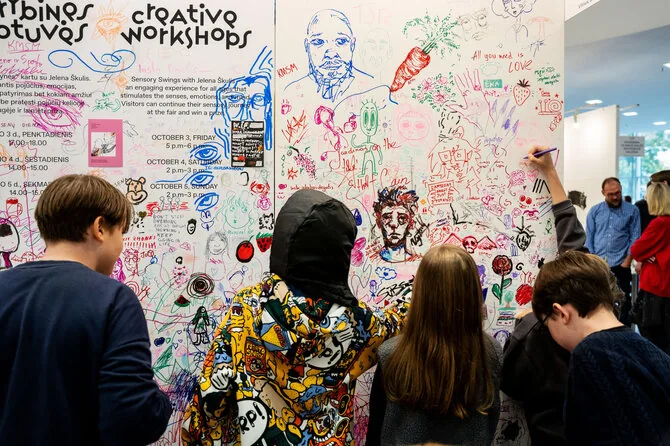
In the third hall, I invite you to have a coffee, take a break, and head to the fourth – the Projects zone – hall. From there – to the fifth, where young fair visitors will find educational programs, and adults can participate in talks and discussions, visit the Young Collector stand, cultural publications, and, of course, even more interesting Lithuanian regional and foreign galleries.
The 17th international contemporary art fair “ArtVilnius’26” will take place from October 1–4 at the Lithuanian Exhibition and Congress Center LITEXPO.
Read more Parliament has begun legalizing a public register of sexual offenders against children