Arnis Aleinikovas, a lecturer of the Pedagogy of the Teaching Subject: Dance and Theatre Pedagogy Bachelor’s program at VDU Education Academy, a director, a voice actor for films and TV series, and an interdisciplinary artist, says that theatre not only reflects these societal changes but is often one of the first to name them. Themes, artistic forms, the relationship with the audience, and along with that – how future creators perceive theatre and their place in it – are changing.
Aleinikovas observes these changes daily while working with students. According to him, the themes young people bring, their creative interests, and a different pace of life constantly force him to reassess his own knowledge.
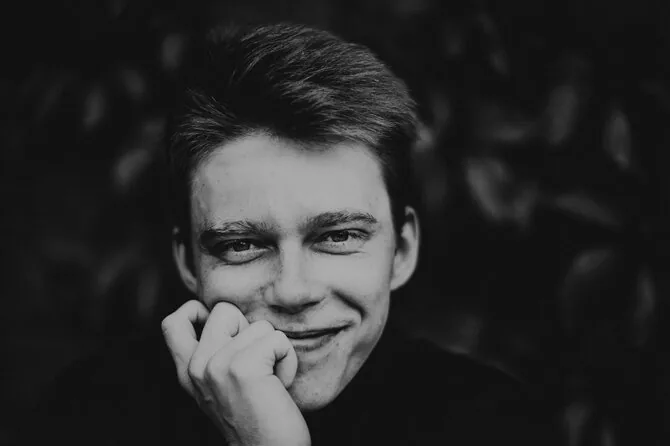
“It is very easy for an adult to find themselves in a state where it seems like you already know and understand everything. Working with young people, you see that another generation is coming with a different perspective, themes, pace of life, and understanding. This helps to renew oneself, not to close off in one’s own bubble, and at the same time – it is a very good remedy against aging,” says Aleinikovas.
This constant movement between pedagogy, creativity, and the international art scene is also characteristic of his own professional path. The artist mainly works in contemporary performance, alternative theatre, and interdisciplinary art, creates electronic music under the pseudonym SINUO, and has published a poetry book titled “JŪRA.” In 2018, he completed his bachelor’s studies in theatre and film acting at VDU, and in 2022, a master’s degree in theatre directing at the Academy of Performing Arts in Prague.
Since 2020, he has collaborated with foreign theatres and interdisciplinary art organizations, and his works have been presented in various European countries, Canada, and the United States.
Youth do not want to be defined by a few words
Speaking about generational change, Aleinikovas is skeptical about attempts to fit the entire young generation into one description. According to him, there are many different interests, temperaments, and creative directions among students, so labels about supposed uniform traits of Generation Z or other generations often simplify rather than explain.
Nevertheless, he notices certain changes. Young people today access information almost instantly, so their attention and interests can change very quickly. However, despite the abundance of technology, the need for human connection and sincerity is strengthening.
“Students choose to talk about anxiety, panic attacks, loneliness, obsessive love. You realize they are nineteen years old, but the themes they bring are not necessarily those stereotypically associated with nineteen-year-olds. They boldly talk about what truly hurts and concerns them, rather than choosing a topic just because everyone is talking about it at the moment,” the lecturer notes.
Students choose to talk about anxiety, panic attacks, loneliness, obsessive love.
In his assessment, the study direction itself also influences this – arts pedagogy is often chosen by sensitive, creatively curious people who tend to analyze their experiences. In the Theatre and Dance Pedagogy program, students encounter not only different art forms but also perspectives that can change their initial professional intentions.
About half of the students come already having dance experience, while the other part is more interested in theatre, text, and acting expression. However, during the four-year studies, these boundaries begin to blur.
“There is more movement in contemporary theatre, and dance incorporates elements of text and theatre. Our program is composed roughly equally of theatre and dance subjects, so students inevitably face both directions. Sometimes a person comes having danced for ten years and in the third year says that theatre is now more interesting to them,” Aleinikovas shares.
Not everyone enters studies already firmly decided to become teachers. Some see themselves immediately in pedagogy, others first want to dance, act, or create. According to the lecturer, pedagogical education in such cases does not limit but expands opportunities.
“After four years, a person’s direction can change a lot. It is important not to confine a student to the frame that they will only be a dancer, actor, or teacher, but to help them find an individual path. Some want to act in Lithuanian productions, others participate in artistic projects or go abroad through the Erasmus program, and others choose pedagogy more. You take from studies as much as you want,” he says.
It is important not to confine a student to the frame that they will only be a dancer, actor, or teacher, but to help them find an individual path.
This openness of students to different directions is revealed not only in choosing a professional path but also in creativity. The younger generation does not shy away from technology, seeks new forms, and experiments with tools that until recently seemed unusual in theatre.
The first play in Lithuanian created by AI before “ChatGPT”
The influence of artificial intelligence on art is becoming increasingly evident, but Aleinikovas began talking about it well before the rise of generative AI. In 2019, together with a team of creators from Sweden and Lithuania, he experimented with a system that generated a play text in Lithuanian.
Read more Forget intense workouts: why can slow running be more effective than fast?
The creators’ goal was not to task the algorithm with writing a “good” play or coherent dramaturgy. They were interested in what technology could say about humans and society when not given a clear creative assignment. The generated text was fragmentary but had a plot line about two lovers traveling from a hotel to a forest and facing various challenges there.
Today, when AI can already generate texts, images, music, and video material, students also want to incorporate new technologies into creativity. According to the lecturer, it is natural for artists to try emerging tools, but this does not mean that all theatre will soon become a product created by algorithms.
“I think we are now experiencing a wave where people want to play and experiment with new technologies. Later, some will get tired of it and turn back to classical theatre, where you come and clearly understand what you see. Different forms will always coexist in theatre: some will be traditional, others experimental and conceptual attempts,” the interlocutor predicts.
However, technology changes not only how a performance is created. It also shapes the audience itself – their attention, information consumption habits, and expectations for theatre.
Aleinikovas emphasizes that a creator should not blindly cater to the audience but also cannot create while completely ignoring it. A performance is not just the author’s personal game – it is created for a meeting with the audience: “Theatre does not have to be comfortable or funny. It can and should be diverse. Often theatre is the first to show the direction in which society is moving. If a person comes and says there is nothing to watch in theatre, maybe the problem is not with the theatre but with their expectations.”
Often theatre is the first to show the direction in which society is moving.
Social networks change not only the audience but also dramaturgy
How technology and changing information consumption habits affect theatre was especially clear to Aleinikovas while studying abroad. In Prague, he encountered a theatre culture that at that time was quite different from the Lithuanian scene.
According to him, in 2019 Prague already had many immersive, object-based, new dramaturgy, and interdisciplinary performances, while these trends were just on their way to Lithuania.
Today, experiments are increasing in Lithuania as well. This is influenced not only by international exchanges but also by information consumption habits changed by social networks. In the new dramaturgy program in Prague, in which the artist participated, there was much discussion about shortening attention spans and how theatre should adapt to it.
“The question arises whether a performance, like a social media post, must capture interest, engage, and avoid losing especially young viewers within the first ten seconds. Social networks change how we receive information, so dramaturgy, theatre, and dance are changing. But this does not mean every work must become fast and fragmentary. Rather, we need to understand what kind of audience we meet today,” he explains.
The interlocutor is convinced that the future theatre will be strongly shaped by the generation currently finishing their studies. They will bring to the stage not only new technological tools but also different themes, sensitivity, and a relationship with the audience.
“I always went the way I wanted”
Today teaching at several universities, leading creative workshops for different communities, and dedicating much time to students, Aleinikovas was convinced in his youth that he would not work in pedagogy himself.
He started working at sixteen while still in school – organizing events at the Kėdainiai Cultural Center, participating in the TV project “Chorų karai” (Choir Wars) in his adolescence. The intense combination of activities taught him to plan time early. Today, some of his work is planned until the end of 2027.
“It is important for me to know what I will do in a month, when I will work and when I will rest. Recently, I devote a lot of attention to students, but at the same time, I create electronic music, direct performances, lead creative workshops, and carry out other art projects. When you plan not only work but also rest and vacations, everything becomes possible,” Arnis openly says.
Aleinikovas’s parents hoped he would become an economist or basketball player, so his decision to choose acting studies was initially met with mixed feelings in the family. However, the artist himself says he never doubted his chosen path.
“I always went the way I wanted. I often told myself: it will somehow work out. And it did. Of course, with a lot of work put in. In life, we often do what others recommend, and later realize we did not do what we ourselves wanted. I try to remain honest with myself and choose what interests me and brings joy,” the interlocutor admits.
Read more Regional labor market: challenges, possible policy measures, the role of regions