He is wanted in Russia on terrorism charges, filed back when K. Budanov was head of Ukraine’s military intelligence. However, unlike most Ukrainian leaders, he spoke much more openly about the need to do whatever is necessary to try to achieve peace through negotiations.
Read more Careless video cost freedom: tourist in Bali sent behind bars for a year
“I am ready for any step that will end the war, if the conditions are acceptable to Ukraine,” emphasized K. Budanov, the second-highest-ranking Ukrainian government official, in an interview with The New York Times more than a week ago.
Ultimately, the trip to Moscow, which was previously unknown, did not take place, and the negotiations soon stalled, said the head of the Ukrainian president’s office.

As analysts note, this episode revealed the multifaceted personality of him as a person: he seeks to inscribe his name in history as a warrior fiercely fighting against the Russians, but later took on a key role in stopping that bloodshed.
Russia and Ukraine, partly aiming to gain an advantage in possible negotiations, moved to a stage of war escalation. However, even at a time when both sides attack each other with drones and missiles, K. Budanov stated in an approximately hour-long interview that negotiations, mediated by U.S. President Donald Trump’s administration, are expected to resume at the end of September – a few days after the Russian parliamentary elections and a few weeks before the U.S. midterm elections.
According to him, the process will be renewed with the visit of U.S. envoys Steve Witkoff and Jared Kushner, Trump’s son-in-law, to Kyiv.
At 40 years old, K. Budanov is a lieutenant general of the Ukrainian Armed Forces, currently serving as head of President Volodymyr Zelensky’s administration. Advocating for negotiations, he no longer has to prove himself as a warrior fighting against the Russians.
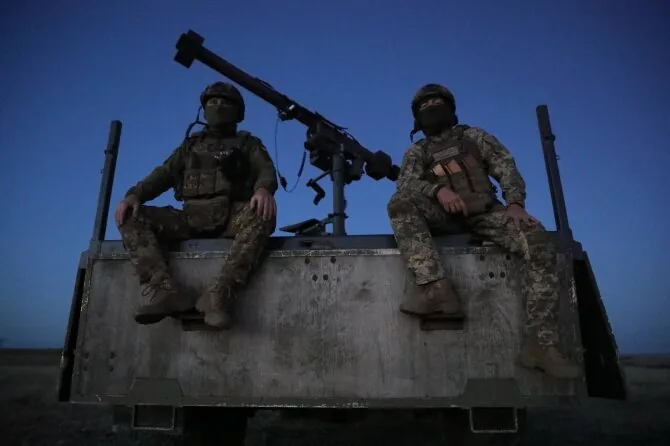
During the prolonged war in Eastern Ukraine, which Russia started in 2014, K. Budanov led raids of his groups into enemy territory, including one in which the son of a Russian general was killed in battle.
He also served in a unit trained by the U.S. Central Intelligence Agency (CIA) within the Ukrainian military intelligence structure, whose head was killed in a car bombing orchestrated by Russia in Kyiv.
In 2016, a machine gun bullet shattered K. Budanov’s elbow. He required several months of treatment and rehabilitation at the Walter Reed National Military Medical Center in Maryland. After 2022, when Russia launched a large-scale invasion of Ukraine, he helped plan some of Ukraine’s boldest counterattacks.
K. Budanov still keeps his hair short, in a military style, and is known for his piercing dark-eyed gaze. In his office, decorated with a Christian icon painted on a ceramic plate of a bulletproof vest, he slightly lifted the veil to let understand what it means to negotiate with mortal enemies.
“You cannot waste time trying to prove you are right,” emphasized the lieutenant general.

“Of course, we cannot trust each other because we are at war,” said K. Budanov. “That is logical and understandable. At the same time, both sides know they need to find a solution. The war cannot last forever.”
The issue of negotiations divides the Ukrainian government. In its analysis, the Carnegie International Peace Foundation’s Russia and Eurasia Center described K. Budanov as a leader of the side advocating for an agreement rather than risking greater losses. They noted that other Ukrainian leaders oppose any major concessions, arguing that it would demoralize the Ukrainian armed forces and society.
Meanwhile, the Ukrainian public’s attitude toward negotiations led by the United States is skeptical. Before they reached a deadlock, most believed that the Trump administration, eager to win a Nobel Peace Prize for its president, sought to force Ukraine to capitulate. Ukrainians were also convinced that Vladimir Putin had no intention of ending the war, regardless of any agreements made.
Nevertheless, K. Budanov expressed a strong belief that negotiations must continue even during the war.
“I am a military intelligence officer,” he stated. “I have been involved in dialogues and communication all my life. It is not difficult for me.”
Russia and Ukraine have been negotiating since the first day of the large-scale invasion, when Putin’s aide tried twice unsuccessfully by phone to agree on a quick Ukrainian capitulation.
Read more An impressive amount in the bank, a career, and luxurious suits: «I had everything except life»
However, both sides missed several opportunities. About a month after the war began, Russia refused to make a more balanced agreement. Later, it faced a series of defeats on the battlefield. Moscow lost about 10% of Ukrainian territory that it might have retained if it had accepted the agreement, although the exact proposed territorial division was never disclosed to the public.

After a year, when Ukraine was confidently advancing and full of self-confidence, it missed a potentially suitable moment for negotiations, which the United States urged to seize. Then Russia launched an offensive during which Kyiv lost about 1.5% of its territory.
Negotiations resumed when Trump began his second term as U.S. president. However, a few days after talks were held in Geneva in February, the U.S. and Israel attacked Iran, starting a war that consumed all of Washington’s attention.
However, according to K. Budanov, lower-level negotiations behind the scenes never stopped.
He said he often communicated with Admiral Igor O. Kostyukov, head of Russia’s military intelligence service (GRU). He first negotiated with him in 2022, still mediated by Turkey, when efforts were made to open Black Sea shipping routes for grain trade – the main export commodity of both warring countries.
“Over all these years, we have managed to accomplish a lot, including issues related to prisoners of war,” noted K. Budanov.
He maintained this dialogue even while issuing orders that caused significant losses to I. Kostyukov. In K. Budanov’s office hangs a photo capturing Ukrainian special operations forces storming GRU fortifications in the cement factory area in the city of Vovchansk in 2024. This operation claimed the lives of several subordinates of Russian admirals.
Among other things, K. Budanov admitted to regularly communicating with Yevgeny Prigozhin – the sociable but brutal founder of the Russian mercenary company Wagner. As the head of the Ukrainian president’s office indicated, their conversations continued until 2023, when J. Prigozhin and his mercenaries staged a rebellion against the Kremlin. A few weeks later, J. Prigozhin died when his private plane exploded in the air.

One of the main reasons why K. Budanov agreed to take the post of head of the Ukrainian president’s office in January, according to him, was the opportunity to lead the negotiations.
By that time, S. Witkoff, Russian and Ukrainian negotiators had already narrowed a 20-point peace plan down to two essential but unresolved issues: the Russian-occupied nuclear power plant and the territory still controlled by Ukraine in eastern Donbas. The dispute centered on four partially destroyed medium-sized towns and a strip of agricultural land.
As K. Budanov said, during a meeting in Abu Dhabi, United Arab Emirates, he tried to set a new tone for the negotiations.
To the Russian delegation, the highest-ranking Ukrainian official proposed setting a goal, for example, to prepare compromises on post-war governance in Donbas and pursue it.
According to the lieutenant general, possible ideas were already being considered in February: handing over this territory to private military companies, allowing it to be governed by Trump’s Peace Council, or forming a joint Ukrainian and Russian civil administration.
K. Budanov revealed that he advised V. Zelensky not to agree to any compromises on Donbas that would allow Russia to declare its control by raising a flag. Ceding territory, he said, would mean rewarding Moscow with a prize its army could not win on the battlefield.

Although full-scale negotiations may be resumed this month, the lieutenant general hinted that conditions for a ceasefire will most likely be created only in the spring.
It is believed that until then Russia will try to break Ukraine by launching another strategic bombing campaign in winter – the fourth such since the start of the large-scale invasion.
“Negotiations will yield results sooner or later,” he said optimistically. “After all, you cannot fight your whole life.”
Read more Lava fountain erupted: Indonesian volcano eruption heard hundreds of kilometers away
This article was published in The New York Times.
© 2026 The New York Times Company