One of the first performances of this play, recorded on video, will be presented on September 17 at 8 p.m. together with the Vilnius City Municipality by its creators. All curious residents and guests of Vilnius are welcome to come, the event will be free. It will begin at 7 p.m. with introductory discussions and talks with opera field professionals.


The well-known Giacomo Puccini opera is the beginning for many young vocalists. After all, the work itself tells about the struggles of young Parisian artists, their path to professional heights, and personal challenges. Thus, an unprecedented creation was born at that time – the second professional opera theater in the country’s history – the „bohemians“. This is a collective whose main mission has always been to bring young opera soloists to the big stage, giving them the opportunity to perform leading roles.
In the first performances, the characters were created by their peers, among whom are today well-known soloists such as Asmik Grigorian and Edgaras Montvidas. These are the first „bohemians“ who, together with the entire unique group from October 25, 2006, can be seen by the audience at Town Hall Square.
By director D. Ibelhauptaitė’s decision, the time setting in „La Bohème“ was both „modernized“ and distanced – Lithuania, which was part of the Soviet Union and experienced exile, never truly felt the intoxication of the 1950s. At least not openly. So while Puccini’s story moved forward in time, the Lithuanian audience turned the clock back to a past probably seen only in cinema.
This was aided not only by the impressive decorations of British scenographer Dick Bird but also by costumes by Juozas Statkevičius, who made theater and fashion history, created from clothes bought in second-hand stores, re-sewn, and unexpectedly used scraps of clothing and furs. They were complemented by authentic hairstyles of that era, crafted by hairdressers for several hours before each performance. Chorus performers and a large group of then-studying actors said that when performing several shows in a row, they sometimes stopped undoing the hairstyles after each show – the firmly styled hair could „withstand“ even a couple of performances.
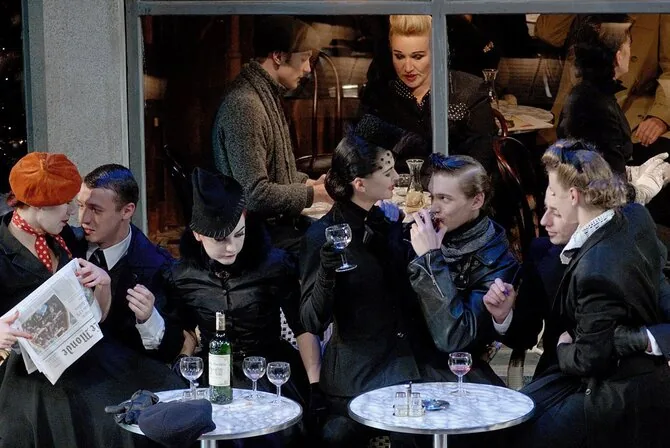
The lasting impression of „La Bohème“ was also enhanced by a new element for that time – cinematographic style on stage. The static chorus, acting as a commentator in the opera, suddenly became individual, characteristic Parisian residents telling their life stories. The audience would come to watch this play several times, trying different seats in the hall. This completely changed the impression of the play – so many details were placed in every corner of the stage, in every soloist, actor, and chorus member’s role.
Speaking of soloists, their character lines were arranged like the score itself and filled not only with emotions but also physical tasks, even stunts, such as Laimonas Pautienius’s Sonar somersault or A. Grigorian’s Musetta jump from the second floor of the „Momus“ café. By the way, choosing Asmik to perform the role of Musetta was an unusual decision by D. Ibelhauptaitė, whose far-sighted idea became clear much later: the director wanted Asmik, who grew up in a family of opera stars, to create her own unique career path. Probably no one would dare say that such measures did not pay off.
And Asmik, together with Sandra Janušaitė, who performed the role of Mimi, could not resist trying even more colors and once decided to swap roles, reassuring the director and conductor that their shoe sizes matched, so there would be no problems with costumes. „We are talking about two main big roles, and they – about shoes!“, recalls D. Ibelhauptaitė laughing today.

„La Bohème“ opened paths not only for young opera talents in Lithuania at that time but also allowed the troupe to attract foreign performers to establish the international scale characteristic of opera today. Over the years, tenors from neighboring Latvia, other European countries, and even Australia could be seen in the role of Rodolfo. And the Frenchman Sébastien Guèze returned several times to work with VCO and even created the huge role of Faust.
Read more Poland decided strictly: will close the airspace along the border with Ukraine
Many acting tasks allowed soloists to feel confident but also to improvise. Unfortunately, not all creativity born instantly on stage ends successfully. During one performance, a careless move with a heavy prop on stage ended with a cut on the head of Egidijus Dauskurdis, who was singing Koleno. The shock was such that other soloists… did not even stop the scene and managed to sing the colleague’s part while the blood flowing from the wound was stopped backstage by a soloist, as if it were written in the opera. Everything ended successfully, but since then this scene has been rehearsed much more carefully.
Scenographer Dick Bird, working in Lithuania for the first time, revealed unexpected possibilities of the then Congress Hall (now the LVSO concert hall), proving that a miracle can be created with the right trick. The audience was amazed by the roofs and attics of Paris, which later turned before their eyes into the bustling Montmartre square.

Probably for the first time in Lithuanian opera history, the audience gave thunderous applause to stage technicians. At that time, it was also unexpected that ninety percent of the money for this grand production was raised from private sponsors and large business companies, which revived a long and fruitful path of modern patronage in Lithuania.
No opera lover needs to be told what happened after the first performances of „La Bohème“ in Vilnius. The new theater was then born from an idea and a huge desire to create as the creators themselves thought right. Dalia Ibelhauptaitė, Gintaras Rinkevičius, Juozas Statkevičius became probably the first creative team of this type.
Having tested their strength abroad and been appreciated there, they returned to Lithuania to build safe creative islands for those unnoticed by others or those who did not know where or if they could return at all. Alongside them, future trampoline stars were growing in Lithuania – the children’s choir on stage included today internationally developing conductor Giedrė Šlekytė and the current artistic director of the Lithuanian National Opera and Ballet Theatre Martynas Stakionis. Many well-known names would also be found among the actors who worked here, now scattered across jobs in television and drama theaters.
In many of their decisions, the „bohemians“ surprised at that time, seemed different, alternative. It is obvious that their bold start officially became a historic mark and entered the pages of national importance opera. Over the last 20 years, dozens of performances, concert programs have been created, and a whole generation of the brightest opera stars has been raised, promoting the country’s name worldwide.
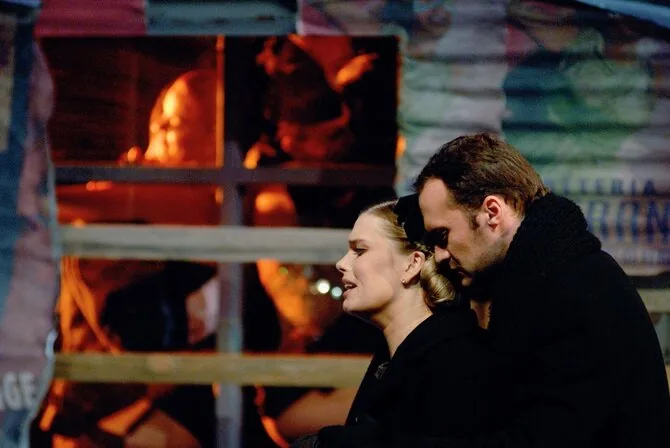
Meanwhile, „La Bohème“ itself has been revived several times on other stages: at the Klaipėda State Musical Theatre, and later at the Lithuanian National Opera and Ballet Theatre, where it could continue to be a springboard for the newest opera generations to shine. Here it will be shown live for the last time this December: „I always knew that performances cannot live too long, especially those created to nurture youth.

Our twentieth anniversary is a great opportunity to see „La Bohème“ as it was at the premiere, with a cast that will no longer be, and then, after the last showing on the LNOBT stage, to say goodbye to it as a past stage of our activity, without locking ourselves into a live museum display, but striving to continue creating new, relevant things, looking forward.“, says D. Ibelhauptaitė.
Read more Foreign Minister: The EU should increase, not decrease pressure on Belarus
Project funded by: Lithuanian Council for Culture and Vilnius City Municipality.