According to the article, the letter was signed by the European Commission members of the three Baltic states: Kaja Kallas, Andrius Kubilius, and Valdis Dombrovskis. Representatives from Finland and Poland also joined them.
The letter dated July 30 is one of many warnings about possible Russian aggression. Similar warnings circulated in the world media throughout the summer, reaching a peak on August 25, when the head of the US Central Intelligence Agency (CIA), John Ratcliffe, unexpectedly visited Moscow.

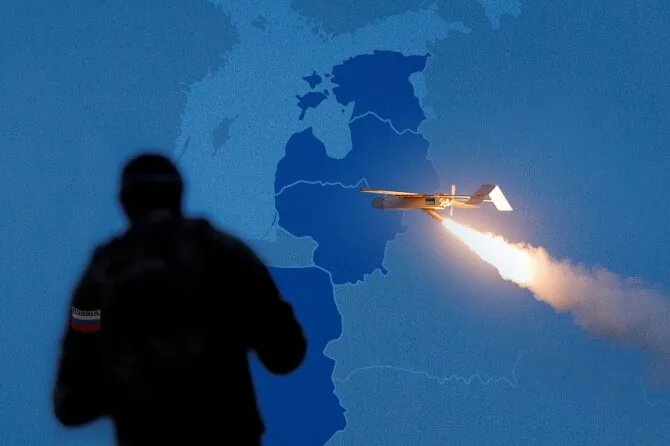
As reported by American publications and confirmed by sources from Radio Free Europe, the head of US intelligence flew to Moscow to warn the Kremlin not to seek escalation with US allies – specifically with Lithuania, Latvia, and Estonia.
Baltic diplomats who spoke to Radio Free Europe journalists on condition of anonymity confirmed that additional intelligence data about possible Russian “false flag” operations was received during the summer, but there were no signs of a conventional attack being prepared in the near future.
The diplomats also noted that such operations might not be limited to the Baltic countries – this concern is reinforced by recent cases where Russia is suspected of involvement in sabotage acts – assassination attempts, arson, and drone intrusions – in several NATO countries, including Germany, Poland, and Slovakia.
The Baltic countries have long spoken about Russia’s true intentions and the threat posed by the aggressor. They themselves are urgently preparing for this. All three countries have already reached or will soon reach NATO’s 2035 target of allocating 5% of GDP to defense. Additionally, the European Union has promised and already started paying approximately 14 billion US dollars in loans for defense and security investments in the region.

However, not everything is so rosy. Negotiations on the next 7-year European Union budget began with the European Commission’s proposal to allocate 145 billion dollars for security and defense investments. However, several major payers, including the largest – Germany, stated that they want to allocate less money to the EU budget in the future.
Many EU officials fear that defense will likely be one of the areas where spending will be cut. Such fears are also expressed in the leaked letter from the Baltic countries.
Some of the proposals outlined in it are symbolic, for example, stating that the entire European Commission could “urgently” visit one of the eastern NATO flank countries this fall, “because we all see the escalation of threats to the Baltic states.”
What the Baltic countries are asking for
However, as Radio Free Europe writes, the main demand set out in this letter is to allocate additional funding – about 115 billion US dollars – to strengthen the business and investment environment in the frontline states.
“These incidents are already negatively affecting the region’s business environment and public confidence in security. To prevent further deterioration of the situation and strengthen deterrence, clearly visible and timely actions are necessary,” the Baltic representatives’ letter states.

Among the listed aid measures are rapid response capabilities in case of energy supply disruptions and protection of critical electricity and gas infrastructure, creation of regional reserves of essential goods and civil protection resources, installation of shelters and evacuation infrastructure, as well as preparedness to respond to hybrid, cyber, sabotage, electronic, and informational threats.
What happened to the “drone wall”?
The letter – as in most recently published EU reports – mentions a clear lack of a “drone wall” – a widely discussed proposed project last year that the bloc considered funding. The idea was to equip the entire eastern flank of Europe with sensors and means to detect and shoot down hostile drones.
“Talking about a drone wall is easier than building one. But let’s be honest – so far, no one has such a wall, not even the Ukrainians,” one official told Radio Free Europe.
It is said that talks about the “drone wall” have quieted down due to financial, technical, and legal problems.
“It is unclear who should pay for such an expensive system; the main components, including sensors, radars, and an effective command and control system, are not yet fully developed. Moreover, discussions are still ongoing about whether the entire system should be fully automated or supervised by humans,” Radio Free Europe highlighted.
One of the essential elements for the Baltic region mentioned is the “Rail Baltica” railway – another EU-funded project that is not being implemented according to plan.
The project, started in early 2015, was supposed to connect the Baltic states, whose railway networks still mostly use Soviet-era track gauge, with Poland and the rest of the EU.
The original goal of opening the line this year has long been abandoned, and the newly set deadline – 2030 – raises doubts due to rapidly increasing costs, poor initial planning, constant project changes, and disagreements within and between the countries.
This railway line is considered extremely important because it would form the main strategic military mobility corridor, allowing the maximum increase of NATO troops and weapons needed for the region’s defense, and would neutralize the so-called Suwałki corridor connecting Poland and Lithuania. Most military planners have repeatedly expressed the opinion that if Russian forces were to attack NATO, they would most likely choose this location.
Read more Suspected September 11 terrorist attack mastermind to stand trial in June 2028