The exhibition connects uprisings, independence struggles, partisan warfare, the dissident movement, the Baltic Way, the events of January 1991, and today’s threats, showing that preserving freedom requires constant effort. At the same time, visitors are asked: what can each of us do for our country today?
Opened to visitors on August 23, the exhibition occupies the entire third floor of the Gediminas Castle Tower. The opening was attended by Deputy Minister of Culture Lina Baublienė, the exhibition creators, the heroes of the stories, and museum partners.
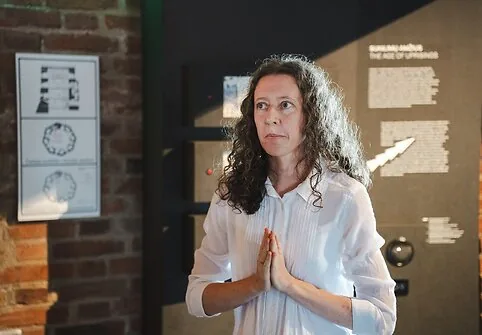

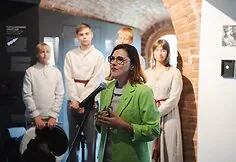
The date of the exhibition opening was chosen deliberately – it has special significance. Gediminas Castle Tower is closely linked to the modern history of Lithuanian freedom: on October 7, 1988, after nearly half a century of occupation, the Lithuanian tricolor was publicly raised here again, and on August 23, 1989, the Baltic Way symbolically began from Gediminas Castle.
Freedom is created by people’s decisions
Dr. Rūta Kačkutė, General Director of the Lithuanian National Museum, emphasized at the opening of the new exhibition “Frequency of Freedom” that different periods of Lithuanian history are primarily connected by people’s ability to take responsibility.
“Circumstances and forms of resistance differed, but time and again there were people who took responsibility and asked themselves: what can I do now? They could have been afraid, doubtful, uncertain of the outcome, but they chose not to give up. Freedom does not arise by itself – it is created by people’s decisions and actions. Today we live in a free country, but the question of responsibility has not disappeared. The exhibition invites reflection on how we ourselves would behave in difficult circumstances and what we can do for our country today,” said R. Kačkutė.
Freedom does not arise by itself – it is created by people’s decisions and actions.
Deputy Minister of Culture Lina Baublienė drew attention to the symbolism of the exhibition’s location and date. “It was precisely from this place, at the foot of Gediminas Hill, thirty-seven years ago that the Baltic Way began. It united three nations and became one of the most powerful signals of our independence, heard around the world. Therefore, opening an exhibition here in this tower, telling about continuous resistance, is a meaningful symbolic step,” said the deputy minister.
Different periods merge into one “frequency”
Visitors get to know the history of freedom struggles through the fates of specific people, authentic objects, documents, photographs, video and audio recordings. Among the exhibits are the Lithuanian flag that flew over Gediminas Castle Tower during the January 1991 events, the lighter of the fallen freedom defender Darius Gerbutavičius, a box made by political prisoner Juozas Grušas in which a booklet of his poems was hidden in the camp, photos of partisans, dissident documents, underground signs, gold items from the 1990 Blockade Fund, and other historical valuables.
The narrative is complemented by interactive solutions. Radio stations play voices from different periods, and at the end of the exhibition, visitors can express their position and contribute to a virtual protest chain.
Read more These are not places tourists go to relax: what draws them there so strongly?
Exhibition curators Dr. Aistė Petrauskienė and Severija Subačiūtė said they aimed to present the history of Lithuania’s freedom struggles not as a sequence of dates and events. Although the uprisings of the late 18th and 19th centuries, the 20th-century freedom struggles, and today are separated by different historical circumstances and forms of resistance, according to the curators, they are united by the same desire for freedom.
“Frequency of Freedom is like a constantly recurring signal that at some moments in history intensifies and becomes audible to the whole society, while at others remains quieter but never completely disappears,” said the curators. According to them, the exhibition invites viewing history not only as the past but also as a personal responsibility today. “Freedom is not just a political concept. It is very personal. It begins with the individual, with each of us,” emphasized the exhibition creators.
The story does not end with the restoration of Lithuania’s independence
The story of “Frequency of Freedom” does not end in 1990. At the end of the exhibition, the story transitions to the present – presenting recognizable threats today and forms of civic action.
Reports of air danger, an example of a cyber incident, public protests, and other signs of today remind us that freedom is not an unchanging given. The exhibition also raises the question of societal resilience: how can knowledge of history help recognize threats, resist fear and disinformation, and preserve the ability to act together?
The exhibition does not provide a single answer. At its end, the visitor is invited to answer for themselves: what and by what means would they stand up to fight for today?
The exhibition “Frequency of Freedom” is organized by the Lithuanian National Museum, supported by the Ministry of Culture of the Republic of Lithuania. Partners: Lithuanian Central State Archives, Lithuanian Armed Forces, Ministry of National Defence of the Republic of Lithuania, Lithuanian Special Archives, LRT Archives, Vytautas the Great War Museum.
Read more Young Lithuanian Rifleman – third in the world, the team – tenth