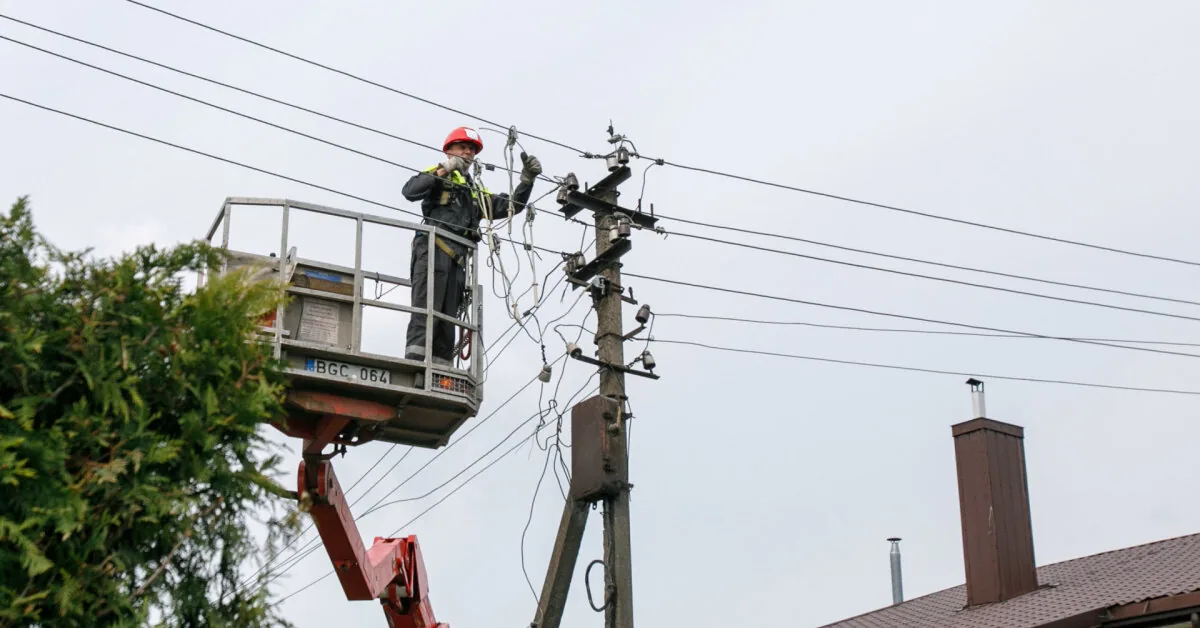
“Although the 2026 data covers only the period up to August 5, it already shows a more pronounced activity of damage caused by storms, heavy rains, hail, and lightning than during the entire last summer. This summer, about 18% more such events were recorded than last year, and comparing the same period up to August 5, the growth is about 44%,” says Viktorija Bužokaitė, Head of the Claims Department at Balcia Insurance.
Read more After a 9-year break – a new album by Domantas Razauskas: «No one plays like this anymore…»
However, the growth was not uniform. In June and July, the number of damages caused by storms and heavy rains was about 11% lower than at the same time in 2025. The situation changed dramatically at the beginning of August, when an extremely intense episode of storms and heavy rains recorded in just a few days significantly increased the overall damage statistics.
Water reveals what is not visible during a home inspection
According to Andrius Dambrauskas, Product Manager at Balcia Insurance Group, analyzing the nature of summer damages in 2026 shows that, alongside traditional storm effects, infrastructure in the areas is increasingly affected. The number of flooded basements, underground parking lots, and garages has doubled compared to last year. Damage to landscaping, paving stones, rainwater, and sewage systems has been recorded more than twice as much, and the number of damages related to soil and water infiltration has nearly tripled.
“When assessing flood risk, it is important to evaluate not only the building but also the surroundings. Rainwater can flow from higher areas or streets, so even a technically well-maintained property can suffer due to insufficient infrastructure capacity,” says A. Dambrauskas.
The greatest danger – underground parking lots and basements
According to the expert, flooding of basements, garages, and underground parking lots is usually caused by several reasons rather than just one. Among the most common risk scenarios are insufficient capacity of the rainwater drainage system, clogged gutters, ineffective drainage, as well as water entering through gates or building structures.
“Underground parking lots are one of the most vulnerable parts of a building. Their structure creates a so-called ‘basin effect,’ so even a relatively small amount of surface water can quickly accumulate and cause significant damage. For this reason, it is important to assess not only the building’s age or construction quality but also the height of the lowest point of the premises, the geometry of the entrance, and the condition of rainwater collection systems,” says A. Dambrauskas.
Practice shows that a failure of a single important infrastructure element can also cause significant damage. For example, if the power supply is interrupted or the pumping station stops working during the heaviest rain, the consequences can be much greater than the storm’s impact on the structures themselves.
Flood risk is also determined by the surrounding area
With the increasing risk of extreme precipitation, more attention should be paid to the infrastructure of the neighborhood and plot. According to specialists, when evaluating a new project, it is important to understand what precipitation intensity the rainwater drainage systems were designed for, whether there is sufficient capacity reserve, and where the water is directed when the system reaches its limits. It is equally important to assess the natural characteristics of the area. Even neighboring houses can have completely different flood risks due to terrain, soil composition, or groundwater level.
“Clay soil is not a problem by itself, but combined with a large amount of impermeable surfaces and insufficient surface water collection, it can significantly increase the risk posed by precipitation. Therefore, before making a decision, it is worth investigating the building itself, the neighborhood’s terrain, and previous cases of water accumulation,” emphasizes A. Dambrauskas.
According to the expert, a single intense downpour can be a serious test for the entire neighborhood, so the long-term value of a home depends not only on the quality of the building but also on its resistance to water-related risks.
“However, even with careful assessment of the home’s location and infrastructure, it is impossible to completely eliminate the risk of extreme natural phenomena. Therefore, it is important not only to choose a home responsibly but also to ensure its protection. During storms and heavy rains, damage is increasingly suffered not only by buildings but also by property stored in basements or underground parking lots, so residents should regularly review their insurance coverage and ensure it matches today’s climate risks,” says V. Bužokaitė.
Read more Moscow: Russian ambassador to the UK no longer performs his duties