This text is the second part of a two-part series about cooperation among the Baltic countries. The first part, which tells about the cooperation of the Baltic countries before the Baltic Way – here.
Here, attempts to act together with other nations of the Baltic countries and Central and Eastern Europe enslaved by the Soviet regime took place already in the first post-war decade, where, especially on the initiative of border partisans in Soviet-occupied Lithuania (primarily the Tauras district in the southwest and Vytautas in the northeast), attempts were made to establish certain armed anti-Soviet resistance connections with Latvians, Poles, and Ukrainians.
Attempts to act together with brothers of tragic fate were also made later, during the period of unarmed anti-Soviet resistance.
One of the most prominent examples is the August 23, 1979 appeal by anti-Soviet activists of the Baltic countries, later called the memorandum of 45 Baltic people, initiated by the most active members of the Lithuanian Freedom League (Antanas Terleckas, Vladas Šakalis, Julius Sasnauskas), addressed to the governments of the USSR, GDR, FRG, the countries that signed the Atlantic Charter, and the UN Secretary-General, emphasizing the illegal occupation of the Baltic countries by communist USSR and Nazi Germany dividing their territory according to the secret protocols of the August 23 and September 28, 1939 agreements.
The memorandum recalled the principles of free self-determination of peoples from the 1941 Atlantic Charter and the equality and right to manage their fate from the 1975 Helsinki Final Act. It is no coincidence that this document by Lithuanian, Latvian, and Estonian anti-Soviet resistance activists was signed on August 23, 1979, on the 40th anniversary of the Molotov-Ribbentrop Pact.
However, much more favorable conditions for closer and more effective cooperation among the Baltic peoples developed in the second half of the 1980s.
On the one hand, it became clear during this period that the Soviet empire was losing the Cold War and beginning to collapse. On the other hand, important processes were also taking place within the Soviet Union itself (the political and economic reform program perestroika, the policy of openness glasnost, which made the system’s shortcomings even more apparent in many areas – from the failure to control ecological disasters to an inefficient political and economic system).
Moreover, the inspiring example of Poland’s independent self-governing trade union “Solidarity” (Polish: „Solidarność“) also contributed to the idea matured in 1988 to establish change-seeking organizations one after another in each of the three occupied Baltic countries – the Estonian Popular Front (Estonian: Eestimaa Rahvarinne), the Lithuanian Reform Movement (hereinafter – LPS), and the Latvian Popular Front (Latvian: Latvijas Tautas fronte).
Latvian émigré historian Andrejs Plakans noted that at the end of the same year, mass demonstrations turned into mass organizations. A kind of starting point was the congresses held in separate countries in October 1988 – in Estonia on October 1–2, in Latvia on October 10. Meanwhile, in Soviet-occupied Lithuania, a certain turning point was symbolized by the founding congress of the LPS held on the nights of October 22–23 at the Vilnius Concert and Sports Palace.
In the second half of the 1980s, the symbolic date of August 23, marking nearly half a century of totalitarian regimes’ occupation woes, was increasingly emphasized.
Already in 1986, on this day, Black Ribbon Day demonstrations were held in twenty-one Western cities, including New York, Ottawa, London, Stockholm, Seattle, Los Angeles, Perth, and Washington, to draw the world’s attention to human rights violations carried out by the Soviet Union. A year later, Black Ribbon Day protests were again held in 36 cities, including Vilnius (where a rally took place near the Adam Mickiewicz monument), Riga, and Tallinn. On August 23, 1988, commemorative actions were already led by national movements and gathered tens of thousands of people.
Meanwhile, answering the question of when exactly the idea of the human chain action (i.e., the Baltic Way) was proposed is quite complicated. The need to commemorate the 50th anniversary of the Ribbentrop-Molotov Pact was essentially discussed from the August 23, 1988 rallies.
Discussions on this topic continued until the Baltic Assembly held in Tallinn on May 13–14, 1989, where representatives of the Sąjūdis, Estonian, and Latvian Popular Fronts discussed how to jointly commemorate this important event that determined the tragic fate of independent Baltic states. There were various versions of the idea’s origin: some claimed it happened at a trilateral meeting in Paris on July 15, others (specifically, Latvian Popular Front leader Dainis Ivanas) linked the idea’s birth to one of the meetings of Lithuanian and Latvian movements in the Panevėžys parish house.
Interestingly, there were other similar, albeit even grander and politically, organizationally, and logistically more difficult to implement ideas. One was to connect the three Baltic countries with Poland by a living human chain, another was geographically even broader: to connect the three countries with Belarus, Ukraine, and Bessarabia (Romania), and even to reach Finland, considered the fourth Baltic country before World War II.
There were also proposals to cycle from Vilnius to Tallinn, and the list of ideas was supplemented by a variant of initials reminding of the Ribbentrop-Molotov Pact anniversary. People were to stand according to such letter forms: R – in Estonia, M – in Latvia, P – in Lithuania.
Based on historian Arvydas Anušauskas and one of the Baltic Way organizers Angonita Rupšytė’s detailed text, the Baltic Way idea was finally refined on July 15, 1989, at the Baltic Council meeting in Pärnu, Estonia. It was decided to connect the capitals of Estonia, Latvia, and Lithuania by a living chain – the Baltic Way, which was to take place on August 23 at 7 p.m. The decision was made by these persons: Lithuanian representatives Virgilijus Čepaitis, Bronislavas Juozas Kuzmickas, and Romualdas Ozolas; Latvians Ivars Gudmanis, Valentina Zeile, Dainis Ivanas, Arnolds Klotins, and Janis Lucans; Estonians Kiulo Arjakas, Rein Veideman, Mart Tarmak, Edgar Savisaar, and Arvo Juntis.
Intensive preparations for the Baltic Way action began. Many organizational problems had to be solved. One was that the organizers had no experience in organizing events of such scale. Second, there was fear that the action might fail and not gather enough people because summer is vacation time, and August 23, 1989, was a Wednesday.
At the first Sąjūdis coordination meeting dedicated to the Baltic Way, the distance occupied by one person standing with outstretched arms was first calculated. Measurements showed that at least about 300,000 people were needed. In Lithuania, the entire Baltic Way section was divided into 50 segments (commemorating the 50th anniversary of the signing of the Molotov-Ribbentrop Pact and its secret protocols).
To ensure easier coordination, the action route was divided into three longer sections, each assigned coordinators. The Vilnius–Ukmergė section was coordinated by Arūnas Grumadas, chairman of the Vilnius Sąjūdis Council’s organizational commission and curator of the coordination center; the Ukmergė–Panevėžys section by Kaunas Sąjūdis Council members Aleksandras Abišala and Algimantas Norvilas; and the third section Panevėžys–Latvian border from Panevėžys to Pasvalys by Panevėžys Sąjūdis Council members Algis Plitnikas and Rytis Račkauskas, and from Pasvalys to the Latvian border by Pasvalys Sąjūdis Council member Algirdas Mulevičius.
The beginning of the Baltic Way was planned at the Gediminas Castle Tower; from Gediminas Hill, the route was to descend to Cathedral Square, wind along the Neris River bank, cross the Green Bridge to the then Pedagogical Institute, then along Ukmergė Street towards the Vilnius–Ukmergė highway.
Further along the route, certain difficulties were encountered – for example, the highway from Ukmergė to Panevėžys was not yet fully completed, and the road from Panevėžys to Latvia was of the worst quality, narrow, and essentially unsuitable for large flows.
To ensure smoother logistical and organizational progress of the action, it was even planned which people from Lithuanian localities would stand in specific Baltic Way sections. Vilnius, Birštonas, Prienai residents, and Dzūkai were to pass through Vilnius. Suvalkija residents were to turn near Vievis and reach their section via Maišiagala.
Representatives of Eastern Lithuanian districts were assigned the Molėtai–Kaunas section, residents of Central Lithuanian districts the Kaunas–Ukmergė direction. Rokiškis, Kupiškis, and Anykščiai residents were to turn towards Panevėžys on connecting roads to the unfinished highway.
Žemaitija and the coastal region residents were to reach their sections via Pasvalys and connecting roads. Finally, Biržai residents were to join Latvians at the border in the last 5 km section.

The communication aspect of the organization was also very important – after all, with the information means of that time, it was necessary to inform people about the upcoming mass action. An important role was played by the weekly television program “Atgimimo banga” (“Wave of Revival”), during which the Sąjūdis Seimas Council on August 16 once again invited Lithuanians to the Baltic Way.
Special informational bulletins were also prepared, asking participants to bring radios, tricolor flags, and after the action to hold rallies, take black ribbons and candles, and remember those who died for Lithuania’s freedom and could not stand together.
On the eve of the Baltic Way day, a rally organized by LPS took place in Vilnius Kalnai Park (on the same day, a mass rally was also held in Kaunas, Santaka Park), demanding the denunciation of the Molotov-Ribbentrop Pact and its secret protocols and the restoration of Lithuania’s independence.
The rally read the conclusions published by the Supreme Soviet of the Lithuanian SSR commission: it was recognized that the agreements between the USSR and Germany and the secret protocols “caused the abolition of Lithuania’s independence and its forced incorporation into the USSR,” the Soviet army’s entry into Lithuania on June 15, 1940, was an occupation, and the declaration on Lithuania’s accession to the Soviet Union and the August 3, 1940, USSR Supreme Soviet law on the admission of the Lithuanian SSR to the Union of Soviet Socialist Republics are illegal.
On the Baltic Way day, exactly at 7 p.m., bells rang on the radio. Participants held hands, many national flags of the three Baltic states that had been independent half a century ago fluttered, candles were lit in memory of the victims of Stalinism. Many people brought wayside shrines, commemorative stones, and erected them in the sections where they stood. After linking hands, rallies were held in many sections, Holy Masses were celebrated, bonfires burned, and documents adopted at the 6th session of the LPS Seimas were read.
One of them was a statement to the peoples of the world, governments, and all people of goodwill, stating that “the secret agreements of the USSR and Germany on August 23, 1939, September 28, 1939, and January 10, 1941, and the documents attesting to them certainly existed,” “the act of aggression against a sovereign state carried out in 1940,” “the 1940 elections to the ‘People’s Seimas’ were illegal, so the decisions adopted by the People’s Seimas on the introduction of Stalinist Soviet power in Lithuania and the request to join the USSR had no and have no legal force.”
It was also stated that “the day is approaching when the USSR government will have to recognize the occupation status of Lithuania and the necessity of its abolition” and emphasized that “1,400,000 Lithuanians have already expressed their opposition to the presence of the occupying army with their signatures” (in total, more than 1.6 million signatures were collected).
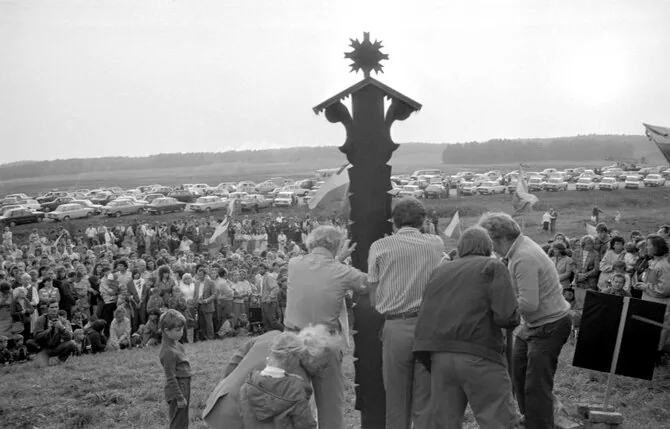
In Latvian territory, people joined hands in the Baltic Way near Bauska, Riga (one of the most important points was the Freedom Monument), Cēsis, Valmiera, and Rūjiena; in Estonia, the united human chain continued through Viljandi, Türi, Rapla, and the final point of this huge action was marked by the Hermann Tower in Tallinn.
The exact number of Baltic Way participants was difficult to calculate. In total, approximately 2 million Lithuanians, Latvians, and Estonians participated, although the Soviet propaganda tried to minimize the number of participants as much as possible through various information channels.

It is important to emphasize that there were many cases when people who could not reach the planned place due to transport difficulties spontaneously formed certain additional branches of the Baltic Way.
It is not surprising that such a large-scale action of the Baltic peoples also received a reaction from the occupying authorities themselves. On August 27, all USSR daily newspapers (including the Lithuanian Communist Party newspaper “Tiesa”) wrote: “A long way has been gone. The fate of the Baltic peoples is in serious danger. People must know into what abyss nationalist leaders are pushing them. If they succeed in achieving their goals, the consequences could be catastrophic. The organizers of the events on August 23, 1989, tried to heat up the mood to real national hysteria.” However, these words primarily reflected not the alleged “nationalist hysteria” but the desperation of the Soviet occupying authorities themselves.
On the other hand, solidarity rallies supporting the Baltic Way were held in the Soviet Union itself – in then Leningrad, Moscow, and Tbilisi. Meanwhile, in Soviet-occupied Ukraine, in Ternopil, the Ukrainian Popular Movement (Ukrainian: Narodnyj Ruch) and the “Memorial” society organized a rally “International Relations and Support of the Baltic Peoples in Connection with the 50th Anniversary of the Stalin-Hitler Pact.”
Despite the Iron Curtain separating the Soviet Union and the socialist bloc from the West, in the warming atmosphere of the Cold War, news about the Baltic Way action spread more easily beyond its borders. Of course, politically active Baltic émigré diasporas also contributed to this.
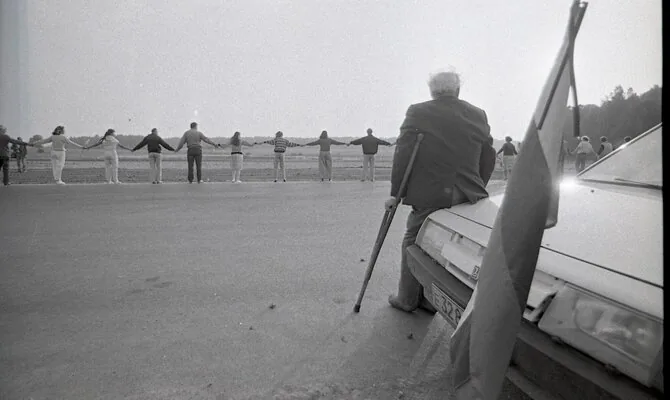
Meanwhile, “The Guardian” correspondent Jordan Steele was in Lithuania that day and witnessed the event with his own eyes. He was impressed by the organization, without which such a large-scale patriotic action would not have been successfully implemented.
This event was also described by other well-known publications: American “The New York Times,” “The Washington Post,” “Los Angeles Times,” British “The Times,” “Windsor Star,” French “Le Monde,” Spanish “El Pais,” and others. Moreover, during the World Youth Congress held in Paris at that time, Lithuanians, Latvians, and Estonians held a demonstration – a march from the Arc de Triomphe to the Freedom Monument.
It was also attended by representatives of Poles, Romanians, Hungarians, Americans, free European states, and some Asian countries. During the demonstration, Lithuanian, Latvian, and Estonian flags and posters demanding the withdrawal of the Soviet army from the Baltic states fluttered against the backdrop of the Eiffel Tower.

The significance and impact of the Baltic Way not only on the Baltic countries but also on freedom movements in other countries remain difficult to measure. As Angonita Rupšytė noted, the Baltic Way action demonstrated the political maturity of the three Baltic peoples, the ability of the emerging civil society to mobilize, unite, act organized and united, and express their opinion to achieve a common goal. The Baltic Way action essentially proved that the pursuit of independence was sought not only by national movements – LPS or the Latvian and Estonian Popular Fronts (although they had hundreds of thousands of associated members) but also by much broader layers of the populations of these peoples. Moreover, these three peoples and their mentioned movements chose not a violent but a legal parliamentary path to liberation. Probably not without the political, social, and even visual (in terms of public relations) impression and impact of this action, although with certain reservations, on December 24, 1989, at the second Congress of People’s Deputies of the USSR in Moscow, it had to be recognized that the Molotov-Ribbentrop Pact and secret protocols violated international law, and the sovereignty of the Baltic states was illegally trampled. Thus, we can say that the essential tasks raised by the Baltic Way were successfully implemented.
It is also interesting that this action essentially had a global impact and inspired peoples seeking freedom or political change in various parts of the world in the 21st century – in 2004, the people of Bangladesh joined hands in a living chain, in 2013 – Catalans, and in 2019 – Hong Kong protesters.
After regaining independence (of course, to achieve this, a very long and complicated path demanding even dozens of human lives had to be taken in the following years) and receiving international recognition, the states of Lithuania, Latvia, and Estonia again began to seek new cooperation opportunities. Already on May 12, 1990, the 1934 Geneva treaty and the Declaration on the Concord and Cooperation of Lithuania, Latvia, and Estonia were renewed, the Baltic Assembly and the Baltic Council of Ministers coordinating cooperation among the governments of Estonia, Latvia, and Lithuania were established. Important agreements for regional economic and cultural cooperation were also concluded, e.g., the Baltic Free Trade Agreement.
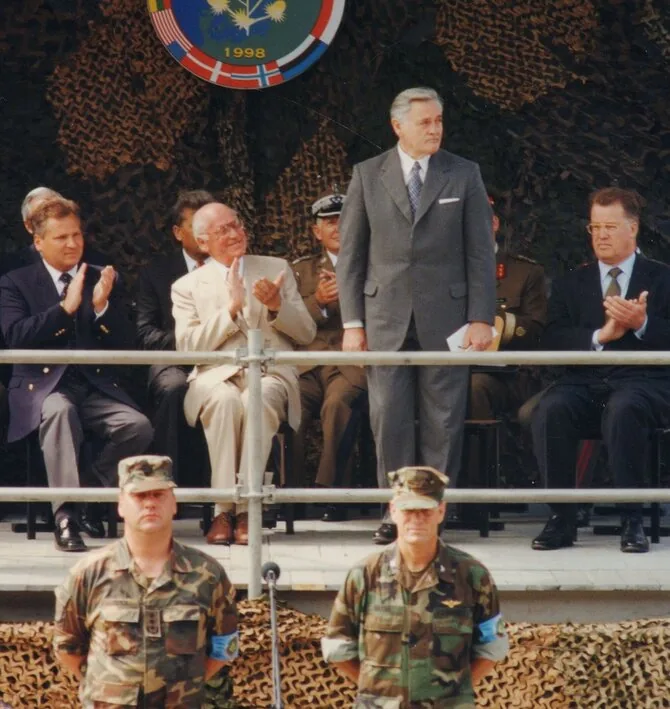
Considering the overall, especially today’s relevant geopolitical situation in the region, the importance of cooperation in the security field should be highlighted. In 1994, an agreement on the Baltic Battalion (Baltbat) was signed, in 1998 – on the Baltic Air Surveillance System (Baltnet), in 1998 – a government agreement on the Baltic Sea Squadron (Baltron) and the Baltic Defence College (in the latter case, the agreement and arrangements were facilitated by the USA, UK, Denmark, Norway, Sweden, and Poland).
In the same year, the security of these countries was strengthened by the US-Baltic States Partnership Charter – establishing a common goal of the four states to create suitable conditions for Lithuania, Latvia, and Estonia to integrate into European and transatlantic political, economic, and security (military) structures. This goal was significantly achieved after six years when the Baltic trio finally joined NATO.
Not only remembering the Baltic Way day but also approaching the 35th anniversary of Ukraine’s Independence Day (August 24), fighting for its country’s and region’s security, it is worth briefly looking at the broader regional cooperation prospects in the 21st century. Much has been done in various fields over more than 30 years, although unresolved dilemmas still remain.
However, compared to the complicated potential cooperation directions before World War II in Lithuania – not only East (USSR), West (Germany), but also South (Poland) – in the 21st century, it is essentially possible to talk about at least three (West, South, and North) relatively stable and resolved possible interaction “dimensions.”
On the other hand, even in the Western direction, certain unknowns and geopolitical contradictions and ambiguities remain. For example, it seems that the US tradition of resolute foreign policy and global leadership formed during the Cold War is facing a re-emerging isolationist pragmatism tendency quite close to the historical nature of American foreign policy before World War II.
A similar dynamic is currently seen in Europe: although increasingly closer and positively encouraging ties between Lithuania and Germany in defense (e.g., the creation of a German brigade in Lithuania) and other areas are evident, one must always keep in mind the close, multilayered (political, trade, cultural, etc.) ties between Russia and Germany that lasted for several centuries and the historically recurring joint actions of these countries in various geopolitical chess games – from the late 18th-century partitions (more precisely – occupation) of the Polish-Lithuanian Commonwealth to the Soviet and Nazi agreements discussed several times in this article in the mid-20th century.
Meanwhile, in the promising South direction, especially due to Poland and the global US leadership in the region, visions of transnational projects such as the Three Seas Initiative have revived in the last decade, and positive examples from Ukraine and Romania allow considering certain closer ties with the Black Sea region.
Complementing the two mentioned directions with cooperation with allies in the North (Scandinavian and Baltic countries – members of NATO, and closer interaction in this region is confirmed by cooperation formats such as the NB8 (Nord-Baltic Eight), uniting eight countries – five northern (Iceland, Norway, Denmark, Sweden, and Finland) and three Baltic – and the Baltic Sea Parliamentary Conference, with this octet also working together with Baltic Sea neighbors (north) in Germany), it might even be possible to develop a vision of a continuous block of united states in the Intermarium zone from the northern Baltic Sea coasts in Finland to the southern Adriatic Sea shores in Croatia.
On the other hand, cooperation in the broader Central and Eastern European region is still hindered by problematic cases of Serbia, Montenegro, Bulgaria, Hungary, and partly Slovakia. In the societies and elite layers of the first three countries, strong pro-Russian sentiments still persist due to various historically, politically, and socioculturally formed reasons.
Meanwhile, Hungary’s policy is still influenced by certain deeper historical, mental peculiarities of this country’s state, which began to emerge after World War I, losing vast territories and forming the so-called Trianon syndrome, whose psychological trauma reflections and certain grimaces can still be recognized today in Hungarian society and political processes.
Of course, the most geopolitically complicated remains the Eastern dimension (Russia and Belarus under its influence). Unfortunately, serious changes in this direction are hard to foresee in the near future.
This is also reminded by the historical experience of many centuries, understanding essentially at least since the 15th–16th century the orthodox unchanging imperial nature of Russia (clearly emphasizing the difference of Moscow Kremlin’s power from (Kyiv) Rus or, for example, from the 12th-century Novgorod Republic case as certain former alternatives in this region) and the recurring geopolitical reality – the threat from the East to the entire region.
Thus, looking at the issue of Baltic countries’ unity, it becomes clear that it is extremely relevant in the face of today’s geopolitical threats. The path of the Baltic countries’ freedom and unity ideas throughout the 20th century was indeed winding, encountering primarily external obstacles, starting with the conscious regional division policy carried out by the Nazis and Soviets in the 1930s–40s, ending with half a century of terror and occupation darkness on the eastern Baltic Sea coast horizon.
Despite this, the unprecedented Baltic Way inspires (as it inspired other peoples worldwide from the Mediterranean or South China Seas to the Indian Ocean shores) to believe that the three Baltic peoples, seemingly small but able to unite in the face of a common threat, can act together in the 21st century. One hopes that the revived Baltic solidarity will go beyond just regional security and homeland defense and that the awakening spirit of Baltic unity will encourage closer cooperation among Lithuania, Latvia, and Estonia in other fields as well.
Information sources used in the article
Anušauskas Arvydas, Lithuania, 1940-1990: History of Occupied Lithuania, 2007.
Laurinavičius Česlovas, Sirutavičius Vladas, History of Lithuania. Vol. 12, Part 1. Sąjūdis: from “Reform” to March 11, 2008.
Samoškaitė Inga, Thirty-five years later, the Baltic Way still inspires the fight for freedom, 2024, in: https://www.atlanticcouncil.org/blogs/new-atlanticist/thirty-five-years-later-the-baltic-way-still-inspires-the-fight-for-freedom/.
Plakans Andrejs, A Concise History of the Baltic States, 2021.
Rupšytė Angonita, August 23, 1989 – Baltic Way, in: https://www.lrs.lt/sip/portal.show?p_r=38090&p_k=1.
Virtual exhibition “Baltic Way – to Freedom” (LVNA), in: https://virtualios-parodos.archyvai.lt/lt/virtualios-parodos-itraukios-istorijos/34/baltijos-keliu-i-laisve-lvna/exh-131/baltijos-kelias-fotografijose/case-734#slide1.
Read more Beds freed up? Here’s what else you can plant in August and expect a second harvest
Universal Lithuanian Encyclopedia.